
Okay people.
Time for the weekly Linkfest!
Immerse yourself in the finest linkage I could scavenge from the beach-shores of the endless Internet.
To begin …
1) 🧵 The intricate beauty of the "Tiny Tapestries" exhibition
Every two years, the American Tapestry Alliance runs a "Tiny Tapestries" event in which they solicit tapestries 10 inches square or smaller, based on a theme. This year's theme: "Tiny But Mighty".
There are photos of some contributions at the My Tapestry Journeys blog, and they're really striking!
I love tapestry for its innate beauty, but also for nerdy reasons: Early low-rez computer graphics of the 70s and 80s borrowed extensively from centuries-old tapestry techniques. It turns out that if you need to make curves and patterns with low-fi chunky bitmaps, tapestry folk had pioneered tons of useful aesthetic tricks looooong ago.
So when you look at these small-and-square tapestry works, they seem weirdly like textile screenshots of artsy, unreleased Gameboy cartridges. Go check out all of them!
2) 🐜 The biomass of ants outweighs that of wild birds and mammals
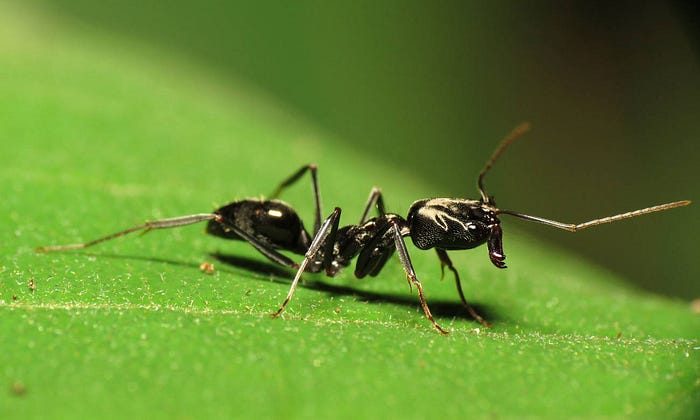
It's not easy to know how many ants there are, but recently the ecologist Mark Wong set about to figure it out. He surveyed 498 entomological studies and came up with a staggering figure: 20 quadrillion ants.
It's more impressive if we write the number out: That's 20,000,000,000,000,000.
"We further estimate that the world's ants collectively constitute about 12 megatons of dry carbon," said Wong, an ecologist at the University of Western Australia's School of Biological Sciences. "Impressively, this exceeds the biomass of all the world's wild birds and mammals combined."
To put that staggering quantity into perspective, multiply the team's ant biomass estimate by five. The number you get equals just about the entirety of human biomass on Earth — and this might be a conservative estimate. Each of the 489 global studies was quite thorough — employing tens of hundreds of booby trap tactics like catching runaway ants in small plastic container ditches and gently shaking leaves to learn how many take shelter in crunchy homes. But as with most research endeavors, caveats remained.
As that CNET story notes, part of the reason it's important to estimate the global ant population is so we can get a benchmark. Global warming is killing off a lot of species, and "dark extinction" is when a species isn't charismatic or well-known and vanishes without us noticing.
Ants are pretty well-known, of course — but educators and journalists do not stress often enough how ecologically critical ants are! Among other things, ants can be found "tunneling seeds into the ground for dinner and accidentally blooming plants from their leftovers", as well as feeding predators, preying on others; they're also "soil churners and scavengers".
Citizen science could be useful going forward, as Wong notes …
Wong believes it's important to regularly survey ant populations, and even expedite the process by outsourcing it to anyone able and willing to participate. "Things like counting ants," he said, "taking photographs of the insects they encounter in their backyard and noting observations of interesting things that plants and animals are doing can go a long way."
3) 🧮 Music made from prime numbers
Greg Davis is a musician who created an album based on sequences of prime numbers.
How exactly do you do that? Well, he used the computer-synthesizer software Max/MSP (which I'd never heard of before and am now verrrrry interested to try), and — as he told Bandcamp — used prime sequences thusly …
But how do you make music out of a sequence of prime numbers? "We'll start with a lower frequency, like 100 hertz, which is pretty easy," Davis explains. "Then you have a prime number set, let's say something really simple like five, seven, et cetera. So you take the base frequency of a hundred and multiply that times each of the prime numbers, and then you get a set of frequencies going from low to high." Simple enough, until you get to prime number sets that reach into the millions. "In some of the prime number sets, the prime numbers are really large. If I multiply those times the frequency, the frequency is super high, outside of the range of hearing."
This is where math meets art, as Davis had to divide or multiply the frequency values so that they created an engaging sonic field while maintaining their tuning relationships. "That allowed me to put all of the frequencies into a comfortable harmonic space, something that I liked the sound of," he says. After selecting enough frequencies to achieve a dramatic density of sound, Davis then determined their rhythm and spatialization by tying each one to metronomes and panning effects in Max/MSP based on their associated prime numbers. The result is a generative piece that could, hypothetically, play forever. "The idea is that with prime numbers if you have them playing against each other, they're not going to repeat. They're never going to line up at the same time, so they're always going to be shifting and moving in different ways."
I enjoyed the results a lot — it's drone-y weirdness, useful to space out to while I'm working.
You can hear the whole album here for free at his Bandcamp page, and buy it digitally or on vinyl.
4) 🌊Cool wave-form generator

Anatolii Babii, a creative coder in Kyiv, Ukraine, has released this gorgeous and trippy little wave-creator, the "RITM-Generator".
Go to his page for it, and you can tweak different settings to generate different styles of waves — shallower, wider, with different patterns of stripes and amplitude and color. You can also make the container itself wider or narrower, and when you're done, save it as an animated gif to put online.
It's super fun, and he did a full writeup on Medium describing all the ways you can tweak it. It was built using P5, a truly wonderful artsy language for creative coding, which I blogged about a few months ago.
5) 🐱 The physics of how cats can twist while falling
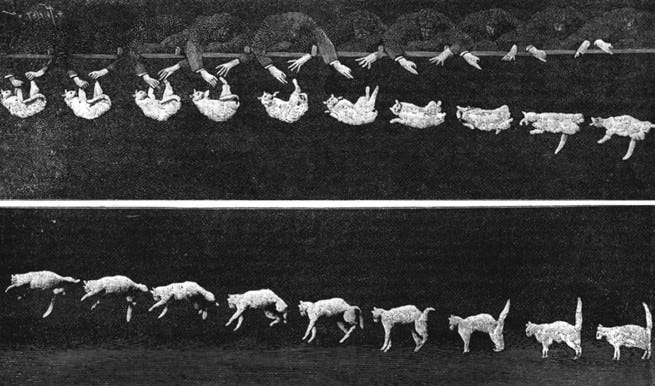
Over at the Atlantic, Katherine J. Wu has written a terrific piece about the historic mystery over how cats, if they fall upside down, are able to right themselves in mid-air.
This appears to violate laws of physics, because as Wu notes, "bodies that aren't rotating won't start unless some external force is applied. Without a push, a cat would have no leverage, nothing to induce it to turn right side up." When a physiologist in 1894 displayed the first sequence of rapid-fire photos showing a cat performing this seemingly impossible feat, the scientists there argued about at heatedly.
Wu delivers the best lay explanation I've ever read of how cats do it:
Angular momentum can still be conserved within a spinning object — er, cat — if half of the body rotates in one direction while the other half turns the other way, sort of like a pepper grinder. The two bits of the body then act as each other's fulcrums, imparting on one another an equal and opposite shove-y, twisty force. Which is exactly what appears to happen in cats. "The cat skeleton is incredibly flexible," says Barbro Filliquist, a veterinary surgeon at UC Davis. Cats can arch their spine so sharply that they effectively split their body into two, almost like "having a knee joint on top of your back," says David Hu, a mechanical engineer at Georgia Tech.
When a cat falls through the air upside down, the half with the head is usually the first to flip. For that to happen, the front has to turn more quickly than the back — a move the cat probably initiates by tucking its forepaws toward its tummy (akin to figure skaters pulling in their arms while executing a rapid twirl) while the back paws remain splayed. The cat then relaxes its front legs out while yanking its back limbs in. This time, the bit with the bum twists faster, bringing the rest of the body to the right-side-up position. Meanwhile, the tail may, delightfully, act as a kind of propeller, speeding the body's spins.
The rest of the piece, which is about how far a cat can fall without hurting itself, is really worth the read.
6) 🎶 The music of early American malls
Fardemark got his hands on some Bruton and De Wolfe Music records from the mid-to-late 70s that were used as background muzak in malls and elevators. He recorded them onto cassette to add some low-fi saturation, then digitized the result and put it on Youtube … so we can sit around working with cheesy mall jazz-pop playing in the background.
This stuff is so weird, and so historically specific! I'm just old enough to remember hearing music like this when it was originally played in the wild, at Toronto's Yorkdale shopping center.
7) 📸 Why photography didn't kill portrait-painting
Will image-generating AI kill off commercial photography?
Already, it seems to threaten to take a bite out of it. Some people are beginning to use images created by DALL-E, Midjourney and Stable Diffusion in place of, say, stock photography for their web sites. Graphic-design toolmakers like Canva have begun to build AI image-generators into their warez.
It turns out that painters in the mid-to-late 19th century were deeply worried that portrait-painters would be unemployed by the hot new tech of the day. "A method has been found whereby sunlight itself is elevated to the rank of drawing master, and faithful depictions of nature are made the work of a few minutes," as one Dutch journal wrote.
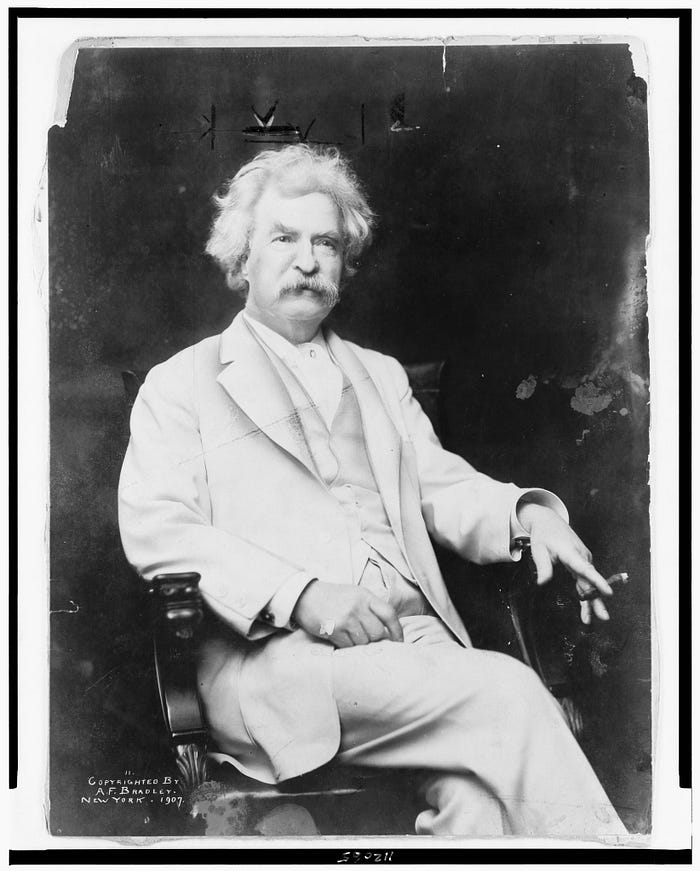
But that didn't really happen. Roosebloom could only find one single (possibly apocryphal) story of a portrait photographer being put out of work by photography. In contrast, by 1900 there was a fresh boom in portrait-painting; Roosebloom found letters by portrait-painters lamenting that they were getting more inquiries from clients than they had time to execute. For whatever reasons, having your portrait done by a live artist still seemed like a cool thing to do, even if you were also getting one done by a photographer.
What's more, photography offering painters some interesting new abilities …
Some picked up taking photos as a side gig when painting work was slow. Photos could be used as studies for paintings, in place of sketches. And they represented a way to easily reproduce artworks, allowing artists to sell prints of their work or keep them on display after an original work was sold. As Veth wrote in 1885 regarding the decision to photograph a portrait, "It is such a nuisance in our art that once a thing has been delivered you never see it again."
As early as 1855, one anonymous writer argued that predictions that photography "would be the death of art" had proven mistaken. "Experience shows that it marks the breaking of a new dawn for art by producing a different, unexpected outcome each day," he added.
Of course, as with all technological shifts, past performance is no guarantee of future performance, so this time around things could be different; sometimes code really does render jobs obsolete. (I knew people in the 90s who were paid to verify the links on web sites; they just sat there, clicking on 'em all day long, and writing up error reports where the links were broken! Then someone figured out how to do it in, like, three lines of python and the jig was up.)
But I bet Roosebloom is right, and this new wave of image-generators becomes incorporated — in ways we can't yet predict — into the world of paid, commercial artists.
8) 💾 A final, sudden-death round of reading material
A letterpress landscape made from broken bits of fonts. 💾 A Pokemon version of every country, created by Stable Diffusion. 💾R O the deep quirks of mainframe computers. 💾R Te curiously impractical Peutinger Map. 💾R The explosion of consumerism in London after the Black Plague. 💾R Behold Antimatter, an educational site for shitposting about what you've learned. 💾R Did Neanderthals create art? 💾R The road to full-body deepfakes. 💾R Why grown adults still have dreams/nightmares about high school. 💾R A text-adventure plaed inside the Typescript system. 💾R The surprisingly diverse crews of whaling ships in Melville's time. 💾R Looks like they ve finally deciphered Linear Elamite. 💾R Behold "Whisper", speech-to-text transcription AI recently open-sourced by OpenAI. 💾R The a style="text-decoration: underline;" rel="" title="" href="https://www.reddit.com/r/Damnthatsinteresting/comments/xm4mdk/possibly_the_worlds_first_customer_service/" target="_blank">world's first customer-service complaint, 4,000 years old. 💾R Cmpendium of weird metal noises you can make on electric guitar. 💾R Aerting the bees to the queen's death.
(Enjoyed this Linkfest? I've got more — I've done 57 of them so far; days and days of reading! And while you're here, locate that "clap" and whack away. It's good for up to 50 clicks per reader!)
Clive Thompson publishes on Medium three times a week; follow him here to get each post in your email — and if you're not a Medium member, you can join here!
Clive is a contributing writer for the New York Times Magazine, a columnist for Wired and Smithsonian magazines, and a regular contributor to Mother Jones. He's the author of Coders: The Making of a New Tribe and the Remaking of the World, and Smarter Than You Think: How Technology is Changing our Minds for the Better. He's @pomeranian99 on Twitter and Instagram.