

Everyone judges a book by its cover.
Gone are the days when an author could catch a reader's interest when they open the first few pages in a bookstore. Now, readers shop online from their Kindle app or Barnes & Noble account. Some never even look inside the book before passing on the purchase.
While you might sell more easily to book-eaters (who read 30+ books/year), it is hard to get the average reader (who reads ~5 books/year) to stop to see what your book is all about.
Bright colors, weird fonts, and celebrity faces are the favorites of the average reader. So, how do you compete?
I'm working on a large PDF guide designed specifically for self-published authors who want to DIY their book covers and bring their vision to life. Join my newsletter for more updates as this project continues!
This is a crash course featuring some of those ideas on design elements, color, images, and book cover formatting for the front cover of your book.
In this article, I will discuss the basic design elements in popular fiction and nonfiction that you might see on the bestseller lists. I've also created 4 of my own designs to break down these "tropes" and common designs further. This will hopefully explain which design elements should be used on certain book covers!
Design Elements in Fiction
I looked at this month's NYT bestseller list to see the book covers in every bookstore window.
As I mentioned, bright colors and celebrity faces are the most popular in the top-5 of hardcover, paperback fiction, and nonfiction.
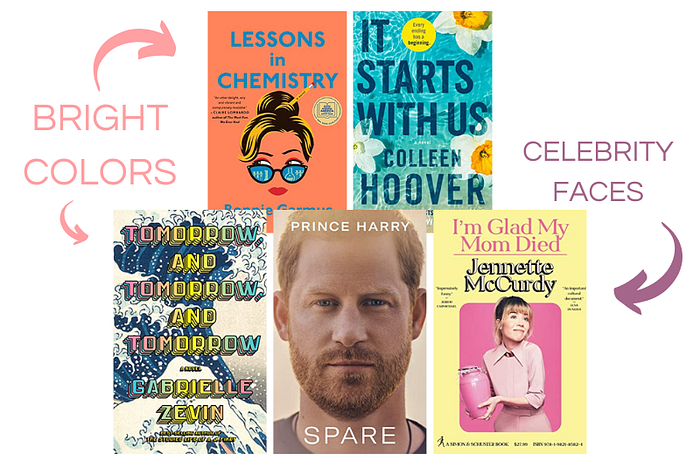
These are eye-catching because they draw your attention by enticing your brain with vibrant colors and cartoons or by triggering your recognition of a famous face.
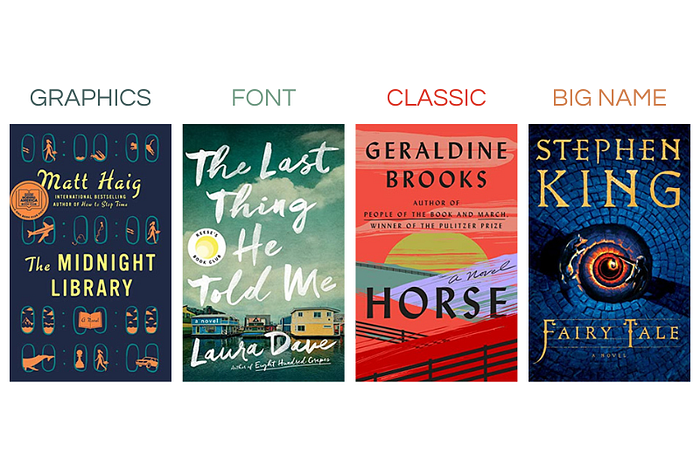
Some book designs use intriguing fonts, big-name authors (like Stephen King), or simple graphics and cartoon elements.
Others will rely on classic styles, like those of Catcher in the Rye or To Kill a Mockingbird, such as Horse by Geraldine Brooks, in the examples below:
Some designers choose pleasing colors to evoke a sense of peace, comfort, or love (Mad Honey, Jodi Picoult). This matches the book's tone and the genre, which is a women's family saga.

"Mixed" elements (meshing the font and image together) for a 3D effect, like Leigh Bardugo's Hell Bent, make you stare harder at the cover and pique your curiosity.
Cartoonish illustrations or abstract shapes and colors also draw the eye (see: Remarkably Bright Colors and The Myth of Normal) since vibrancy is like candy to our brains.
Design Elements in Nonfiction
If you are writing nonfiction (self-help, memoir, how-to guides, or getting political), it is still important to be aware of trends.
How are these authors displaying their titles, faces, or subject matter? How are they squeezing in subheadings?
Do you immediately see it, or are you squinting to read more?
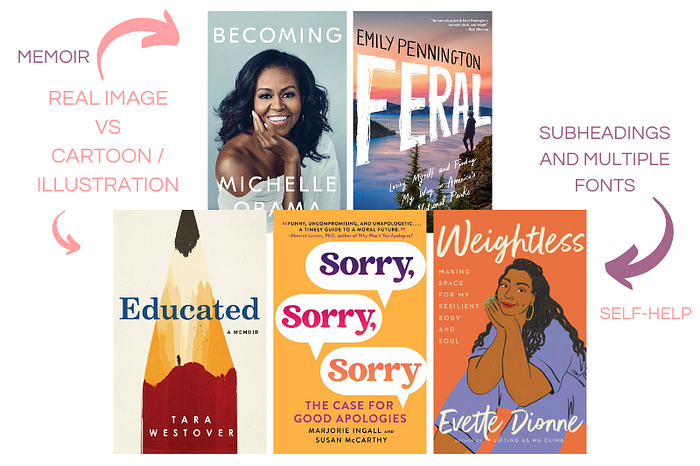
Some authors and designers will use a shock value to get your attention, such as swearing or suggestive photos.
The Subtle Art of Not Giving a F*ck by Mark Manson was famous for including a swear word in the title, and self-help gurus have been doing it ever since (see: Do Epic Shit by Ankur Warikoo below).
Girl With No Job by Claudia Oshry shows a covered photo of her in a bathtub. Though not necessarily risque, the quirkiness is meant to catch your eye.
Simple designs can also emphasize subject matter, such as with Cait Flanders' The Year of Less. Recognizable images like the American flag on the cover of Chip War by Chris Miller give you a quick idea that the book might be political.

Planning Your Own Cover
Knowing how you want to create your book cover is not as simple as picking a font and an image. It is about structure, style, formatting, and color.
Do you want to evoke calm and happy emotions, unsettle your readers, and entice them to read more?
Do you want to utilize graphics and cartoons for a modern look? Or would you prefer a static photo with a stylized font overtop (like with The Last Thing He Told Me by Laura Dave)?
You don't have to know how the end result will look immediately, but having an idea of the tone and general style you are looking for is a very important step in the planning stage.
In fact, take a moment to ask yourself a few questions:
- What do you want your book cover to say about your book?
- What emotions or ideas do you want to evoke in potential readers?
- What design elements (in your genre) are repeated, and how can you incorporate them into your cover?
Want a look at the back cover designs? Check out my newest article!
Picking Apart My Designs
Let's explore how we use color, font, and images to shift the reader's perspective about a book based on its cover alone!

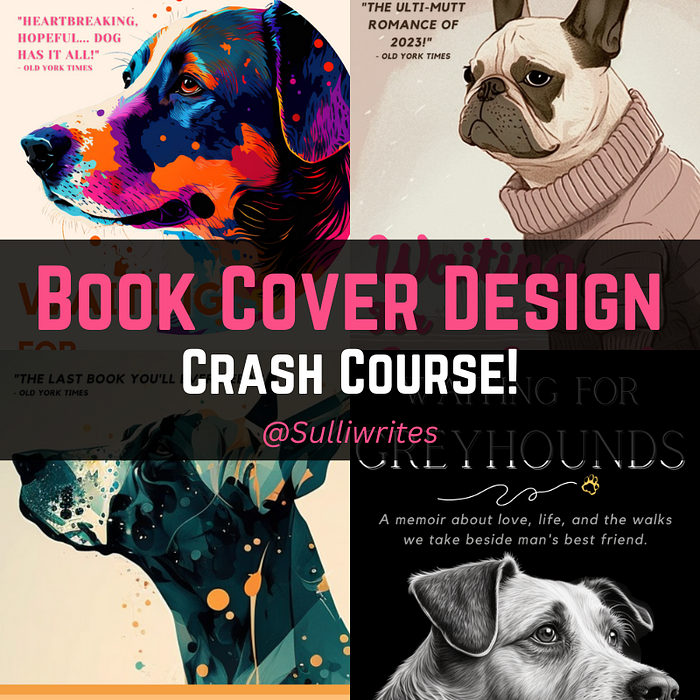
Here are 4 more fake book covers from yours truly! I have created a line of books, all titled "Waiting For Greyhounds" (a pun on both the dog breed and the bus line).
Each dog was created with Midjourney and then put into Canva by me to create mockup covers for this exercise. The author names, taglines, reviews, fonts, images, colors, and styles are all slightly different to emulate their chosen genre.
So, although the theme (dogs) and title are the same, how the information is presented should mirror certain tropes that readers are used to seeing in those genres.
These tropes are important because most people — especially book lovers — can catch a glimpse of a book and instantly guess (correctly) what genre it might be. They pick it up with interest, read the blurb, and hopefully buy it.
In this short crash course, I will briefly touch on some tropes and design elements and explain my reasoning when making these covers.
Romance
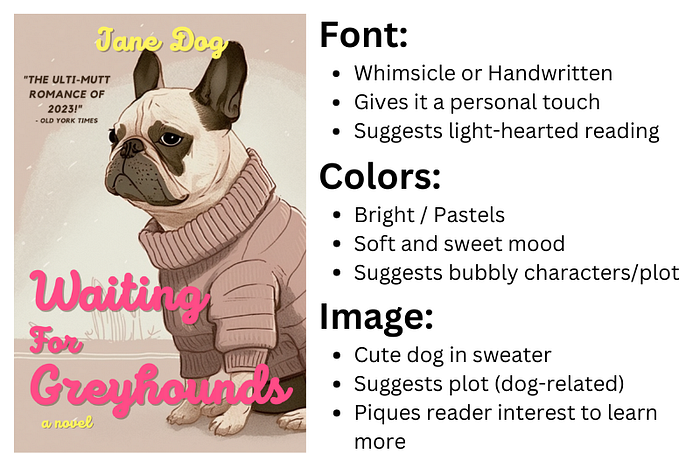
Frenchie represents our romance version of "Waiting For Greyhounds."
She's cute, slightly cartoonish, wearing a sweater, and surrounded by bright yellow and bubblegum pink. The author's name is smaller than the title, and the image takes up a good portion of the cover.
The font around Frenchie is loopy and cursive-looking, evoking feelings of whimsy and fun. You wouldn't imagine the interior of this book to include super heavy topics.
It's currently popular to have simple illustrations on romance covers, such as with Emily Henry, Katherine Center, and Ali Hazelwood books, so I emulated that here.
If you picked this book up, you might see it was about two dog lovers falling in love. Maybe it is the story of a French bulldog falling in love with another dog. Perhaps she was waiting for a handsome greyhound but realized her soulmate was a whippet or a German shepherd.
The point is that this book looks like a romance. It looks like an easy read, something to take to the beach. If you spotted it from across the crowded bookstore, you might smile at the sweater-wearing French bulldog in shades of pastel pink.
Literary Fiction
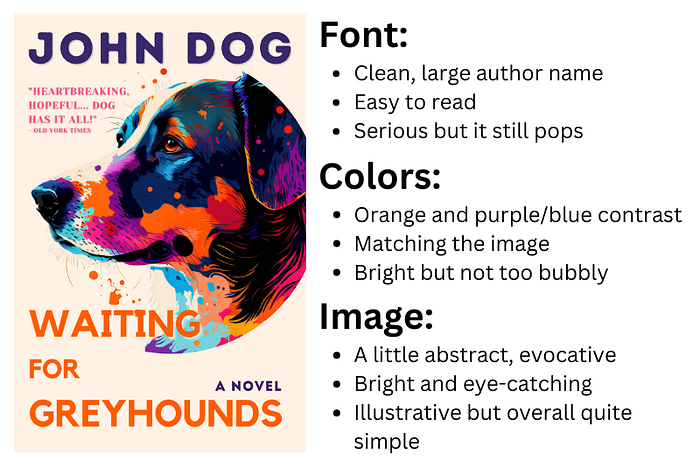
Literary fiction book covers often feature more abstract or symbolic imagery or illustrations that are evocative rather than descriptive. That's why many literary fiction covers have fun with abstract illustrations and bright or striking colors.
I have a painted dog here, but he doesn't take up the whole page. Rather, he is a bright mascot for the book, luring you in from across the store. Instead, the font pops and focuses on the large author name and clean lines of the title.
The typography used on the cover of a literary fiction book is often simple and easy to read, with a focus on legibility and clarity. It is simple but bold, not whimsical but bright.
Of course, the subject matter of your literary fiction will change the "mood" of the design, but from this image, we can guess that this fiction is lighthearted with a little seriousness — especially by reading the small quote.
Perhaps the dog is dead, or perhaps the dog is a metaphor. We don't know, but maybe this cover makes us want to find out!
Memoir
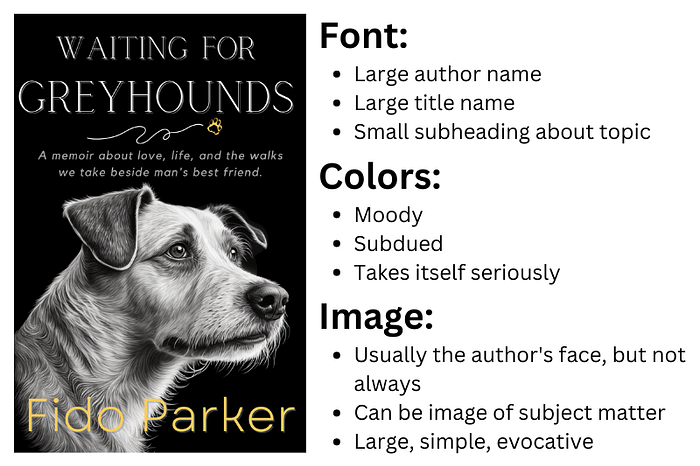
Memoir book covers typically have a photograph or illustration of the author or an image representing the memoir's subject matter.
Imagine that the dog is the author of this memoir. Or perhaps the memoir includes stories about the author's dog. Either way, a single, large image takes over the book and suggests the subject matter or author to you.
The typography used on a memoir book cover should be simple and easy to read. The title and author's name are prominently displayed. While the author's name is not always the most important part of the cover, most celebrities and politicians make their names big.
The color scheme should reflect the book's mood, whether serious and sad or more lighthearted and playful.
This color scheme evokes the idea that there are sad stories to be had within, but the gold on the pawprint and the author's name suggests light at the end of the tunnel.
How-To's and Self-Help

The typography of a how-to or self-help book is really important because you have to fit a lot on the page. That's because most have a title and then a subheading or two.
Here, we have the title "Waiting for Greyhounds" followed by "15 Ways to Make Life Less R.U.F.F."
You may feel free to congratulate me on my puns.
Fitting all of that means thin, businesslike fonts. No swooping cursive here!
These covers also often show the face of the author if they are a famous businessperson or artist.
The color scheme for self-help or how-to book covers is often bright and vibrant, with colors associated with the book's topic, such as green for gardening or blue for mindfulness.
In this one, I used green and gold to suggest a "get rich" how-to book, like a "15-step program to be more successful."
Would you buy this book from Dane Great, a dog with an MBA?
What Would YOUR Book Cover Look Like?
I hope this crash course has given you an idea of the importance of book cover design and how you can create a compelling cover for your own book.
Your book cover is the first impression a potential reader will have of your work, so it's crucial to make it count!
Are you willing to invest the time and effort into creating your own cover? Remember, studying the greats is a huge step toward learning to do it yourself.
And while book cover design can be challenging, it's also an opportunity to express your creativity and showcase your unique voice as an author. It can be fun, too!
Good luck, and happy designing!
Want to create your own book cover? Sign up for my newsletter to get exclusive sneak peeks into my new Book Cover Design Guide for Indie Authors and Freelance Writers!