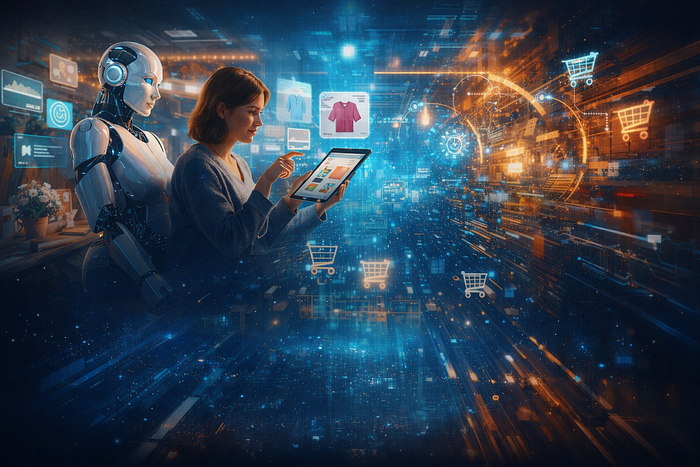

E-commerce has spent the last decade optimizing speed. Faster pages, faster checkout, faster replies. But speed alone no longer wins in 2026. Clarity, confidence, and continuity do.
That's where AI agents enter — not as smarter chatbots, but as autonomous systems capable of understanding intent, reasoning with real-time data, and executing actions that move revenue forward.
At Skara, we see this shift clearly. High-performing brands aren't asking, "How do we add AI?"
They're asking, "How do we redesign the entire customer journey around AI agents?"
This evolution is what defines agentic commerce — a model where AI doesn't sit on the sidelines responding to queries, but actively orchestrates discovery, conversion, support, and retention.
What is Agentic Commerce? Agentic commerce refers to an e-commerce model where autonomous AI agents proactively guide shopping, resolve issues, and execute workflows using live business data. Unlike traditional chatbots, AI agents reason, decide, and act to achieve outcomes such as higher conversion rates, lower returns, and improved customer lifetime value.
What Is an E-commerce AI Agent: Beyond the Buzzword?
An e-commerce AI agent is best understood as a goal-driven digital employee. It doesn't wait for perfectly phrased inputs or predefined flows. Instead, it interprets shopper intent, pulls data from inventory systems, CRMs, order management tools, and policies, then determines the best next action.
This distinction matters psychologically. Shoppers don't think in menus or workflows. They think in needs, uncertainty, and emotion. AI agents bridge that gap by adapting in real time — just like a skilled in-store associate would.
The 9 AI Agent Use Cases Defining E-commerce in 2026
1. The Autonomous Shopping Concierge
Most shoppers don't arrive knowing exactly what they want. They arrive with context.
"I'm hosting a taco night."
"I need something formal, but it's outdoors."
Traditional e-commerce forces these customers to translate intent into filters and keywords. AI shopping concierges remove that burden. They interpret natural language, understand situational context, and instantly map intent to available inventory.
By recommending complete bundles instead of isolated products, AI agents shorten decision time and increase average order value — while making the experience feel intuitive rather than transactional.
2. Hyper-Personalization Using Live Context, Not Guesswork
Personalization in 2026 is no longer about showing "recommended products." It's about intervening at moments of hesitation.
Ecommerce AI agents continuously evaluate live signals — time on page, cart value, prior purchases, sentiment cues — and decide when action is needed. A stalled checkout, for example, becomes a psychological signal, not a passive metric.
Instead of waiting for abandonment, an agent may step in with reassurance, a shipping clarification, or a time-sensitive incentive that aligns with margin rules. The result feels helpful, not pushy, because it responds to behavior, not assumptions.
Why AI Agents Convert Better Than Traditional Personalization AI agents outperform rule-based personalization because they react to real-time behavior, not historical averages. By responding to hesitation, uncertainty, or intent shifts as they happen, agents reduce cognitive friction and increase checkout completion rates.
3. Size, Fit, and Compatibility Guardians
Returns are one of e-commerce's most expensive trust taxes. They happen when shoppers hope something will work instead of knowing it will.
AI agents eliminate that gap by acting as fit and compatibility guardians. Drawing from previous purchases, product specifications, and user inputs, they provide tailored guidance that feels consultative rather than generic.
In categories like fashion, electronics, or furniture, this confidence layer dramatically reduces post-purchase regret — cutting return rates while increasing buyer satisfaction.
4. Hallucination-Free L1 Support Automation
By 2026, accuracy is non-negotiable. Customers don't tolerate confident-sounding wrong answers — especially about orders, refunds, or policies.
AI agents solve this by grounding every response in verified sources of truth: live order data, shipping carriers, return rules, and ERP systems. This allows them to autonomously resolve the majority of L1 queries without improvisation.
The psychological impact is subtle but powerful: customers trust systems that are consistently correct, not just fast.
5. Continuous Conversations That Remember
One of the fastest ways to erode trust is to make customers repeat themselves. AI agents prevent this by maintaining conversation memory across channels.
Whether a discussion starts on live chat and continues on WhatsApp or email, the agent retains context, preferences, and unresolved questions. This continuity creates a sense of being recognized — one of the strongest psychological drivers of loyalty.
How AI Agents Improve Customer Experience (CX) AI agents improve CX by maintaining persistent memory, reducing repetition, resolving issues faster, and adapting responses based on emotional and behavioral cues. This continuity creates a more human-like and trustworthy experience across all touchpoints.
6. Proactive Post-Purchase Retention
Most brands disappear after checkout, assuming the job is done. In reality, this is when buyer anxiety peaks.
AI agents monitor post-purchase signals such as delivery status and usage timelines. At the right moment, they proactively send setup guidance, usage tips, or reassurance messages — turning uncertainty into confidence.
These micro-interventions create "success moments" that dramatically increase repeat purchase likelihood and long-term value.
7. Real-Time Merchandising Intelligence
AI agents don't just talk — they listen.
Every question, hesitation, or objection becomes structured insight. When patterns emerge — such as frequent questions about sizing gaps or unavailable variants — agents surface this data to merchandising and product teams in real time.
This transforms customer conversations into a live feedback loop, enabling faster inventory decisions and smarter product planning.
8. Agent-to-Agent Commerce and Autonomous Negotiation
By 2026, shoppers increasingly rely on personal AI assistants to handle research and purchasing. This introduces a new paradigm: machine-to-machine commerce.
Brand AI agents must be able to negotiate pricing, confirm availability, and schedule delivery directly with consumer agents. Transactions happen without human intervention, but still within predefined business constraints.
The brands that prepare for this shift early will dominate frictionless buying channels others can't even see yet.
9. Intelligent Human-in-the-Loop Escalation
The most effective AI agents know when not to act alone.
When emotional intensity rises or complexity exceeds defined thresholds, agents seamlessly escalate to human support. Crucially, they don't hand off blindly. They provide full context, summaries, and sentiment cues — allowing humans to step in with clarity and empathy.
This partnership ensures AI scales efficiency while humans focus on judgment and emotional intelligence.
Why Human-in-the-Loop AI Matters Human-in-the-loop AI ensures complex or emotional scenarios are handled with empathy while routine tasks remain automated. This balance maximizes efficiency without sacrificing trust or customer satisfaction.
Why Skara for Your eCommerce Business
Skara is purpose-built for e-commerce, not retrofitted from generic AI tools. Its AI agents are designed to work where buying decisions actually happen — inside product discovery, checkout, and customer support flows.
Skara's agents are grounded directly in your product catalog, knowledge base, and policies, ensuring every response is accurate, contextual, and aligned with how your store operates. This allows agents to understand shopper intent instantly and guide customers to the right products using real-time context and preferences, not scripted replies.
When buyers hesitate, Skara steps in at the most critical moment. Its AI agents address shipping concerns, sizing doubts, and last-mile objections in real time, helping recover abandoned carts before intent disappears. If a shopper leaves, Skara continues the conversation across channels, bringing them back with relevance — not reminders.
On the support side, Skara automates routine customer questions with confidence and consistency while seamlessly escalating complex or emotional cases to human agents. Conversations stay continuous across chat, email, and messaging platforms, so customers never have to repeat themselves.
By unifying sales and support through AI agents, Skara turns every interaction into an opportunity to convert, retain, or learn — reducing friction, protecting revenue, and delivering a better buying experience at scale.
The Strategic Reality of 2026
E-commerce leaders are no longer debating whether AI agents matter. The real question is who operationalizes them better, and sooner.
In the agentic era, competitive advantage belongs to brands that create the least friction, the most confidence, and the highest continuity across the entire journey.
AI agents are no longer optional infrastructure. They are the new frontline of commerce.