
Alright, from part 1, we already get our intermediate equation:

At the end of this article, we will obtain the energy levels.
Table of Contents
Series form of F Termination of Energy Levels Possible Energy Levels
Series Form of F
We plan to use F that has a series form. Since at q = 0 the wave function might be nonzero, the power series does not include negative powers:
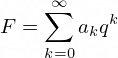
Its first derivative is
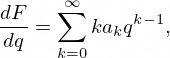
and its second derivative is

Therefore,

Let us expand the first term, i.e. the term with k(k — 1):
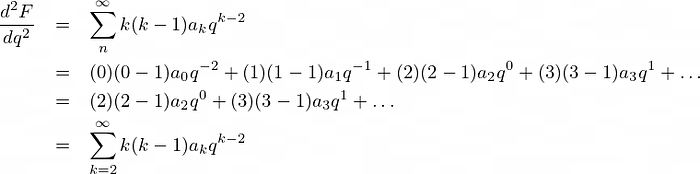
If the start of the summation is to be changed from 0, then we should change k into k + 2.

Now let's modify Eq. (2.5) a little bit more
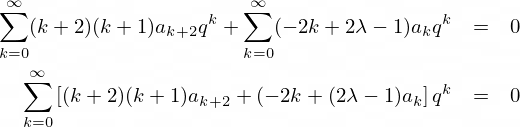
For that power series to vanish, all coefficients must be zero, which means:

Termination of Energy Levels
Eq. (2.9) is a recursion formula for F. The power series F must terminate at a certain value of k, because the wave function has to be finite everywhere, especially when q goes to plus and minus infinity. Look at this illustration for more clarity.
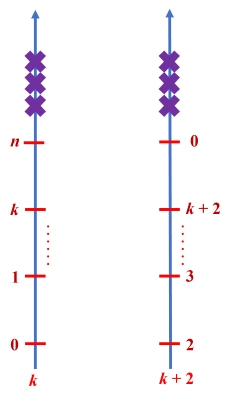
Let's say that we arrive at a certain value of k, namely k = n. After that k, aₖ₊₂ = 0. This means

Possible Energy Levels
Recall that

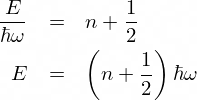
Thus we have the possible energy levels.
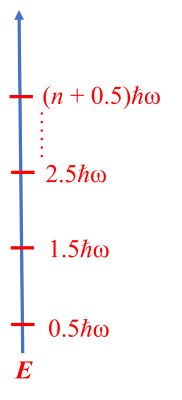
Here is how the energy levels look like.
In the Part 3, we will calculate the closed-form solution of the wave function.
References
Fock, Vladimir A. (1978). Fundamentals of Quantum Mechanics. Mir Publishers. Note: The Russian edition was published in 1976, while the English translation in 1978.