
We are living through a profound structural reset. The global economy was built on a foundation of endless debt expansion and a stable rules-based international order.
Today, that order no longer exists. Sovereign debt has exploded faster than actual economic growth. The United States is now embroiled in a massive new military conflict in the Middle East.
This geopolitical chaos is terrifying. Many retail investors are panicking. They are looking at the dying purchasing power of their currency and rushing to buy safe-haven assets like gold. They believe they are making a smart and defensive financial move.
They are completely wrong.
Today, we will dissect the current geopolitical crisis and the resulting global wealth rotation. We will explore why the new Middle East conflict is destroying the old financial playbook. We will expose the catastrophic psychological trap that destroys gold investors during every single crisis. Finally, we will outline a strict framework to protect your portfolio using hard data and historical evidence.
The New Forever War and the Inflation Shock
To understand where your money is going, you must first understand the current geopolitical reality. In 2026, the United States administration launched a massive military campaign against Iran. This was a war of choice initiated without congressional backing or the support of NATO allies.
The strategic intent behind this war has been incredibly chaotic. Initial assertions warned of Iranian missiles reaching American soil. Intelligence agencies quickly refuted this claim. The narrative then shifted to regime change. The US Secretary of Defence promised it would not be an endless war. However, the US President contradicted him by vowing a "whatever it takes" stance.
This absence of strategic clarity is incredibly dangerous for global markets. Iran knows it does not need to win a traditional military victory against the United States. Iran simply needs to make the war politically unbearable. They can achieve this by creating a long, drawn-out affair that disrupts global shipping and supply chains. Iran also aims to shatter the perception of stability in neighbouring rich countries. This will force those nations to pressure the US to end the conflict.
The primary threat to the global economy is an oil price shock. A sustained oil price spike will cause severe margin compression and weaker consumer spending.
Different regions face very different risks. Japan is highly vulnerable. Japan imports more than 90 percent of its crude oil from the Middle East. Most of this oil travels directly through the Strait of Hormuz. If this Strait is blocked, the Japanese yen will weaken rapidly, and input costs for Japanese manufacturers will soar.
Europe is surprisingly resilient. Since the Russian invasion of Ukraine, Europe has heavily reduced its energy dependence. Their energy import bill has fallen to near historical lows.
The United States is structurally insulated from direct supply shocks because of its massive domestic energy production. However, the US faces a massive inflation risk. Higher oil prices will immediately raise gasoline and transportation costs. This renewed inflation will force the Federal Reserve to delay rate cuts or tighten financial conditions.
The Great Capital Rotation
This geopolitical fracturing is triggering a massive shift in global capital.
Economists call this a Capital Rotation Event.
For the last few decades, global capital flowed heavily into the US dollar and American financial assets. This created a massive bull market for stocks. However, as the debt system reaches a breaking point, money is aggressively searching for a neutral asset. A neutral asset sits completely outside the control of any specific government. Historically, assets with a finite supply fill this role.
Gold is currently breaking out to incredible new highs. Central banks are buying physical gold at the fastest pace in modern history. Sovereign nations with nuclear weapons are actively choosing gold over US Treasury bonds.
When we look at the financial data, the evidence for a massive capital rotation is overwhelming. Almost every major financial metric is currently in a severe bear market relative to gold. The S&P 500 is losing to gold. The Nasdaq is losing to gold. The US dollar and the broad money supply are both losing to gold.
Nominal versus Real Returns. During a capital rotation event, you must understand the difference between nominal returns and real returns. Your nominal return is simply the number you see on your screen. Your real return is your actual purchasing power after inflation is subtracted.
If you receive a 10 percent pay rise, your nominal income goes up. If the cost of living rises by 11 percent, your real income has actually fallen by 1 percent. The stock market works the exact same way.
In the 1970s, the US suffered from massive inflation. The stock market was basically flat in real terms for an entire decade. During that exact same period, gold went up over 2000 percent. When investors prefer neutral assets over productive financial assets, real returns in the stock market are heavily compressed.
The Technical Failure of Bitcoin
Many people assumed Bitcoin would act as the modern digital equivalent of gold. They believed its digital scarcity would make it the ultimate safe haven.
This is not happening. Bitcoin has actually lost value relative to gold during this crisis.
To understand why, we must look at technical market forces. Historically, Bitcoin follows a predictable four-year cycle. It typically reaches a peak in the fourth quarter of the year following a halving event. Following this peak, Bitcoin usually enters a brutal bear market that lasts for roughly one year.
Technical analysts monitor the 50-week moving average and the 200-week moving average very closely. When Bitcoin closed below the 50-week moving average recently, it officially confirmed the start of a bear market. Historically, this triggers a price compression toward the 200-week moving average.
The Capture of Digital Rebellion. Why does Bitcoin no longer trade purely on its scarcity? The answer is uncomfortable. Bitcoin has been completely captured by the traditional financial system. It is now highly financialised and securitised.
Bitcoin sits inside exchange-traded funds. Corporations borrow massive sums of money against it. Mining companies finance their global operations using Bitcoin as collateral. Bitcoin's price discovery is no longer driven solely by supply and demand. It is heavily suppressed by massive leverage and paper derivatives.
The Psychological Gold Trap
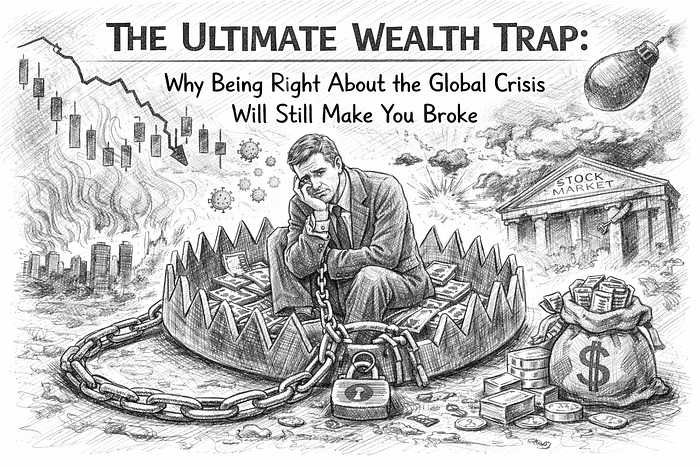
Seeing the stock market struggle and Bitcoin fail, retail investors are rushing blindly into gold. They are making a massive historical mistake.
Gold does not just go up during a crisis. It follows a very specific four-phase pattern that has repeated for over 150 years.
Phase one is the early warning. Smart money and central banks start buying gold 12 to 24 months before a crisis becomes obvious. Gold rises steadily. Nobody pays attention because it is boring.
Phase two is the panic spike. The crisis hits the mainstream news. Gold explodes by 50 to 100 percent in a few months. Everyone talks about it on television. It feels like the safest and most obvious investment in the world.
Phase three is the trap. Gold stays elevated. People congratulate themselves for being smart. More people pile into the trade.
Phase four is the slow bleed. Gold quietly begins a multi-year decline. It is not a dramatic crash. It is a slow, hope-destroying decline that can last for decades.
Most retail buyers enter the market during phase two or phase three. They buy gold when it feels safest. This is precisely when it is most dangerous.
Consider a tale of two investors. Greg is a mechanical engineer. He bought gold during the panic spike of 2020 because he feared inflation. He paid 1780 dollars per ounce. He watched it spike and then slowly bleed. By 2022, he was down 18,500 dollars.
His neighbour, Dan, is a retired insurance worker. Dan bought gold in early 2019 when nobody was talking about it. When the panic hit in 2020, Dan sold half his position for a massive profit. He took that cash and bought dividend stocks and farmland.
Greg was right about every single macroeconomic problem. He was right about inflation. He was right about the dollar. He analysed the research perfectly. Yet, he still lost a fortune.
Correct Analysis Does Not Equal Correct Trade. You can be entirely right about the macro picture and still lose all your money. Timing and execution matter just as much as your core thesis. If you buy an asset after it has already risen by 100 percent, the easy money is gone. You are simply providing liquidity for the smart money to exit.
This happened in 1980. Gold spiked by 280 percent in 12 months. Retail buyers rushed in at the absolute peak. Those buyers had to wait 28 years just to break even. It happened again in 2011. Buyers at the top waited 9 years to recover their initial investment while the S&P 500 tripled in value.
When you hear your relatives talking about buying gold, you are already late.
The Illusion of Absolute Safety
Many gold investors believe physical metal provides absolute protection from government overreach.
History proves this is an illusion.
In April 1933, President Roosevelt issued Executive Order 6102. He made it illegal for American citizens to own more than 100 dollars in gold. Citizens were forced to surrender their gold to the Federal Reserve at roughly 20 dollars per ounce. Nine months later, the government revalued gold to 35 dollars per ounce. The citizens who correctly predicted the banking crisis were robbed of a 69 percent profit.
Governments do not even need to use force. In August 1914, the German government launched a patriotic campaign. They asked citizens to donate their gold to defend the fatherland. Millions of patriotic Germans handed over their gold rings and watches. They received iron replacements in return.
Nine years later, the German currency completely collapsed. A newspaper costs 100,000 marks. The citizens desperately needed their wealth, but they had voluntarily given away their gold a decade earlier.
The Utility of Wealth. Gold is only a store of value. It is not a medium of exchange. In a true crisis, you do not hand a gold coin to a baker for a loaf of bread. You must convert that gold into a usable currency or directly barter it for goods. If you own a safe full of gold but have no trusted network and no plan for conversion, you do not have financial protection. You simply have an expensive feeling of security.
How to Protect Your Portfolio Today
So how do we navigate this chaotic rotation without falling into a trap? We must rely on strict frameworks and diversified income streams.
First, treat gold as an insurance policy, not a primary investment strategy. You should cap your gold exposure at 5 to 10 percent of your total portfolio. Institutional investors rarely hold more than 7 percent in gold. This is enough to protect you during a severe crisis, but small enough to prevent a slow bleed from destroying your retirement.
Second, you must hold assets that complement gold by generating actual income. Gold produces zero cash flow. You must pair it with productive assets. Farmland real estate investment trusts are excellent defensive assets. Farmland has only seen three negative return years in the last 50 years. It consistently pays dividends. You should also hold consumer staple companies. People will buy toothpaste and groceries regardless of the economic climate.
Third, follow the strategic guidance from institutional capital allocators. The current Middle East crisis heavily favours the Defence sector. We are entering a multi-year golden age for military spending as global fragmentation accelerates. NATO members are materially raising their defence budgets.
The Energy sector is also highly attractive. Any disruption in the Strait of Hormuz will drive oil prices significantly higher. Integrated oil majors will see massive margin expansion and higher revenues. The Healthcare sector provides an excellent defensive posture because medical care demand is entirely inelastic. It performs well regardless of the broader economic environment.
If you are buying bonds, avoid high-yield corporate credit. High-yield credit carries severe repricing risks during geopolitical conflicts. You must focus entirely on quality investment-grade credit. High-quality credit provides reliable income and limits your overall drawdown risk. Treasury Inflation-Protected Securities are also a brilliant play to hedge against the renewed inflation shock.
Finally, do not try to perfectly time this market rotation. Capital rotations do not happen in a clean or straight line. They are filled with violent whipsaws and fake market breakdowns.
Do not sell all your stocks out of fear. Bear markets make fools of everybody. You must maintain a highly diversified portfolio. Hold some Bitcoin in case the long-term adoption phase continues. Hold the S&P 500. Hold dividend stocks to generate cash flow in a sideways market. Hold a strong cash position to take advantage of severe market corrections.
The global rules are changing rapidly. The new forever war will test the limits of our financial system. Do not let your emotions dictate your investments. Cap your gold exposure, buy productive assets, and prepare for a very turbulent decade.
If you found value in this article, please hold down the like ❤️ button or consider sharing with someone who might benefit from it, or simply buy me a coffee ☕️ to fuel the next one!