
Part of series — Why Most Senior Engineers Fail System Design (And How Staff Engineers Think Differently)
Most system design conversations begin the same way.
A blank page. A pen or a whiteboard. Boxes. Arrows. Labels.
The diagram is clean. Familiar. Comforting.
At senior levels, this is exactly the problem.
Because diagrams are safe. They let you talk for ten minutes without committing to anything real.
Why Diagrams Feel Productive (And Why That's Dangerous)
Diagrams feel like progress because they:
- Look concrete
- Create shared vocabulary
- Signal technical competence
- Avoid confrontation
But they also allow a subtle form of evasion.
You can draw a system that:
- Scales
- Caches
- Replicates
- Fails over
- "Improves over time"
…without ever saying what actually matters.
At Staff level, that avoidance is visible.
Core Insight
System design is not the act of drawing boxes. It is the act of owning irreversible decisions.
Boxes describe what could exist. Decisions describe what must exist — and what will break when reality intrudes.
Staff engineers are evaluated on the latter.
The Diagram Trap
Here's the hidden pattern in weak senior-level design answers:
- Draw a generic architecture
- Keep boundaries intentionally vague
- Avoid sharp constraints
- Defer hard choices with "we can later…"
The result is a diagram that looks reasonable, scalable, and "industry standard."
And yet, it means nothing.
Why?
Because nothing in the diagram forces a consequence.
No part of it answers:
- What are we optimizing for?
- What are we sacrificing?
- What happens when this fails?
A system without consequences is not a system. It's a suggestion.
What Ownership Actually Sounds Like
Ownership shows up in language — not in diagrams.
It sounds like this:
- "This service is stateful, and I'm accepting the operational burden."
- "We will shard by user ID even though it creates hotspot risk."
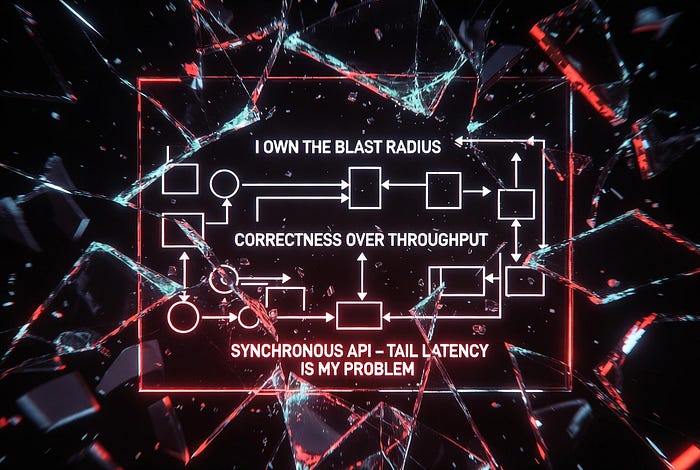
- "This API is synchronous, which means tail latency is now my problem."
Notice what's missing:
- No new components
- No trendy tools
- No buzzwords
Just accountability.
That is the difference Staff reviewers are trained to hear.
Why This Is Uncomfortable for Senior Engineers
Senior engineers are taught to:
- Be precise
- Be correct
- Avoid over-claiming
- Keep options open
Those instincts serve you well — until they don't.
At Staff level, keeping options open is often a liability. It suggests you're not ready to close doors on behalf of the organization.
Designing is not listing options. Designing is choosing one — and living with it.
Concrete Example: Checkout System
Prompt: Design a checkout system.
A diagram-first approach usually sounds like:
"Client → API → Order Service → Payment Service → Database"
It's neat. Logical. Safe.
A decision-first approach sounds like:
"Checkout is a correctness-critical path. I will sacrifice latency to guarantee exactly-once payment processing and durable writes."
That sentence does more than the entire diagram.
It immediately implies:
- Transactions or compensating workflows
- Idempotency keys
- Fewer async boundaries
- Lower throughput ceilings
- Higher operational cost
The diagram is now constrained.
And constraint is signal.
Why Constraint Is What Reviewers Look For
Anyone can draw a flexible system. Very few people are willing to say:
"This is the constraint I'm choosing — and here's why."
Constraint forces:
- Tradeoffs
- Failure modes
- Ownership boundaries
Without constraint, there is nothing to review. With constraint, there is everything to discuss.
Why Staff Engineers Avoid Diagram Theater
In real design reviews, Staff engineers often:
- Spend surprisingly little time on diagrams
- Spend most of their time on:
- Failure modes
- Invariants
- Load spikes
- Partial outages
- What breaks first
Not because diagrams don't matter — but because diagrams are not where systems fail.
Systems fail at boundaries:
- Between services
- Between guarantees
- Between assumptions
Staff engineers live in those gaps.
The Statement Most People Avoid
In high-stakes design reviews, the sentence that matters most is:
"If this fails, I own the blast radius."
That sentence rarely appears on diagrams. But it changes how every decision is evaluated.
It forces clarity:
- Who gets paged?
- Who explains this to leadership?
- Who absorbs the impact?
Design is easy. Ownership is hard.
Decision Tradeoff (Explicit)
Chosen:
- Correctness over throughput
- A simpler mental model for failures
Rejected:
- Fully asynchronous checkout
- Optimistic concurrency everywhere
Risk accepted:
- Slower peak checkout times
- Higher infrastructure cost
Why acceptable:
- Revenue loss from double charges is worse than slow checkouts
- Trust is harder to rebuild than performance
This is not overthinking. This is Staff judgment.
The Interviewer's Unspoken Question
When someone watches you draw an architecture, they are not asking:
"Do you know system design?"
They are asking:
"If this breaks in production, will you understand why — and will you own it?"
Diagrams don't answer that. Decisions do.
The Quiet Difference Between Senior and Staff
Senior engineers explain systems.
Staff engineers commit to them.
That commitment shows up as:
- Clear priorities
- Explicit tradeoffs
- Stated risks
- Ownership of consequences
Without those, the diagram is just decoration.
Staff-Level Judgment Call
If you cannot state what you are deliberately giving up, you have not designed anything yet.
You have only described possibilities.
Takeaway
Stop treating diagrams as the output of system design.
They are merely the byproduct.
The real output is:
- A small number of hard decisions
- Explicit tradeoffs
- Known failure modes
- Risks you are willing to defend
Everything else is presentation.
Tomorrow (Day 3): From Senior to Staff: what actually changes in your thinking.
This is where decision ownership becomes a mindset.