

Originally Published @ https://asyncq.com/
Introduction
In this article, we will solve the leetcode 131 problems which help us to learn about backtracking/recursion on String.
Problem Statement
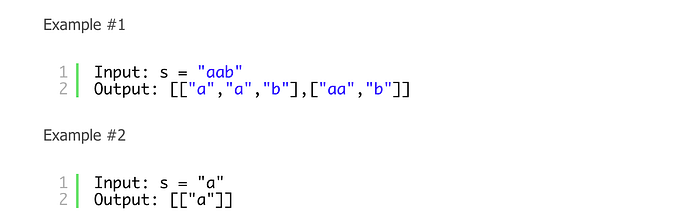
We are given as String s. We need to partition s such that every substring of the partition is a palindrome. We need to return all the possible palindrome partitioning of s.
Thinking About Solution
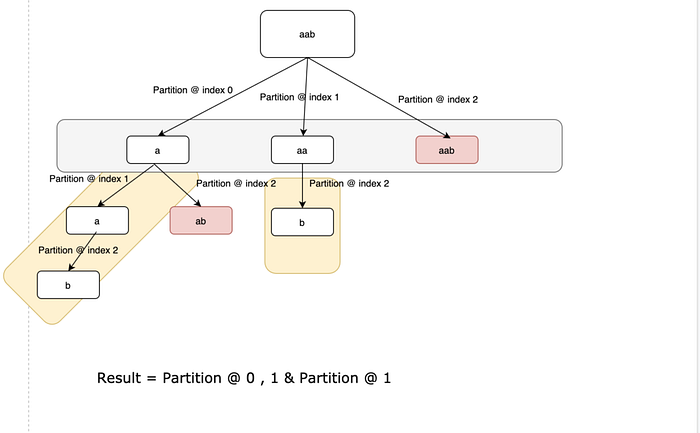
The first thing that comes to mind is that if we can take a substring of String and s and check if it is a palindrome and if it does then we can add it to our result list. We can partition given String it in various ways, for example, if given string s = "aab", then we can either partition it as p1 = [ "a","a","b" ] or p2=[ "a","ab"] or p3 =[ "aab" ] . As for p1, we can say each substring is palindrome since a single character string is always palindrome. But for p2, although "a" is a palindrome, "ab" is not a palindrome hence we cannot take that partition as a solution. The same goes for p3.
So our solution should iterate string s for various combinations and we should check each substring for palindrome.
What would be the criteria to output our result, since some substring in our partition can be palindrome and some might not as we saw in p2. The best way to confirm if all the substring is a palindrome is that check the index whether it reached the end of String s , because if all the substrings are palindromic then the index would reach the end of string otherwise it will not move forward. And that would make our base case.
For loop would be required to create a partition at the index at the various positions and then we need to recursively call to check for the selected index can we do further partition so that we make all the substring palindromic. In the Below diagram, The gray box is the role of for loop and the yellow box is where recursion will play its role.
Solution
Result
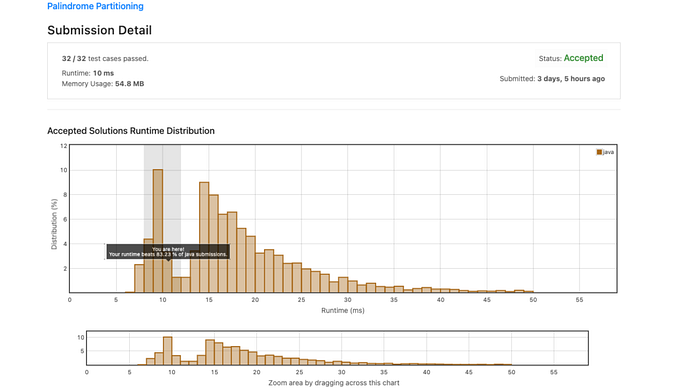
Our submission does get accepted with a runtime of 10 ms and beats 83% of solutions.
Space Complexity: O(N) for our recursion call to store N substring. Time Complexity: O(N*2^N) where N is the length of the substring. For loop = N, recursion = 2^N is a worst-case scenario where we have to break a partition into two substrings at every level.
Conclusion
In this article, we solved leetcode problem # 131, which helps us to understand how backtracking/recursion works with strings.
Bonus
- If you want to upskill your coding interview game, you should definitely check out this bestseller course ( this is in Java )