

The question returned to me in early 2026, not because of a new scientific paper or a breakthrough in energy physics, but because of the news cycle. The year had barely begun, and the world was already watching something… unsettling.
In early 2026, the United States, under a Trump administration, captured and extracted Nicolás Maduro, the sitting president of Venezuela. What followed was familiar, almost ritualistic: the narrative quickly turned to oil.
Venezuela, after all, is known to possess one of the largest proven oil reserves on Earth — by some estimates, even larger than Saudi Arabia's. The memes arrived faster than the analyses. "America always goes for oil," they said. Perhaps too easily. I won't dwell on geopolitics, especially in a moment when international tensions already feel volatile. That is not my interest here.
What troubled me was something more fundamental.
If nations we label as "developed," armed with the most advanced technologies humanity has ever produced, still anchor their power, security, and conflict to fossil fuels, then what does that say about our civilizational trajectory?
Frankly, it does not look like forward motion.
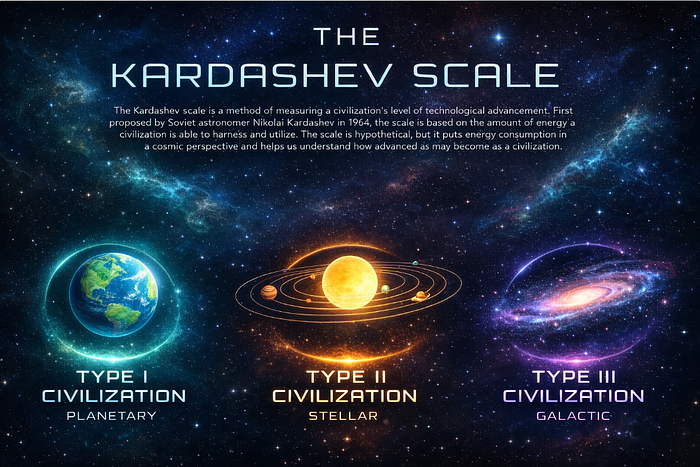
The Kardashev scale, proposed by Soviet astronomer Nikolai Kardashev in 1964, offers a sobering lens. It classifies civilizations by the amount of energy they can harness. A Type I civilization can utilize all the energy available on its home planet. Type II can harness the full output of its parent star, often illustrated through the speculative concept of a Dyson sphere. Type III would command energy on a galactic scale.
By most estimates, humanity currently sits around Type 0.7 — not even fully planetary.
Some argue that fossil fuels qualify as planetary energy. After all, they originate from Earth's biological past. But this interpretation misses a crucial point. Fossil fuels are not a controlled planetary energy system. They are a finite geological inheritance, unevenly distributed, environmentally destructive, and historically prone to conflict.
In fact, our generation occupies a peculiar and narrow window in Earth's history.
We live in what might be called the golden age of fossil fuels — a brief geological moment when hydrocarbons are abundant, accessible, and energetically profitable. Not before us, and likely not after us, will this be the case.
Earlier civilizations — no matter how clever — could not have tapped oil at scale because the geological processes that create it were incomplete. Future civilizations may find it depleted, or abandoned after its long-term harm became undeniable.
This raises an uncomfortable thought.
If there were an advanced civilization before us — long before Göbekli Tepe, long before recorded history — it almost certainly did not rely on fossil fuels. The geology would not allow it. Any hypothetical lost civilization capable of advanced technology would have needed a different energy paradigm entirely.
That is speculation, yes — but constrained speculation.
Energy sources shape technology. Technology shapes civilization. And civilization determines whether a species remains planetary… or steps beyond.
Today, despite satellites, nuclear physics, and artificial intelligence, our energy foundation remains stubbornly archaic. We burn compressed remains of ancient life to power digital networks and launch probes toward Mars. The contrast is difficult to ignore.
Projects like Artemis, ambitions for nuclear propulsion, and dreams of sustained interplanetary presence all depend on a deeper truth we rarely confront: interstellar capability is an energy problem before it is an engineering problem. Without a stable, scalable planetary-level energy system, space remains symbolic rather than transformative.
This is why recent events feel regressive. The fear is not only that we are standing still — but that we may be sliding backward, re-centering our future on scarcity, extraction, and zero-sum control.
And yet, curiosity wanders.
Nikola Tesla once suggested that the secrets of the universe lie in energy, frequency, and vibration. The phrase is often romanticized, sometimes misused — but not entirely wrong. Modern physics, after all, describes reality in oscillations, fields, resonances, and spacetime curvature. Earth itself is not an inert rock; it is a dynamic system. We already know this. Natural anomalies exist, and, importantly, they have sufficient explanations.
Perhaps the South Atlantic Anomaly is a relic of some lost civilization's free-energy antenna… hahaha. No — just teasing the imagination.
Still, as a thought experiment, one might wonder whether civilizations — past or future — could tap planetary energy in ways that leave no pipelines, no smokestacks, and no obvious ruins. Not fossil fuels. Something quieter. Cleaner. Perhaps something that, once abandoned, becomes indistinguishable from nature itself.
That is not a claim. It is not evidence. It is simply a reminder that energy pathways define destiny.
As of early 2026, the signal is clear. We are not yet a Type I civilization (yet)— not technologically, not ethically, not energetically. Our rockets still rise on the remnants of ancient death. And our conflicts still orbit scarcity.
Whether we ever cross that threshold remains open. But the direction we choose next will decide whether that phrase is a trajectory — or just poetry.