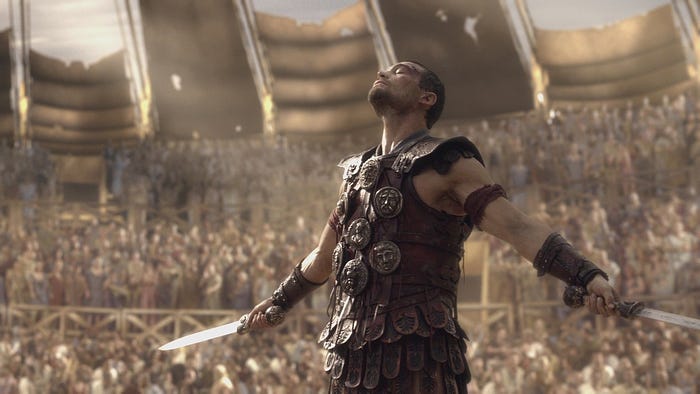

Are You Not Entertained?!
The effective storytelling of an Unwatchable Show, Spartacus: Blood and Sand (2010)
The beating heart of Rome is not the marble of the Senate; it's the sand of the Colosseum.
— Senator Gracchus, Gladiator (2000)
Watchability Ain't Everything
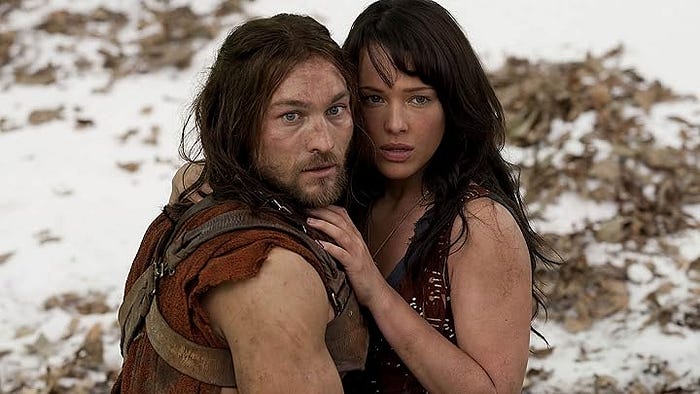
Spartacus is an interesting and complex story made into a baffling screen adaptation. It is visually unhinged, but structurally sound. It's on the verge (one could argue, completely off the cliff) of being unwatchable, yet it eventually, and unexpectedly, strikes a gut-wrenching tragedy, if you let it unfold. Every silly moment actually has a trajectory. It all builds up to something glorious.
It is fundamentally a story about dehumanization and its cost. A story of survival. But wrapped in an over-the-top sexualized gorefest, played like a soap opera.
Perhaps they were simply giving their audience what they wanted to see, and if you don't like that kind of stuff, there are other places for you to go. But there is something deeper to examine here.
Firstly, and forgive me for having to start from the end (it will come full circle later), the show has one of the best payoff climaxes in the penultimate and ultimate episode arc ever. It produces more catharsis than in most (if not all) of your favorite seasons of epic prestige television. It is a particularly bold statement considering that Spartacus is, in fact, really, really bad! It is also emotionally brutal, thematically coherent, with some excellent foreshadowing.
Make no mistake, I am not recommending it for general viewing. I am saying it is a fascinating, utterly unique, and highly mysterious piece of entertainment. It is a challenge and a slog to get through. It is visually assaulting, the dialogue is simultaneously repulsively condescending and so unnatural it is usually impossible to take seriously.
The visuals, soundtrack, and tone in general further make it feel like a perfect setup for satire. Maybe you can even credit it with creating an entire new genre, the "historical" soap opera, if you want to be generous.
Don't get me wrong, I'm sure the slo-mo gore and even slower softcore porn appeal to a lot of people. What the show lacks for others who could theoretically enjoy these fundamentally entertaining aspects is subtlety, of which Spartacus has none.
If I were to rate the show, the numbers would be quite low. From the overacting to the complete lack thereof, cheap CGI, and unimaginative choreography, it is simultaneously cartoonish and devoid of charm.
But underneath what is the vast experience of the show, lies a surprisingly rich plot that builds up systematically, with all the characters operating organically, in contrast with the unnaturalistic acting.
It is a rough, yet ultimately satisfying watch, and if you are interested in fascinating contradictions, you may want to brave it. Be forewarned, however, that all aspects of cringe will be present in overwhelming fashion — even in the better episodes, and all the way to the end. It is the quintessential "not for everyone". It will not go down in the annals of Western pop culture. But as a phenomenon, it is actually quite interesting.
And that has to do with two things: first, the fundamentally solid storytelling, and second, the production adapting to unforeseeable and tragic circumstances, which ultimately proved just how solid those foundations were.
Foundations
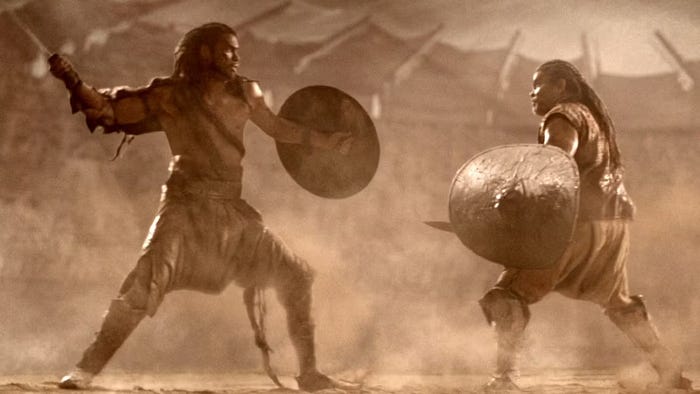
SBS is keenly aware of our cultural perception of the Gladiatorial games of ancient Rome. It uses the scaffolding of previous beloved media to its advantage. In fact, it's counting on it.
The entire premise relies on the audience's understanding of the power of the crowd's reaction to the bloody spectacle in conferring status. Champions rise and fall, and with them, fortunes are made and lost, myths are born, and slaves secure freedom. Think of it as a combination of Disneyland and the UFC, but in a time when entertainment was relegated pretty much only to the arena and the arguably far less exciting theater. The favor of the crowd is therefore tantamount to influence and coin.
The show is derivatively "inspired" by sword-and-sandals predecessors — notably Gladiator, Rome, and 300 — in the same way that Rings of Power is more of a cheap knockoff than an actual homage to Jackson's Trilogy. But yes, its payoff is better than theirs, and arguably, more earned. No character is wasted in driving the plot to its ultimate conclusion, which is — you may be shocked to hear — a gory, slo-mo bloodbath accompanied by dreadful, self-serious dialogue.
The first few episodes are so breathtakingly atrocious that no one can be faulted for not making it to the point at which something actually interesting happens. Or you could just reach that point so jaded that it won't be enough to make you give it some more allowance. And again, neither you nor the show would be at fault, nor will the show suddenly become flawless. Not even close. And it is the show's job to keep you entertained or intrigued enough in the first episode. And Spartacus seemingly won't even bother to make the effort until, at best, the fourth episode.
Yet for all the flaws of the initial episodes, they are laden with setup, character work, and foreshadowing.
And then again, as the show proves beyond all doubt, that is not strictly tantamount to entertainment.
The introduction of the warrior, later to be named "Spartacus" by his Roman master, is particularly dull and uninspiring — and that's if I'm being kind. Despite the absolute slog of the first few episodes, the show does set up essential plots and character arcs in the background that genuinely pay off. Unfortunately, the camp is so excessive and the characters off-putting, it's nearly impossible to get invested.
But that investment sneaks up on you in slow-burn fashion, as the characters' struggles become "real". As you get to know them, these seemingly cardboard cutouts eventually win you over. When disaster strikes, it hits you in the feels. Not strictly speaking, every character, sure, but a surprising amount. Which is weird, considering how much the show seems to be actively trying to alienate its viewers.
Setup
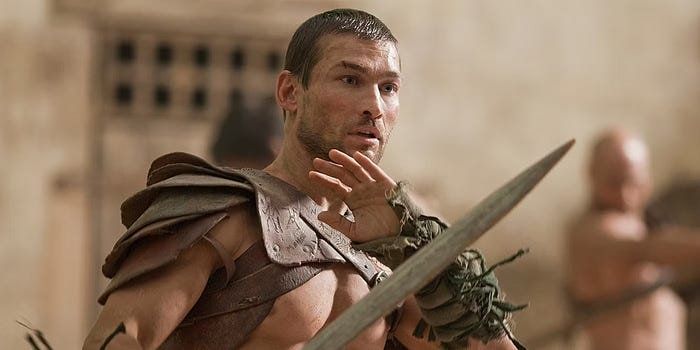
Spartacus is a foreign warrior who defects from a Roman campaign that callously leaves his village in imminent danger, humiliating the ambitious commander of the legion.
He and his fellow mutineers are promptly caught, to be executed in the arena.
Spartacus's success against four trained gladiators earns him the crowd's approval — and his life. A small-time Gladiatorial school owner is a witness to the feat.
A Lanista Always Pays His Debts
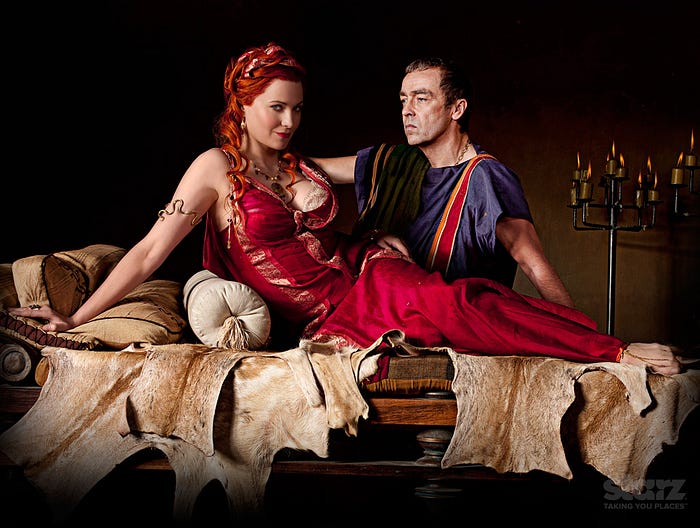
Batiatus inherited his gladiator training facility (ludus) in the city of Capua, second city to Rome, from his father, but never quite attained his level of success. Despite his enormous debts and the long drought choking off the incomes from his land, his life is clearly one of great affluence. But Batiatus's ambition far exceeds his father's successes. He believes that if he can shape a champion in the arena so favored by the people, he would not only clear his debts but also gain influence over the Roman elites.
He is betting on Spartacus to take him there, carried on the wings of the crowd's adoration.
The greed and ambition foreshadow the eventual great and terrible downfall.
Tragedy is such a satisfying storytelling mechanism because it allows fortunes to fluctuate significantly with every meaningful choice and action any of the characters take, even the seemingly more insignificant ones.
This is where the writing in Spartacus excels: weaving the conflicts and escalations that give rise to the next dramatic turn, all based on clear characterization, instead of, say, plot convenience. You know: the way stories used to be told.
Spartacus's slow rise to gladiatorial legend status is the perceived core of the show. But first, Batiatus must ascertain his motivation, as avoiding slave labor unto death is insufficient to yield any sort of compliance. Unfortunately for Batiatus, the only thing that will work (or more accurately, how he goes about securing the object of motivation) ends up being the cause of his house's downfall. And therein lies the real essence, the real tragedy. His ambition informs his strategy, his tactics, and his undoing. The means by which that process occurs is the real story we are fundamentally being told.
A very clear beginning, middle, and satisfying end, wrapped in an unfortunately cheap and ugly suit.
So, What Makes it a Good Story?
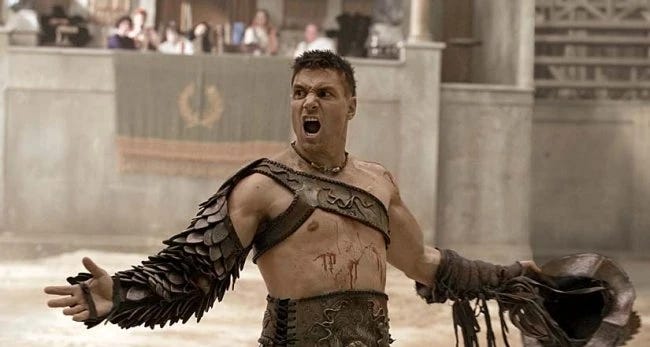
Where Spartacus's story succeeds is in its simplicity. Though it is by no means simplistic, despite what it looks like, we have no arguments about what it looks like. SBS is unique in that all of its characters' motivations are simple. There are no anti-heroes, there is no subversion, and no convoluted mythologies to unpack. More than anything, the show is just telling a story rather than making a statement. There are only dramatic twists and turns, and eventualities. But every plot point comes together and fits together towards that end.
Though tonally it feels satirical at the outset, the absurd self-seriousness eventually ends up feeling strangely earnest. There is banter, but no fatiguing, constant quips. There are appropriate levels of levity, but no undercutting of dramatic tension to protect the audience's perceived sensibilities. It doesn't need to break fourth walls or constantly project self-awareness like so many modern productions.
The campiness makes you take your guard down, so the emotional beats strike, because you never expect to feel anything at all; it actually hits deeper when you inadvertently do.
Then, the silliness takes over again, and you think you are desensitized, but then one little meaningful moment reels you back in. You thought you weren't invested in this dumb show anymore? You were wrong! The shifts can be brutal because you didn't see it coming. The quiet, patient work was continuously being done in the background, while you were being distracted by your own aversion.
The show actually outsmarts you in that respect (if you stick with it, of course). It does excellent work making you think you're too good for it, and then it shows you you've actually been experiencing these caricatures as real characters. You eventually resonate with them emotionally, just not intellectually. You were focused on the surface; the show was working subterraneanly.
On the surface, this show Sucks. But there are deaths, plots, and foiled plans that unexpectedly stop you in your tracks, and remind you that, to your surprise, you've been caring a little all along.
A True Knight Always Finishes His Story
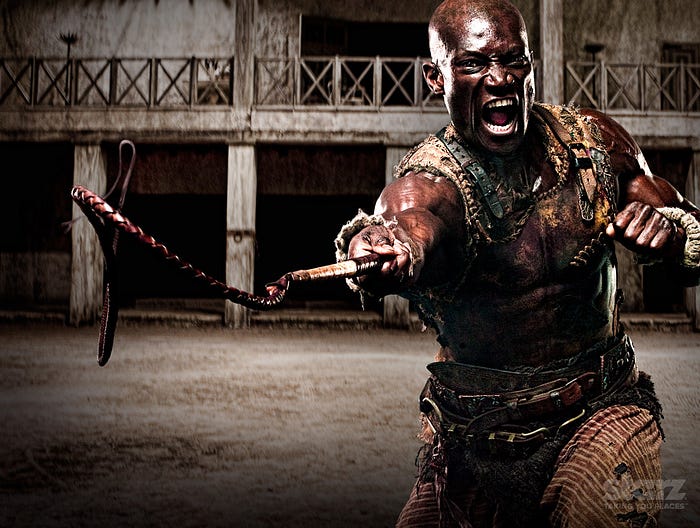
This show is notable in that it tells a complete story arc. Many series today fall apart because they only have a beginning and a mystery box. Without a clear ending, the story is incomplete, and the audience is denied their deserved payoff. The examples are too numerous to mention.
Once Spartacus: Blood and Sand gets to the finish line, your snobbery notwithstanding, you feel exactly like the show wants you to feel. You'd think that's basic for a piece of entertainment, but think for a moment: how often does that actually happen?
Spartacus leaves room for the story to continue, but it doesn't necessitate it. Ending with the slaughter of the House of Batiatus, its guards, and its dignitary guests is the culmination of every character's arc. It sets up the great slave revolt of Spartacus's story, but doesn't necessitate it.
The Proof is in the Sequel
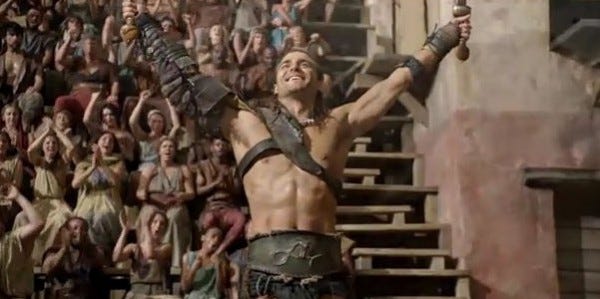
Season 1 ends in spectacular fashion, but that is not the end of the story. As the show was finishing its run, Andy Whitefield, the actor portraying Spartacus, was diagnosed with cancer. In an attempt to buy time for the production of season two, as he went into a brief remission, a six-part prequel series was produced as a holding measure, expecting his return to the role. He died on September 11, 2011, 18 months after the initial diagnosis, fundamentally changing the layers of the story of the production.
The prequel series is the incontrovertible proof that the storytelling worked. It inherited the world, the characters, and the tone. The production team could assume most people come to it already calibrated. We start from the massacre at the climax of season one, and the story rewinds to how Batiatus and his Ludus arrived at the state they were when Spartacus was purchased, coming full circle.
The prequel was not only better received than season one, but it is also an excellent follow-up. It is much tighter, while still establishing the background to all the characters; those we are familiar with from season one are all in a very different place in their lives and within the story, yet all of that is established with proper expedience. The story expands on season 1 events and characters in a compelling, organic way.
But then the sequel does something else; somehow, it completes the story, to make a perfect second season. And that is where I leave the franchise.
The story of the slave revolt without Andy Whitefield makes no sense to me. I hope that's not what they did with season three, but I don't want to know.
Real-life tragedy has ironically made it impossible to tell the story another way. Once both seasons existed, and Andy could not return, life and fiction intersected with something resembling a mystical force. And that is something unique in culture, let alone pop culture. You may not be able to stomach it, you may despise it, or feel you're too good for it. And you would be right on all accounts. That doesn't change the fact that there's something spiritually curious going on with Spartacus. Maybe it's something worth experiencing.
Outro

Spartacus is a good story. It could have been a great TV show if it had been entrusted to more competent hands with any sense of taste. Such as it is, I can't strictly recommend you put in the time it will take you to reach an actual informed conclusion. Most people undoubtedly make up their minds within the first few minutes anyway — and turn it off.
Or, more likely — as with everything else these days — the opinion is made beforehand, and then the truth can easily be discarded.