
In 2026, your brand's visibility won't be determined by where you rank -but by whether AI assistants use your words to answer the world's questions.
The digital discovery landscape has splintered into dozens of AI-powered interfaces where traditional search rankings no longer matter. When someone asks ChatGPT for product recommendations, queries Perplexity for technical explanations, or receives Google AI Overviews summarizing complex topics, they're interacting with generative engines -systems that synthesize answers from multiple sources rather than displaying ranked lists of links. In this new environment, being found isn't enough. Your brand must be quoted, cited, and trusted by AI systems that answer billions of queries daily without ever sending users to your website.
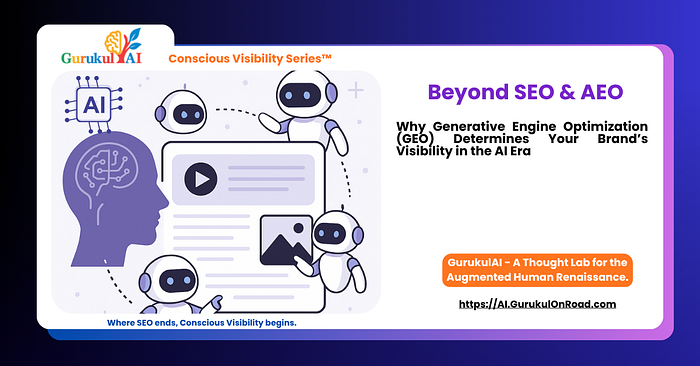
This paradigm shift demands Generative Engine Optimization (GEO) -the practice of optimizing your content and authority signals so AI-powered answer engines recognize your brand as a trustworthy source when synthesizing responses. Unlike Answer Engine Optimization (AEO), which focuses on structured snippets within traditional search interfaces, GEO targets the entirely different challenge of being cited within conversational AI responses where users never see a search results page at all.
The urgency is undeniable: AI-referred sessions jumped 527% between January and May 2025, signaling the fastest adoption of any search technology in history. Early movers are capturing citation share in their industries while competition remains relatively low. By the time GEO becomes mainstream, first-movers will have accumulated citation velocity -the self-reinforcing cycle where each AI citation strengthens authority signals that lead to more citations.
How Generative AI Models Source and Quote Information
Understanding GEO begins with demystifying how AI systems decide which sources to cite -a process fundamentally different from traditional search ranking algorithms.
The Retrieval-Augmented Generation (RAG) Architecture
Modern AI assistants like ChatGPT, Perplexity, and Google's Gemini use Retrieval-Augmented Generation (RAG) -a hybrid approach combining pre-trained knowledge with real-time information retrieval. When you ask a question, the process unfolds in four milliseconds-fast stages:
Stage 1: Query Understanding & Embedding: The AI converts your natural language query into numerical embeddings (vector representations) that capture semantic meaning rather than just keyword matching. This is why you can ask "What's the best way to remove coffee stains from white fabric?" and get relevant answers even though you didn't use SEO keywords like "stain removal tips."
Stage 2: Candidate Retrieval: The system searches its indexed content database using vector similarity matching, retrieving dozens to hundreds of potentially relevant sources. This is where your content's discoverability begins -if you're not in the index or your content doesn't match semantically, you're eliminated before evaluation even begins.
Stage 3: Ranking and Selection: Retrieved sources get scored across five critical dimensions:
· Authority: Domain reputation, backlink profile, and presence in knowledge graphs. Research analyzing 150,000 AI citations shows Wikipedia accounts for 26.3% of all citations, while Reddit claims 40.1% -revealing AI's preference for encyclopedic and community-validated sources.
· Relevance: How precisely the content addresses the query's semantic intent, not just keyword density.
· Recency: Fresh content receives priority for time-sensitive queries, while evergreen content works for definitional questions.
· Structural Clarity: How easily the AI can parse your content. Pages with clear headers, concise paragraphs, and logical flow score higher.
· Evidence Chain: Whether claims include supporting data and links to primary sources. AI systems evaluate backing evidence and inherit confidence from authoritative references you cite.
Stage 4: Answer Generation : The AI synthesizes information from the highest-scoring sources, generating coherent responses that paraphrase and combine insights rather than copying verbatim. This is why traditional "copy-paste SEO" fails in GEO -AI needs to understand concepts, not match strings.
How to Build Earned Authority for AI Visibility
While traditional SEO emphasized "owned" authority (your website and backlinks), GEO elevates "earned" authority -third-party recognition that AI systems use to triangulate trustworthiness.
The AI Trust Triad™
The VISIBLE TO AI™ framework introduces the AI Trust Triad™, which identifies three interconnected authority zones AI systems evaluate:
1. Owned Authority: Your official channels: website, blog, and self-published knowledge. This provides the foundation but insufficient alone for strong GEO performance. AI systems distrust isolated sources that lack external validation.
2. Earned Authority: Third-party recognition through podcasts, guest posts, interviews, media mentions, and public citations. This signals to AI that independent sources consider you credible. When multiple reputable sites reference your frameworks or data, AI confidence increases dramatically.
3. Embedded Authority : Inclusion in open knowledge bases, industry directories, academic databases, and structured datasets that AI systems preferentially index. Being featured in Wikipedia, Crunchbase, or domain-specific encyclopedias dramatically increases citation likelihood.
Practical Earned Authority Building Tactics
Guest Contribution Strategy: Publish original insights on platforms AI systems trust -industry publications, Medium, LinkedIn Pulse, and respected niche blogs. Each guest post serves dual purposes: direct audience building and authority signal strengthening for AI citation.
Podcast and Interview Circuit: Audio content is increasingly transcribed and indexed by AI systems. Appearing on relevant podcasts creates searchable transcripts that AI can cite while building name recognition across platforms.
Open Dataset Publishing: Release original research, survey data, or compiled statistics under Creative Commons licenses. AI systems preferentially cite quantitative data they can verify across multiple sources. Becoming "the source" for specific statistics in your industry creates recurring citation opportunities.
Collaborative Content: Co-author research papers, whitepapers, or industry reports with recognized experts. The cross-pollination of authority signals helps both parties, and AI systems weight collaborative work from multiple verified experts highly.
Knowledge Base Contributions: Contribute to Wikipedia, industry wikis, and open knowledge projects. While direct brand promotion isn't appropriate, becoming a cited source within these encyclopedic platforms dramatically increases your overall citation footprint.
The measurement framework: track not just how often you're cited, but your "citation velocity" -whether the rate of mentions is accelerating as your Earned Authority compounds. (Check Available Measurement Frameworks for AI Visibility)
Structuring Content for GEO Using the Q-Stack Blueprint™
If Earned Authority determines whether AI systems trust you, content structure determines whether they can extract and quote you accurately. The Q-Stack Blueprint™ from VISIBLE TO AI provides the architectural framework for GEO-optimized content. (Check an Example Page )
The Four-Layer Q-Stack Architecture
Layer 1: Anchor Question: Every page must address one clear, primary question users actually ask. Use natural language phrasing that mirrors conversational queries rather than keyword-stuffed variations. For example: "What is GEO (Generative Engine Optimization) and Why It Matters Beyond SEO and AEO?" instead of "AI source citation selection process."
Layer 2: Supporting Questions — Identify 3–5 related subtopics that anticipate user intent and provide comprehensive coverage. These become H2 or H3 headers, each followed by concise Answer Blocks. This structure enables Google's "query fan-out" behavior, where your page can be cited for multiple related angles.
Examples: "H2: How Generative Engines Retrieve, Interpret, and Quote Information? , H3: How AI Identifies High-Authority Sources in Real Time?"
Example: "H2: Building Earned Authority That AI Can Detect, Trust, and Cite, H3: How the Credibility Loop™ Strengthens Your External Authority Signals?"
Layer 3: Context Layer: Provide clear explanations, data, or examples that add credibility without diluting clarity. This is where you demonstrate expertise through specificity -citing studies, sharing case data, or explaining mechanisms in accessible language. AI systems score sources higher when context helps them verify claims.
Layer 4: Decision/Application Layer: Conclude with actionable insights, next steps, or ethical considerations. This transforms passive information into usable guidance, increasing the likelihood AI cites you for "how to" queries.
What are the Key Characteristics of GEO-Optimized Content
Research analyzing AI-cited content reveals consistent structural patterns:
Extreme Clarity: Cited sources average 20–30% lower reading complexity than non-cited alternatives. Write for clarity first, sophistication second. If AI struggles to parse your meaning, it won't risk citing you.
Modular Structure: Content organized as self-contained "Answer Blocks" of 40–120 words performs better because AI can extract individual blocks without losing context. Each block should answer one micro-question completely.
Entity Precision: Explicitly name people, organizations, products, and concepts rather than using pronouns or vague references. AI systems match entities to knowledge graphs -clarity improves matching accuracy.
Evidence Integration: Weave supporting data, citations, and examples throughout rather than isolating them in "sources" sections. AI evaluates whether claims have immediate backing.
Schema Markup: Implement FAQ, Article, and HowTo schema types that provide machine-readable context about your content structure. While not visible to users, schema dramatically improves AI parsing accuracy. (See how Schema Lite™ can help you -a no-code approach to structured data using simple plugins and practical checklists.)
What No-Code GEO Tools Help You Build AI-Optimized, Structured Content
Implementing GEO doesn't require enterprise budgets or technical teams. The VISIBLE TO AI methodology emphasizes no-code tools that integrate into existing workflows.
Research and Discovery Tools
Perplexity serves dual purposes: understanding how AI structures answers in your domain and identifying question patterns users actually ask. Query your target topics monthly and analyze which sources Perplexity cites -reverse-engineer their structural and authority signals.
ChatGPT with browsing enabled reveals how the most-used AI assistant interprets queries in your field. Test whether you're cited for core questions; if not, analyze which competitors appear and why.
Answer the Public and AlsoAsked map question hierarchies that inform your Q-Stack structure. These tools reveal the Supporting Questions layer for any Anchor Question.
Content Structure and Schema Tools
Schema Markup Generators: (Schema.org, Merkle's generator, or WordPress plugins like Yoast and RankMath) implement FAQ, Article, and Organization schema without coding. The Schema Lite™ approach focuses on three high-impact types rather than overwhelming complexity.
Notion or Airtable: manage your content inventory with GEO scoring. Create custom databases tracking each page's SOURCE Score™ (Substance, Original Insight, User Evidence, Relevance, Consistency) and prioritize optimization based on citation potential.
Hemingway Editor or Grammarly simplify your prose to meet the clarity thresholds AI systems prefer. Aim for grade 8–10 readability -accessible to both human and machine audiences.
Workflow Automation and Monitoring
Zapier or Make automate content distribution workflows. When you publish content optimized for GEO, automatically notify team members, update tracking databases, and trigger social distribution -eliminating manual busywork.
SE Ranking's AI Visibility Tracker (or similar emerging tools) monitor your brand mentions across Perplexity, ChatGPT, and Google AI Overviews. Track "share of voice" for category-defining questions -a 70% visibility rate on ChatGPT but 40% on Perplexity signals where to focus optimization.
Google Analytics 4 with custom AI referral segments track traffic from AI sources. While many AI citations don't drive clicks, monitoring which do reveals high-value visibility opportunities.
The Visibility Workflow Loop™
Integrate these tools using the five-step Visibility Workflow Loop™ from VISIBLE TO AI™:
1. Discover Questions: Use AI tools and SEO platforms to identify queries in your domain
2. Draft Answer Blocks: Create concise, structured responses following Q-Stack principles
3. Structure & Publish: Apply schema markup and semantic formatting
4. Distribute & Earn Mentions: Build Earned Authority through guest posts and collaborations
5. Monitor AI Visibility: Track citations across platforms using visibility trackers
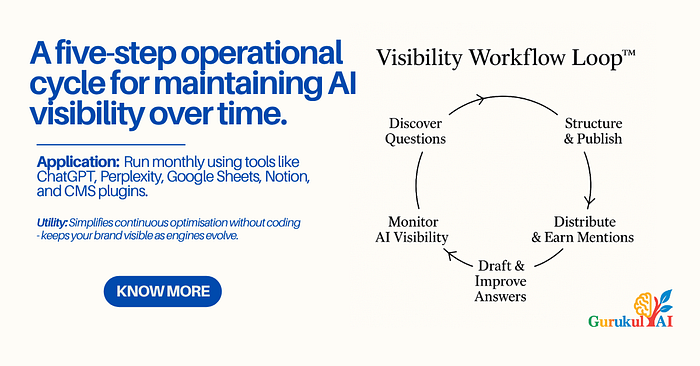
This cycle runs monthly, creating continuous improvement in your GEO footprint without overwhelming small teams.
Conclusion: How VISIBLE TO AI™ Equips You for GEO Mastery
What distinguishes VISIBLE TO AI™ from generic GEO advice is its integrated approach. Most guides focus exclusively on content structure or technical optimization. The book recognizes that GEO success requires simultaneous advancement across four dimensions:
Vocabulary: Using semantically clear language AI can interpret unambiguously Intent: Aligning with actual user queries rather than manufactured keyword targets Structure: Organizing content using Q-Stack architecture for extractability Authority: Building the AI Trust Triad across owned, earned, and embedded channels
The AI Visibility Sprint Framework™ provides a 90-day implementation roadmap, with specific milestones at 30, 60, and 90 days that transform abstract GEO concepts into measurable progress. The Visibility Workflow Loop™ ensures ongoing optimization without requiring full-time attention -making GEO sustainable for resource-constrained teams.
Most critically, the book's Conscious Visibility Charter™ ensures your GEO practices remain ethical as AI systems become arbiters of truth. In an environment where AI can amplify both verified expertise and persuasive misinformation at equal scale, the brands that practice GEO responsibly will build enduring trust while others face algorithmic penalties and reputational damage.
The generative engine revolution isn't coming -it's here. AI-referred sessions grew 527% in just five months. The brands investing in GEO today are capturing citation share that compounds through self-reinforcing visibility cycles. Those waiting for "best practices to stabilize" will find themselves permanently disadvantaged, struggling to compete against competitors who've accumulated years of citation velocity.
The question isn't whether your brand needs GEO. It's whether you'll master it before your industry moves on without you.
Read the Book: VISIBLE TO AI™ -A Non-Technical No-Code Playbook to AEO, GEO, & LLMO for Business
Explore Related Works from GurukulAI:
- The Conscious Corporation -on Soul-Tech Organizations
- The Augmented Self -on Human+ Design in the AI Era
- Deprogramming the Digital Self -on reclaiming attention in algorithmic cultures
- VISIBLE TO AI™ — A Non-Technical No-Code Playbook to AEO, GEO, & LLMO for Business
- Prompt Engineering Playbook: From Hacks to Scalable AI Systems
- Hope Trafficking: The Economy of Emotional Manipulation in Self-Help, Spirituality, and Success Culture
About GurukulAI
GurukulAI is India's first AI-powered Thought Lab for the Augmented Human Renaissance™, dedicated to training humans -not just systems -for the Age of Artificial Awareness.
GurukulAI builds a living ecosystem where technology, consciousness, and creativity evolve together. Its research and training initiatives bridge AI, emotional intelligence, and ethical innovation, helping organizations design Soul-Tech™ architectures that balance intelligence with empathy and scale with awareness.
Visit: https://ai.gurukulonroad.com/p/gurukul-ai.html
Through books like VISIBLE TO AI™ , The Conscious Corporation, The Augmented Self, and Deprogramming the Digital Self, GurukulAI leads a global dialogue on Human-First, Consciousness-First Design -reshaping the way leaders, educators, and technologists approach the next era of evolution.
GurukulAI Public Intent Statement: GurukulAI advances the Augmented Human Renaissance™ -where technology meets consciousness. We democratize knowledge through low-cost books, accessible eBooks, and DIY frameworks designed to build Human+ Leaders with ethical reasoning, AI literacy, and practical clarity for the Age of Artificial Awareness.-GurukulAI -Manifesto for the Augmented Human Renaissance™
FAQs: Generative Engine Optimization (GEO)
Q1: How does GEO differ from traditional SEO and AEO?
A1: GEO focuses on optimizing your brand's visibility within generative AI systems that synthesize and paraphrase answers rather than only delivering ranked links. Unlike SEO that targets rankings and AEO which optimizes concise answer extraction, GEO emphasizes building earned authority across podcasts, guest posts, and open datasets, combined with structured content frameworks like Q-Stack that AI assistants rely on for synthesis
Q2: What are the best ways to build earned authority for GEO?
A2: Key strategies include appearing on relevant podcasts, publishing guest articles on authoritative platforms, contributing to open datasets and knowledge graphs, acquiring third-party endorsements and reviews, and participating in sector-specific forums. Consistency and reliability across multiple platforms enhance AI's trust in your brand as a legitimate source
Q3: Can small businesses realistically compete using GEO strategies?
A3: Yes. GEO rewards authenticity, domain-specific expertise, and consistent authority signals over sheer scale. Small businesses with unique knowledge and active community participation can outperform larger competitors by demonstrating verifiable expertise and engaging in podcasts and guest posts relevant to their niche.
Q4: How can I structure my website content to maximize GEO impact?
A4: Use the Q-Stack Blueprint™ by organizing content with an Anchor Question, Supporting Questions, Context Layer, and Decision Layer. Incorporate FAQPage schema for question-answer pairs, ensure clarity and precision in Answer Blocks, and cross-link related topics to form semantic clusters that AI recognizes as authoritative knowledge hubs
Q5: What tools are recommended for GEO implementation and monitoring?
A5: Perplexity AI helps track AI citations, Notion supports no-code content structuring with Q-Stack templates, while Zapier or Make automate workflow integration between content management, schema generation, and citation monitoring tools. This combination maintains a continuous GEO Visibility Workflow Loop
Q6: How soon can I expect results from GEO efforts?
A6: Initial measurable shifts in AI citation frequency often appear within 30–60 days of implementing structured content and building earned authority. Building sustained GEO success typically requires consistent effort over 90 days or more, following iterative audit and optimization cycles suggested in VISIBLE TO AI™
Q7: How does the Conscious Visibility Charter™ integrate with GEO?
A7: The Charter ensures GEO efforts prioritize accuracy, evidence, transparency, and human benefit. It guides ethical decisions, ensuring that AI visibility gains are earned through truthful, well-sourced content rather than sensationalism or manipulation. This ethical foundation prevents reputational damage and supports long-term trust
Q8: What is the difference between AI visibility and GEO?
A8: AI visibility is the overall practice of being recognized by AI systems across search, generative models, and virtual assistants. GEO is a specific dimension of AI visibility focused on generative AI systems' discovery and synthesis mechanisms, emphasizing earned authority and structured content for AI-driven answer generation.
Q9: Are there risks in pursuing GEO without ethical frameworks?
A9: Yes. Without ethical grounding, GEO can devolve into manipulation tactics that exploit AI biases and misinformation propagation, resulting in short-term visibility gains but long-term damage to brand reputation and loss of user trust. Ethical frameworks like the Conscious Visibility Charter™ mitigate these risks.
Q10: Can GEO optimize content for multi-modal AI systems (voice, video, images)?
A10: Yes. The 3-Layer Multimodal Map™ framework from VISIBLE TO AI™ extends GEO principles beyond text to voice assistants, videos, and images, ensuring comprehensive brand visibility as AI ecosystems diversify. Structured metadata and consistent authority across modes amplify brand recognition in multi-modal AI syntheses
Read the Full Anchor Article
Generative Engine Optimization | GEO optimization for AI | AI visibility strategy | GEO | AI SEO | How to get cited by ChatGPT | Generative search optimization | AI assistant visibility | How AI retrieves information | No-code GEO framework | Q-Stack Blueprint | Schema for generative AI | GEO vs SEO vs AEO | AI citation strategy | Visibility in AI Overviews | Perplexity AI visibility | Earned authority for AI engines | generative AI retrieval systems | structured content for LLMs | AI-driven answer generation | machine-readable authority signals | zero-click generative search | Entity-Based content optimization | knowledge graph alignment for brands | AEO optimization | Answer Engine Optimization | Visible to AI | Conscious Visibility | VISA Visibility Stack | Schema Lite | SOURCE Score | Answer Block framework | AI content structure | generative engines | LLM optimization | AI-first discoverability | AI Overviews optimization | ChatGPT SEO | Google AI Overviews GEO | Perplexity search ranking | Generative citations | Semantic Authority Signals
Ethical AI Disclosure Note: AI technologies were used to assist with formatting, structural refinement, and readability; however, all intellectual substance, ideation, and analytical viewpoints remain entirely human-generated and rooted in the core work of the GurukulAI Thought Lab. This disclosure promotes transparent AI–human collaboration aligned with the Conscious Visibility Charter™. Read Detail GurukulAI Thought Lab -AI Usage & Disclosure Policy