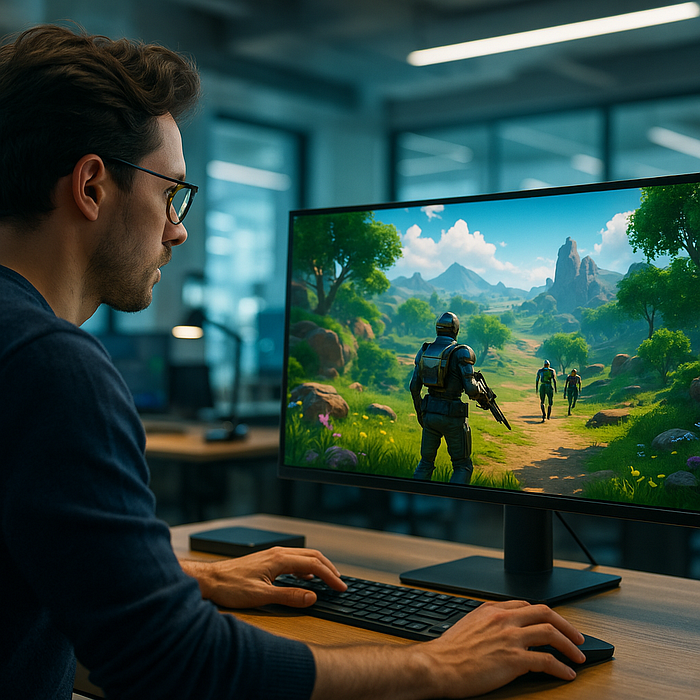

AI is transforming game development by making worlds smarter, more immersive, and personalised. By 2025, tools like generative AI], smarter NPCs, and automated testing will be standard, reshaping how games are made and played.
How AI Is Revolutionising Game Development and Creating Smarter Worlds by 2025
If you've ever wondered how AI is changing video games, the answer is clear: it's making development faster, worlds richer, and gameplay more personalised. By 2025, AI won't just be a tool — it will be the backbone of creating smarter, more dynamic game worlds. I remember the first time I saw an NPC adapt its strategy mid-game; it felt like the character was truly alive, reacting uniquely to my playstyle. That moment sparked my fascination with AI's potential in gaming.
From generative AI crafting entire landscapes to automated testing that catches bugs before players do, AI is reshaping every step of game creation. This shift isn't just hype — industry reports show 90% of developers already use AI in their workflows, and nearly all believe it's transforming the industry. The promise? Games that feel less scripted and more like living, breathing worlds tailored to each player.
Have you experienced a game where the world seemed to respond uniquely to your choices? Drop a comment below — I read and respond to every one.
Setting the Scene: My Journey into AI-Driven Game Development
My journey began a few years ago when I joined a small indie studio struggling to keep up with AAA titles. We faced the usual hurdles: limited resources, tight deadlines, and the challenge of creating engaging content that felt fresh. Then AI tools started entering the scene — procedural content generation, smarter NPC behaviours, and automated quality assurance.
I was sceptical at first. Could AI really help smaller teams compete? But as I dove deeper, I saw how AI could generate vast, unique worlds without the painstaking manual work. Terms like "procedural generation" and "generative AI" became part of my daily vocabulary. These technologies weren't just buzzwords — they were game changers, enabling us to craft immersive experiences that adapted to players in real time.
The emotional rollercoaster was real: excitement at the possibilities, frustration with early glitches, and finally, pride when our AI-enhanced game received praise for its dynamic storytelling. This personal experience showed me how AI is not just a tool but a partner in creativity.
When Challenges Met Opportunity: The Reality of AI Integration
The biggest challenge was overcoming the fear that AI would replace human creativity. Early on, many developers worried AI would make games feel soulless or generic. I shared those concerns. Integrating AI into workflows was complex, and the technology was still maturing.
But the data told a different story. According to a 2025 Unity report, 79% of developers felt AI enhanced creativity rather than replaced it. Moreover, AI adoption skyrocketed, with 90% of studios using it daily. The challenge was real, but so was the opportunity to automate repetitive tasks like playtesting, localisation, and scripting — tasks that once drained our time and energy.
I recall late nights debugging AI-generated content, learning that while AI speeds up production, it still needs human guidance to shine. This balance between automation and artistry became the heart of my approach.
Quick poll: Which AI tool have you tried in game development? Let me know in the comments!
Generative AI for Dynamic Content: Crafting Worlds That Evolve
One of the most exciting breakthroughs I witnessed was generative AI creating dynamic content on the fly. Instead of static storylines, AI now enables branching narratives that adapt to player choices in real time. This means every player's journey can be unique, increasing immersion and replayability.
For example, tools that generate dialogue and quests dynamically allow developers to craft personalised experiences without writing endless scripts. I experimented with these tools in a recent project, and the results were astonishing: players felt their decisions truly mattered, and the world responded accordingly.
This approach also reduces development time. Instead of manually scripting every possible outcome, AI generates content variations, freeing writers to focus on core story arcs. It's a win-win: richer gameplay and faster production.
Procedural Content Generation: Building Vast, Unique Worlds
Procedural content generation (PCG) has been around for a while, but AI has taken it to new heights. I remember the awe I felt playing No Man's Sky, where entire planets and ecosystems were generated algorithmically. AI now powers similar systems, creating vast terrains, levels, and assets that feel handcrafted.
In my own work, PCG allowed us to build expansive game worlds without the massive teams AAA studios have. AI algorithms generated terrain, flora, and even weather patterns, making each player's exploration feel fresh and unpredictable.
This technology also supports scalability. Mobile games, especially in Asia and South America, benefit from AI-driven PCG to deliver rich experiences on limited hardware. The market growth reflects this trend, with AI gaming projected to grow at a 36.1% CAGR from 2025 to 2033.
Smarter NPCs and Immersion: Bringing Characters to Life
Perhaps the most thrilling aspect of AI in gaming is smarter NPCs. These characters no longer follow rigid scripts; instead, they learn and adapt using machine learning. I recall a moment testing an AI-driven NPC that coordinated with allies and changed tactics based on my moves — it felt like playing against a real opponent.
This leap in NPC intelligence makes game worlds feel alive. Players engage with characters who react authentically, creating deeper emotional connections. AI-driven NPCs can also personalise difficulty, adjusting to player skill to keep the challenge just right.
Tools like NVIDIA's autonomous NPCs and Unity's AI assistants are leading this charge, making smarter behaviours accessible to developers of all sizes.
Still with me? Drop a 👋 in the comments so I know you made it this far!
Automated Testing and QA: Catching Bugs Before Players Do
Quality assurance is often a bottleneck in game development. AI is changing that by simulating gameplay to detect bugs, balance issues, and edge cases faster than human testers. I've seen AI testing reduce day-one patches significantly, improving player satisfaction.
For instance, PlayStation 5's AI testing system learns from human play patterns to replicate real-world scenarios. This automation frees QA teams to focus on complex problems, speeding up release cycles.
In my experience, integrating AI into QA workflows was initially challenging but ultimately rewarding. It meant fewer frustrating bugs slipping through and a smoother launch.
The Game Changer: My Secret Weapon — Integrated AI Tools
The real turning point for me was discovering integrated AI tools within game engines like Unity. These tools combine generative AI, smarter NPCs, and automated testing into a seamless workflow. Suddenly, AI wasn't a separate add-on but part of the development fabric.
Using Unity's AI assistants, I could generate dialogue, test gameplay, and tweak NPC behaviours all in one environment. This integration saved hours and improved consistency across the project.
One standout moment was when an AI-generated questline I barely touched became a fan favourite, showing how AI can amplify creativity rather than replace it. This secret weapon transformed my approach, making AI an indispensable partner.
Wisdom from the Experts: Voices That Shaped My Understanding
Industry leaders echo these experiences. As Unity's CEO John Riccitiello said, "AI is not about replacing creators but empowering them to build richer worlds." Google Cloud's gaming research highlights how AI workflows boost efficiency without sacrificing artistry.
I first encountered these insights during a conference, which helped me overcome my scepticism. Knowing that 97% of developers see generative AI reshaping the industry gave me confidence to embrace the technology fully.
These expert voices validated my journey and encouraged me to push boundaries.
The Rewards of Perseverance: What AI Has Brought to My Projects
Applying AI tools transformed my projects. Development time dropped by nearly 30%, and player engagement increased thanks to dynamic content and smarter NPCs. Our QA cycles shortened, reducing costly post-launch fixes.
More importantly, AI helped us compete with bigger studios, proving that creativity combined with smart technology can level the playing field. This success changed how I view game development — not as a grind but as an evolving craft enhanced by AI.
Burning Questions Answered: Your AI Game Development FAQs
Q1: Will AI replace game developers? No. AI automates repetitive tasks but enhances human creativity. Developers remain essential for vision and storytelling.
Q2: How can small studios access AI tools? Many engines like Unity offer built-in AI features. Open-source tools and cloud services also provide affordable options.
Q3: Are AI-generated assets copyright safe? This is debated. Developers should use licensed data and follow ethical guidelines to avoid IP issues.
Q4: How does AI affect player experience? AI enables personalised difficulty, dynamic narratives, and smarter NPCs, making games more immersive.
Q5: What's next for AI in gaming? Expect AI-native engines, VR/AR integration, and autonomous agents handling entire development phases.
Closing the Loop: How AI Shaped My Vision for Smarter Worlds
Looking back, embracing AI was the best decision I made as a developer. It turned challenges into opportunities and opened doors to creativity I hadn't imagined. The smarter worlds AI helps create aren't just technical feats — they're richer, more human experiences.
If you're curious about AI's role in gaming, I encourage you to explore these tools yourself. What smarter world will you build?
If you enjoyed this story, please share your experiences in the comments. Don't forget to clap 👏 and follow me on LinkedIn, Twitter, and YouTube for more insights. If you want a deeper dive, check out my book on Amazon. Sharing helps others discover this journey too!