
1. Microservices Architecture
📌 What it is: Microservices is a way of designing software as a collection of small, independent services that communicate with each other.
📌 Use:
- Each service can be developed, deployed, and scaled independently
- Commonly used in cloud-based systems, e-commerce, banking, OTT platforms, etc.
📌 Scope:
- Very high demand in companies adopting cloud-native and scalable systems
- Used by big names like Netflix, Amazon, Uber
2. Spring Boot
📌 What it is: A Java-based framework that simplifies the creation of production-ready microservices and REST APIs.
📌 Use:
- Integrated with Spring Security, JPA, Actuator, etc.
📌 Scope:
- Popular in enterprise applications, backend systems, APIs
3. REST APIs (Representational State Transfer)
📌 What it is: A design style used to create web services that communicate over HTTP.
📌 Use:
- Enables frontend and backend to talk (mobile/web ↔ backend)
- Supports CRUD operations via simple HTTP methods like GET, POST, PUT, DELETE
- Platform-independent and easy to integrate
📌 Scope:
- Almost every modern app uses REST APIs
- Widely used in mobile apps, web apps, IoT devices, etc.
4. React (Frontend)
- Scope: Building fast, responsive user interfaces (UI).
Use:
- Create component-based UIs.
- Communicate with backend APIs.
- Implement state management (e.g., Redux, Context API).
- Build Single Page Applications (SPAs) with routing and client-side rendering.
5. AWS (Infrastructure / Cloud Hosting)
- Scope: Deploying, scaling, and securing your application in the cloud.
Use:
- Host microservices (e.g., using EC2, ECS, Lambda).
- Store and serve data (S3, DynamoDB, RDS).
- Manage authentication (Cognito) and CI/CD (CodePipeline).
- Monitor services (CloudWatch, X-Ray).
Kafka (Message Broker / Event Streaming)
- Scope: Enabling asynchronous, decoupled communication between microservices.
Use:
- One service publishes messages to a Kafka topic.
- Others consume those messages (e.g., audit logging, analytics, notification systems).
- Handle large volumes of real-time data with low latency.
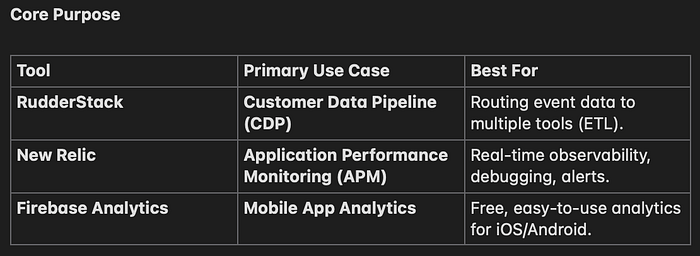
Diff b/w RudderStack vs New Relic vs Firebase analytics
RudderStack
You collect analytics events (like "video_played", "button_clicked", "user_logged_in") once, and then send (or forward) that same data to multiple destinations such as:
- Analytics tools (like Google Analytics, Mixpanel, or Firebase)
- Data warehouses (like BigQuery, Snowflake, Redshift)
- Marketing tools (like Braze, MoEngage)
- Monitoring tools (like New Relic)
All without writing extra code for each tool.
Why is this useful?
- Saves development time (no need to integrate multiple SDKs)
- Keeps event tracking centralized and consistent
- Gives you flexibility: change/add tools without changing app code.
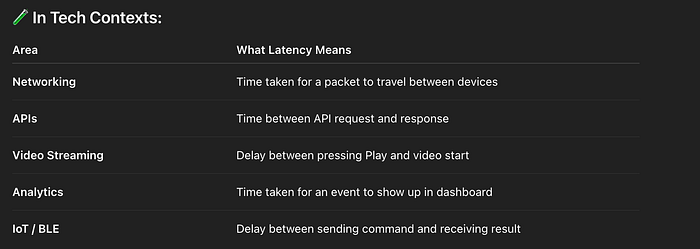
What is Latency?
Latency refers to the time delay between a user action (or a request) and the response (or result) of that action.
In Simple Terms:
It's the time taken for data to travel from source to destination.
Real-Life Example:
Let's say your Apple TV app sends a video_played event to a backend server.
- You press Play ➡️ request goes to server
- Server receives it ➡️ logs it ➡️ sends response back
If this takes 120 milliseconds, then latency = 120ms.
📉 Lower Latency = Better Experience
- Ideal for real-time apps (chat, video, games)
- Lower latency = faster responses, smoother UI