
Search engines powered by AI, like Perplexity and ChatGPT, prioritize content that offers direct, factual answers over keyword-heavy text. Brands must focus on three key areas: clear language, technical setup, and tools to track AI search trends. Here's how to adapt.
1. Prioritize Clear, Actionable Content
Modern AI systems pull direct quotes from content rather than scanning entire pages. To increase visibility:
- Use subheadings and bullet points to highlight key points.
- Write concise facts instead of long, dense paragraphs.
A fintech business saw a 67% increase in AI citations after restructuring their guides into short, modular sections.
2. Update website settings for AI access
AI bots need permission to process your content. Adjust your robots.txt file to:
- Allow access for AI crawlers like PerplexityBot.
- Block sensitive pages from being used in AI training.
One e-commerce site increased AI traffic by 42% after configuring permissions for product FAQs.
3. Add structured data for AI to read easily
Schema markup (like JSON-LD) helps AI systems identify and use your content quickly. For example:
- Label FAQs and product details clearly.
- Use schema for articles, events, or reviews.
{
 "@context": "https://schema.org",
 "@type": "FAQPage",
 "mainEntity": [{
   "@type": "Question",
   "name": "How often should I update my content?",
   "acceptedAnswer": {
   "@type": "Answer",
   "text": "Update key pages every three months to keep information current."
   }
  }]
 ]
A healthcare site boosted AI citations by 58% after adding structured data to symptom guides.
4. Test AI search visibility
Use AI visibility tools to:
- Track how often your content appears in AI summaries.
- Compare your performance with competitors.
A SaaS company boosted AI traffic by 28% after fixing gaps found through competitor analysis.
5. Keep content up to date
AI systems favor recent information. Regularly update key pages about:
- Industry changes (e.g., cybersecurity threats or AI updates).
- Frequently asked questions.
A tech firm increased AI traffic by 19% after refreshing guides every three months.
6. Mix AI and traditional SEO
Core SEO principles still matter. Combine them with AI strategies:
- Focus on semantic SEO (meaningful keywords and phrases).
- Improve page speed and mobile responsiveness.
- Add high-quality backlinks.
A marketing agency improved both search rankings by refining headlines using natural language tools.
7. Build content for small, readable sections
AI systems pull snippets, not full documents. Structure pages to:
- Split content into short, standalone parts (e.g., infographics or FAQs).
- Ensure each section has a clear purpose.
A travel blog saw a 35% increase in AI citations after reorganizing content into bite-sized parts.
Update your approach using these steps. Focus on clarity, technical setup, and real-time analysis to stay visible in 2026.
Summary:
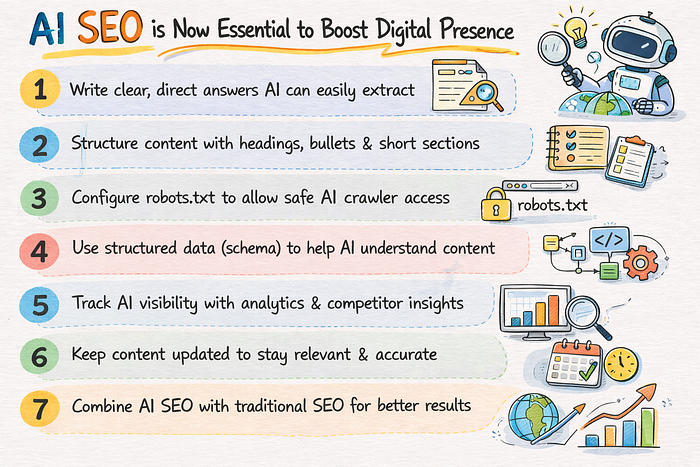
- Write clear, direct answers because AI search engines extract concise facts rather than scanning entire pages.
- Structure content with headings, bullets, and short sections so AI systems can easily pull useful snippets
- Configure technical access like robots.txt so AI crawlers can read your site while protecting sensitive pages.
- Use structured data such as schema markup to help AI quickly understand FAQs, products, and key information.
- Track AI search visibility with analytics and competitor analysis tools to identify content gaps.
- Keep content updated regularly because AI systems prefer recent and relevant information.
- Combine AI SEO with traditional SEO like semantic keywords, page speed, and backlinks for stronger visibility