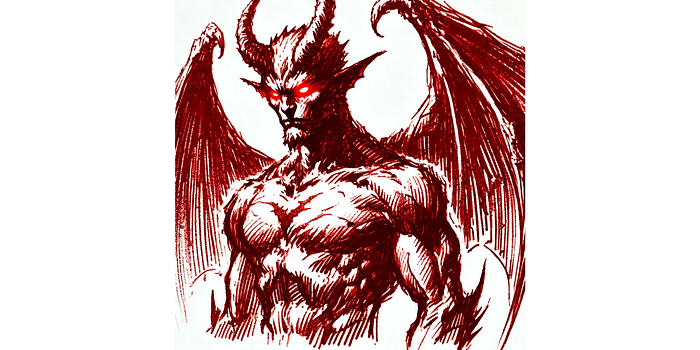

Non-members can read the entire article here.
Now that we've provided a foundation for angels in the first part, we can get to what I'd consider the more practically important part — demons.
But first, a confession.
Red Tights and a Pitchfork
For years, I didn't subscribe to the nature of demonic activity, to the idea of Satan running around causing chaos. I like many others believed in angels and their work supporting God's providential care, but I didn't believe that some dude in red tights with a pitchfork, horns, an evil grin and a pointed tail was running around poking people when they weren't looking:
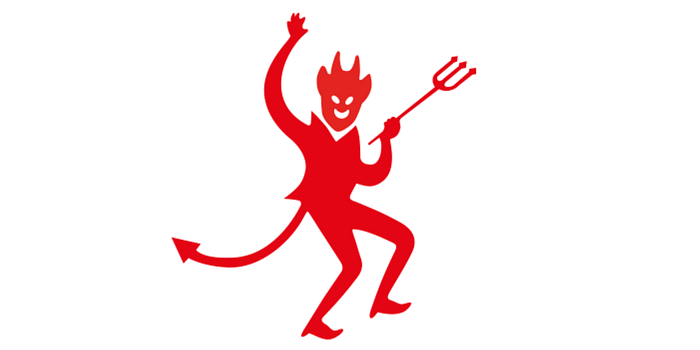
He's even waving and smiling…
But now that I've taken time to learn more about this doctrine, my views on certain atrocities have changed a little bit.
Let's dig in.
Restructuring Demonology
Though as noted some outright deny the existence of evil spirits, it may be worse that others have attempted to restructure belief altogether, according to both Cottrell and Erickson (sources noted at the end).
Rudolf Bultmann
We talked about Bultmann's demythologization program in the first part. We didn't share that some claimed the Christian origin of demons came from Persian mythology. Never mind that it ignores both Scripture and dualism that's central to Persian thinking. To them it's Persian mythology.
Paul Tillich
Paul Tillich (1886–1965), the influential Lutheran theologian, in his 1957 Systematic Theology indicated that some theologians source evil from society, not Biblical demons. "Demonic" is thus viewed as a powerful social force, not one from personal spiritual beings depicted in the Bible.
Karl Barth
And then there's Karl Barth, who in his Church Dogmatics says that angels and demons have literally nothing in common. He goes so far as to say that demons lie in nothingness, chaos, and darkness, and that they aren't created by God, but they are part of the threat to God's creation. Again, this denies the Biblical record and goes against most of what we'll cover here.
The Most Profound Trick
Despite all of this, Cottrell in A Faith Once for All, tells us:
The Bible clearly testifies to the literal existence of both Satan as the ruling evil spirit and the demons as his messenger (angels).
And C.S. Lewis in Screwtape Letters tells us that the devil's most profound trick is convincing people he doesn't exist. If you haven't read Lewis' works, you're missing out. Try The Great Divorce, too. Short, entertaining, useful.
The Origin of Demons
So where do these dudes come from? Make no mistake, they are, like angels, depicted as dudes and not dudettes.
Four Major Views on the Nature of Evil Spirits
Cottrell writes of four major views about the origin of Satan and evil spirits:
- They are the spirits of wicked men who have died. There is no Biblical foundation for this idea, supported by Josephus (37/38–100), the ancient Jewish historian, and others like Alexander Campbell (1788–1866), a well-known colonial minister.
- They are the disembodied spirits of a superior, rebellious race of creatures who inhabited the earth before Adam. This is largely speculative and again doesn't have any roots in Scripture.
- They are the offspring of perverse mating between angels and women. In part one we referred to the "sons of God" in Genesis 6:2 and this very notion, but it makes certain assumptions that contradict other verses.
- They are fallen angels that have sinned. This is the consensus theology.
The Creation and Fall of Angels
Let's go all the way back to the beginning, to Genesis 1:31 (ESV):
And God saw everything that he had made, and behold, it was very good. And there was evening and there was morning, the sixth day.
Right after this, in Genesis 2:1 (ESV):
Thus the heavens and the earth were finished, and all the host of them.
Recall from the first part that "host" seems to be a repeated reference to angels. Thus, by the sixth day, God had created everything, including spiritual beings we refer to as angels — and they were all "good".
In Genesis 3:1–5 however we encounter the serpent tempting Eve. Somewhere in between, something went wrong. The serpent is obviously not, "good", and there are hints throughout Scripture that Satan had wanted to dethrone God and rebelled in an attempt to do so. From John 8:44 (ESV):
You are of your father the devil, and your will is to do your father's desires. He was a murderer from the beginning, and does not stand in the truth, because there is no truth in him. When he lies, he speaks out of his own character, for he is a liar and the father of lies.
Add to this what's written in 1 John 3:8 (ESV):
Whoever makes a practice of sinning is of the devil, for the devil has been sinning from the beginning. The reason the Son of God appeared was to destroy the works of the devil.
Though some theologians vary in their explanations, the mainstream consensus holds that demons are angels who rebelled against God.
Fallen Angels
We know from the first part that angels are moral, spiritual creatures with free will. What happens when they rebel? From 2 Peter 2:4 (ESV):
For if God did not spare angels when they sinned, but cast them into hell and committed them to chains of gloomy darkness to be kept until the judgment; …
Let's look at another verse, from Jude 1:6 (ESV):
And the angels who did not stay within their own position of authority, but left their proper dwelling, he has kept in eternal chains under gloomy darkness until the judgment of the great day —
Angels are not saved — God only offers salvation to man. That 2 Peter 2:4 says fallen angels are cast into hell remains in question — some think it's improper exegesis, and that demons are cast aside, from other angels, in a gloomy part of the spiritual realm. Contrary views hold that some are cast into hell while others remain free to roam until final judgment.
Both cases align with Scripture that makes it clear at least some demons are free to roam and carry out their (wicked) plans.
Satan as Leader of Demons
Satan is the usual name for the ruler or prince of demons (Matthew 12:24; Luke 11:15, Cottrell). This is a transliteration of generic Hebrew meaning "adversary, opponent, one who tries to block your way" (Numbers 22:22; 1 Kings 11:23, 25, Cottrell). There are over 50 Old Testament references.
The Greek word satanas is used over 30 times in the New Testament to refer to the devil, with its basic nature being an opponent or enemy of God and man. Diabolos from diaballo means "to accuse, to slander", and it's used 30 times in the New Testament, translated as "the devil" and slanderer/ accuser, adversary of God and man (Cottrell).
Satan is also referred to as "serpent", "dragon", "tempter", "deceiver", "a liar and the father of lies", "ruler of this world", "the ruler of demons", "the god of this world [age]", "the prince of the power of the air" and "the evil one" (Cottrell, Grudem). Less-common monikers include "Abaddon", "Apollyon", "Belial", "Beliar", "Beelzebub" (pagan, "lord of the flies"), "Beelzebul" (pagan, "lord of the dung-heap"), and several others.
False Idols as Demons
Though at first glance it seems the Old Testament doesn't refer to evil spirits or demons with great frequency, once we recognize that false idols are directly associated with demons, that changes.
Grudem refers to Deuteronomy 32:16–17 as an explicit association between demons and idols, and mainstream sources equate the two. Grudem refers to pagan worship with destructive practices including child sacrifice (Psalms 106:35–37), bodily harm to oneself (1 Kings 18:28, cf. Deuteronomy 14:1), and cult prostitution (Deuteronomy 23:17; 1 Kings 14:24; Hosea 4:14).
The entire Bible is littered with references to false idolatry, reinforcing a common and prominent theme: Idol worship is sin that turns us from God.
A Note on Lucifer and an Angel of Light
Lucifer (only) appears in the King James Version's translation of Isaiah 14:12, but Cottrell believes it refers to one of the kings of Babylon, not Satan. Others like Grudem deem language too strong to apply to humans. Either way, the name Lucifer is not used in today's translations.
It does however draw attention to an important point: The KJV name is associated with the Hebrew word helel meaning "radiant or shining star", translated as "star of the morning" (NASB), "morning star" (NIV), or "Day Star" (ESV, NRSV). Compare to 2 Corinthians 11:14 (ESV):
And no wonder, for even Satan disguises himself as an angel of light.
Either way, deceit is one of Satan's greatest weapons. But what else, and to what end?
The Activity of Demons
Satan and his demons attempted to defeat God's plan and purpose by any means possible. For example, Satan first tried to corrupt man at the beginning by tempting Eve (Genesis 3), then through Herod tried to have Jesus killed (Matthew 2:1–15; Revelation 12:1–5). Satan also tried — and failed — to tempt Jesus to abandon his mission (Matthew 4:1–11). Working through Judas, Satan sought Christ's death (John 13:2, 1 Corinthians 2:8). He didn't realize that would be his undoing, since Christ's crucifixion and resurrection defeated evil once and for all.
So now what? Since Satan couldn't stop God's plan, he is relegated to corrupting as many souls as possible, perhaps so they can join him in eternal condemnation or simply out of spite. He and his demons use:
- False teachings and deceit
- Temptation
- Physical ailments and limitations
False Teachings
Satan and his demons use lies, deceit, and also false teachings to mislead and redirect believers away from God (some repeated from above):
- Satan is a liar and deceiver (John 8:44, Revelation 12:9; 20:7–10).
- Satan has since the "beginning" lied and attacked God's Word (Genesis 3:4–5; Luke 8:12).
- He blinds the minds of the unbelieving (2 Corinthians 4:4).
- He depends on deceitful schemes and snares (2 Corinthians 2:11; Ephesians 6:11; 2 Timothy 2:26). He disguises himself as the angel of light and his demons feign righteousness (2 Corinthians 11:14–15).
- His demons inhabit the false religions of the world and form the root of idolatry (1 Corinthians 10:14; Deuteronomy 32:17; Psalms 106:36–38).
- Satan can even empower people to work miracles in support of his lies (Matthew 7:21–23; 2 Thessalonians 2:9; Revelation 16:14).
Temptation
We've referred to some of Satan's tempting operations, which we'll repeat here with a few others:
- Satan tempted Eve in the Garden of Eden (Genesis 3:1–6)
- He tempted Jesus to sin and fail in his mission (Matthew 4:1–11)
- Satan tempts man to share in his condemnation (Matthew 25:41)
- He enticed ill behavior in the parable of the weeds (Matthew 13:24–30)
- Satan manipulates through subliminal suggestion (e.g. John 13:2)
- He bonds people to things that keep them from God (Galatians 4:8)
Cottrell also indicates that Satan introduces ideas/ imagery to stoke sinful desires or exploit spiritual weaknesses while manipulating one's will through other people (for example through peer pressure).
Physical Ailments
Not all sickness and disease are the result of evil spirits, though the Bible provides some examples of physical manipulation:
- Satan entered Judas to betray Jesus (Luke 22:3).
- He inflicts dumbness (Mark 9:16), deafness and dumbness (Mark 9:25), and blindness and deafness (Matthew 12:22).
- Satan can also inflict convulsions (Mark 1:26; 9:20; Luke 9:39) and paralysis (Acts 8:7). Erickson rightly points out that convulsions weren't always attributed to demons, though the two overlapped on occasion. He also notes that leprosy is never in the Bible attributed to evil.
- He uses every activity for self-destruction (John 10:10).
This brings us to the broad topic of "demon possession". Though some attribute ancient views to ignorance and superstition (mythology, as we have seen), Cottrell quotes Van Rheenen in Christ; and Peterson in Roaring Lion (previously Are Demons for Real?) on modern "demon possession":
Westernized, secularized skeptics need only to hear the testimony of anyone who has done mission work in an animistic culture to know this is the case.
Some say that Christ's victory over evil precludes further demonization, while Grudem denounces the concept altogether (from p. 546):
…demon possession is an unfortunate term that has found its way into some English translations of the Bible but it is not really reflected in the Greek text.
Grudem's issue is that it implies the suffering person has no power over the influence of a demon. Though in rare ancient cases that may have been true, Grudem indicates that Christians since Pentecost have the full power of the Holy Spirit within them to overcome such influences.
This leads us to our final topic as it relates to our ability to ward off evil.
Spiritual Warfare
We will sometimes read of spiritual warfare, perhaps related to Revelation 12:7–9 where Michael leads angels to victory over Satan and his demons. Regardless of what may be taking place in the invisible kingdom of spirits, we are constantly presented with evil in our daily lives. But that's the entire point of the Good News in that through Christ, Christians have the ability to overcome evil and reunite with God. Let's take a closer look.
Weakened Satan and Demons
Satan as a result of Christ's crucifixion and resurrection is much more limited than he was before. He can be resisted and will flee (James 4:7, Ephesians 4:27).
Jesus explains his power over demons as a distinguishing mark on his ministry, which inaugurates the reign of the kingdom of God among mankind (Matthew 12:28–29, Revelation 20:1–3). According to Grudem, this marks a new covenant age characterized by triumph over the powers of the devil. From 1 John 3:8 (ESV) as noted above, with different emphasis:
Whoever makes a practice of sinning is of the devil, for the devil has been sinning from the beginning. The reason the Son of God appeared was to destroy the works of the devil.
Remember that demons, including Satan, are limited by God's sovereignty (Job 1:12; 2:6) and they do not know the future, a common misconception. Even angels don't know the time of Jesus' return (Mark 13:32).
Whereas Satan and his demons had more power before Christ, Cottrell indicates that the Holy Spirit empowers us to defend against their exploits (Romans 8:25, 1 Corinthians 3:16).
What We Can Do
Cottrell offers three specific things believers can do to ward off evil of any form, whether from other sinful men or from Satan and/ or his demons:
- Know the truth: This prevents us from adhering to false doctrine or subscribing to mistruth (2 Thessalonians 2:10–12).
- Submit to the sanctifying power of the indwelling Holy Spirit: This prevents us from submitting to temptation (Ephesians 6:14).
- Avoid activities that give evil the power to enter: Trust in the protecting name and blood of Christ as "the shield of faith" (Ephesians 6:16).
In some respects, avoiding evil activities serves as much a detriment as engaging in explicitly marked good activities. Such evil includes idol worship, gross immorality, occult practices, and seeking supernatural knowledge or powers, mysticism, or trance states (Cottrell). These activities are denoted in the Bible as manifestations of evil, and by pursuing the truth of the Bible and trusting in Christ, 1 John 4:4 (ESV) reassures us:
Little children, you are from God and have overcome them, for he who is in you is greater than he who is in the world.
And now we know, from our discussion, that "he who is in the world" refers directly to Satan and his demons' influences.
Until next time, may your hearts be filled with joy, your family be filled with love, and the protection of the Lord watch over You and Yours…
References
- Cottrell, Jack, A Faith Once for All: Biblical Doctrine for Today (College Press Publishing Company, 2002).
- Erickson, Millard, Christian Theology (3rd Ed., Baker Academic, 2013).
- Grudem, Wayne, Systematic Theology: An Introduction to Biblical Doctrine (2nd Ed., Zondervan Academic, 2020).