

I recently got into a frustrating Twitter fight with a group of people insisting that you can't change your sex. I was accused of lying and told that it was the height of condescension to pretend to believe that sex is fuzzy and changeable.
Sometime later the light dawned. We have different definitions of sex. I've seen a whole bunch of definitions, but these people seemed convinced that the only definition possible was the kiddie version learned in school.
If I understand them right, they define sex solely in terms of gametes. A woman is someone with large gametes (eggs) therefore all people with large gametes are women. A man has small gametes (sperm) therefore all people with small gametes are men. These are the only two possibilities.
Hang on. If gametes are the only thing that matters, then there are three sexes, large, small, and none. Some people never produce gametes in their entire lives. The rest of us don't start producing them until puberty and some of us stop again. Do you change sex at puberty and menopause, or after cancer surgery? If so, you also change sex with gender reassignment surgery. Do you cease to be a woman if you're not ovulating due to contraceptive pills, strenuous training, illness, or pregnancy?
"Good evening, welcome to the sports center. If you could just give me a few of your gametes then I'll have a quick look at them under this convenient microscope and direct you to the correct changing room."
It's also circular, as all definitions are. If you define dogs as "those animals that go meow", then all meowing animals are dogs, QED. I expect they would say, "But women do produce eggs, not sperm." It's very hard to spot your own circular logic.
To be fair, all the definitions of sex are somewhat arbitrary. If you define a woman as someone with XX chromosomes then anyone with XX chromosomes is a woman. And if you define a woman as someone wearing a dress, then anyone wearing a dress is a woman.
I've seen definitions of sex that are based on almost any combination of DNA, hormones, gametes, internal sexual organs, external sexual organs, secondary sexual characteristics, dress, and behavior. Back in the 1970s, I heard even people say gays and lesbians were intersex. I'm happy to say that I haven't heard that one since about 1980.
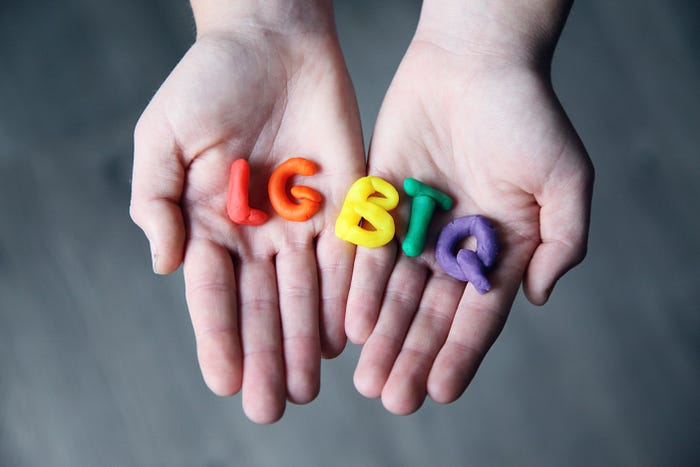
With so many definitions to choose from, gametes are spectacularly impractical. Going by gametes, I don't know the sex of anyone I've ever met. What am I supposed to say? "Good evening, welcome to the sports center. If you could just give me a few of your gametes then I'll have a quick look at them under this convenient microscope and direct you to the correct changing room." What about the 27 days of the month when people with large gametes don't have the evidence handy? What about people with no gametes?
When you meet a new person walking down the street, you usually classify them instantly as a man or woman (and some people get very upset if they can't). At that point, you haven't examined their DNA, hormones, internal sexual organs, gametes, or external sexual organs at all. In practice, you go by secondary sexual characteristics, dress, and behavior.
Clothing as a marker of sex is arbitrary: high heels were originally worn by men, Agamemnon wore skirts and George Sand wore trousers. You can change to the arbitrary standard for the other sex. Just ask Ru Paul.
Gestures are harder to change but plenty of good actors can play the opposite sex convincingly. In Shakespeare's time, it was considered scandalous for women to go on stage, therefore all female parts were played by boys.
In practice, what we mostly go on are secondary sexual characteristics. These are largely the result of hormones. Breast growth and voice pitch are the most obvious, but things like the shape of the brow or the size of the nose or Adam's apple are all down to hormones, and hormones can come in a bottle. (One friend refers to hers as "titty skittles.")
I would suggest that it makes sense to use the definition appropriate to the situation. After all, a biologist defines " fruit" as the part of the plant with seeds in it or on it, but you don't serve up tomato or avocado in a pie with ice cream any more than you'd put rhubarb in a beef stew. If you're cooking, it makes far more sense to use a cook's definition. If you're gardening, you need to know the difference between a stem and a seed.
Gametes are important for reproductive health care. Chromosomes are important when screening for breast cancer in men with Klinefelter syndrome. Internal sex organs are important for cervical and prostate screening The rest of the time it really doesn't matter. When it comes to public toilets, surely the important thing is not to put people in danger. The evidence is clear: trans women are not dangerous; they are, however, in danger themselves.
Of course, all this fuss is to "prove" that trans women aren't women. Trans women have male gametes or none, but most of them have female secondary sexual characteristics, dress, and behavior and many have female external sexual organs. Gametes are about the only standard that excludes them.
I can't see inside other people's heads, but gametes are exactly what you would choose if you were doing it exactly backward, starting with the result you wanted and searching high and low for a rationalization.
Actually, I'd like to suggest a definition of sex that I haven't seen elsewhere.
Biologically race doesn't exist. It's just that people get hung up on the stuff you can easily see; the climate adaptations like skin color rather than things like the shape of teeth or whether you can easily digest milk as an adult — things that don't match the conventional race groupings. Socially, however, people get different treatment based on their perceived race. So there's a school of thought that your race is what people assume your race to be, and how they treat you as a consequence. Barack Obama wasn't descended from American slaves but for much of his life he was treated that way, so he's black. (Even though most Kenyans apparently consider him to be white.)
I suggest your sex/gender is how people treat you.
- Do trans women get criticized for their looks? Hell, yes.
- Are they at risk of male violence? Hell, yes.
- Do they get paid less for the same work? Hell, yes.
- Do they get talked over while their own voices are ignored? Hell, yes.
- Are there religious leaders who say they are inherently evil? I've seen a few.
So by this standard at least, trans women are more women than cis women like me.
More from Sheila in feminism: