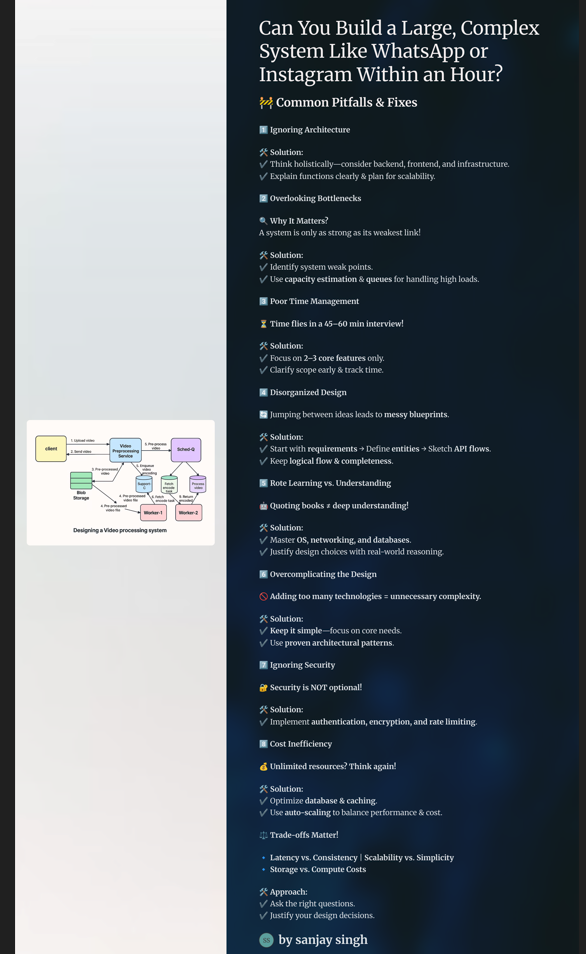

In reality, building a system at the scale of WhatsApp or Instagram takes years. However, in system design interviews, you are expected to complete the design within an hour. The ambiguity of these problems often overwhelms candidates. I have seen many candidates panic and ask, "Is 1 hour sufficient to complete the design?"
Story List Categories:
- About Me & List of Stories
- Java — All things Java-related.
- Java Interview Playbook: Your Go-To Reading List — For interview preparation.
- JAVA-8 — Dedicated to Java 8 topics.
- Spring Boot & Spring — Focused on Spring and Spring Boot.
- Microservices Topics List — Covering various microservices to
Understanding the Purpose of System Design Interviews
The goal of a system design interview is not to build a fully functional real-world system. Instead, it assesses your structured thinking, technical depth, and problem-solving skills.
Having conducted over 200 interviews, I have identified common mistakes that hinder candidates. With the right approach and dedicated practice, you can overcome these challenges and ace any system design interview.
In this article, I will outline common mistakes candidates make, provide examples, and offer actionable ways to avoid them.
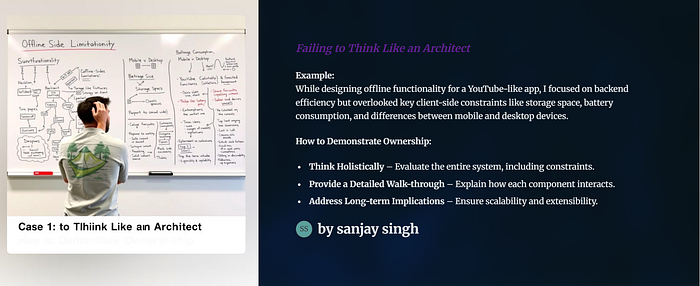
Case 1: Failing to Think Like an Architect
Example:
I was once asked to design offline functionality for a YouTube-like app that required video downloads and storage on client devices. Having worked primarily on backend systems, I overlooked critical client-side limitations — such as storage space, battery consumption, and different client types (mobile vs. desktop).
How to Demonstrate Ownership:
- Think Holistically — Consider all components of the system, including limitations.
- Provide a Detailed Walk-through — Explain the function of each component.
- Address Long-term Implications — Highlight extensibility and scalability.
Case 2: Overlooking Critical Roadblocks
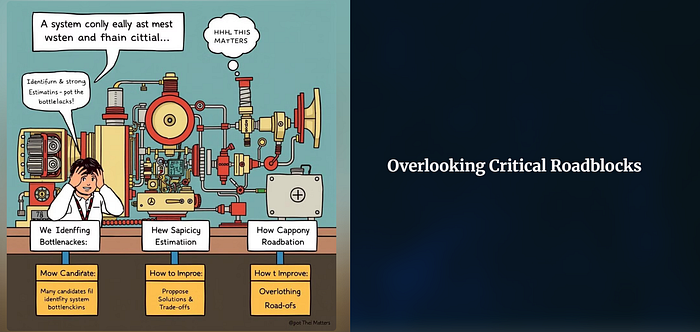
"A system is only as strong as its weakest link — spot and fix the bottlenecks!"
Many candidates fail to identify system bottlenecks and propose designs that don't scale.
Why This Matters:
Identifying bottlenecks demonstrates a deep understanding of system limitations and trade-offs.
How to Improve:
- Perform Capacity Estimation — Back-of-the-envelope calculations help define system constraints.
- Highlight Bottlenecks — Recognize limitations and address them proactively.
- Propose Solutions & Trade-offs — Offer alternatives like queues for handling high write throughput.
⏳ Case 3: Racing Against the Clock
"A great design is useless if you run out of time — plan wisely!"
System design interviews typically last 45–60 minutes. Managing time effectively is crucial.
Time Management Tips:
- Limit Scope — Focus on 2–3 core features.
- Keep Track of Time — Check progress after completing key sections.
- Engage with the Interviewer — Clarify requirements and expectations early.
Case 4: A Messy Blueprint
"Jumping between ideas without a roadmap leads to chaos — structure is key!"
How to Structure Your Design:
Jumping between different components without a structured flow can lead to a disorganized design.
- Follow a Top-Down Approach — Start with requirement gathering, define entities, sketch API flows, then refine the design.
- Maintain Logical Connectivity — Ensure each step leads naturally to the next.
- Ensure Design Completeness — Address both functional and non-functional requirements.
Case 5: Reciting, Not Reasoning
"Quoting books won't save you — understanding concepts will!"
Example:
A candidate designing a group chat system proposed horizontal scaling but couldn't explain why a single server couldn't handle millions of connections — other than quoting a book.
How to Avoid Rote Learning:
- Master the Fundamentals — Deepen your understanding of OS, networking, and databases.
- Challenge Assumptions — Research and verify the numbers you use.
- Identify System Patterns — Recognize common patterns used in real-world systems.
Case 6: Overcomplicating the Design
Some candidates try to incorporate every possible technology and optimization, making the design unnecessarily complex.
How to Keep It Simple:
- Focus on Core Requirements — Address the must-have features first.
- Avoid Premature Optimization — Solve problems as they arise, not in anticipation.
- Use Proven Architectural Patterns — Don't reinvent the wheel unless necessary.
Case 7: Ignoring Security Considerations
Security is a critical aspect of any large-scale system, but candidates often overlook it.
Key Security Aspects to Address:
- Authentication & Authorization — Implement secure user access mechanisms.
- Data Encryption — Protect sensitive information in transit and at rest.
- Rate Limiting & Throttling — Prevent abuse and ensure system stability.
Case 8: Not Considering Cost Efficiency
Some designs assume unlimited resources, leading to inefficient and costly solutions.
How to Design Cost-Effectively:
- Choose the Right Database — Optimize storage and retrieval costs.
- Leverage Caching — Reduce redundant computations and database calls.
- Use Auto-Scaling — Adjust infrastructure dynamically based on demand.
The Role of Trade-offs in System Design
System design is all about trade-offs. There is no perfect solution — only choices that depend on constraints and requirements.
Common Trade-offs to Consider:
- Latency vs. Consistency — Should your system prioritize fast responses or strict data consistency?
- Scalability vs. Simplicity — How complex should the architecture be to handle growth?
- Storage vs. Compute Costs — Should you store precomputed data or compute on demand?
How to Approach Trade-offs in Interviews:
- Ask Clarifying Questions — Understand the exact problem you need to solve.
- Justify Your Decisions — Explain why you chose a particular approach.
- Acknowledge Alternatives — Show awareness of other solutions and their trade-offs.
Mastering trade-offs is key to acing system design interviews. A well-reasoned choice matters more than a perfect answer!
🙏 Stay Connected!
I appreciate you taking the time to read my article. If you found it helpful, check out my other stories! 👉 Follow me on Medium 🚀