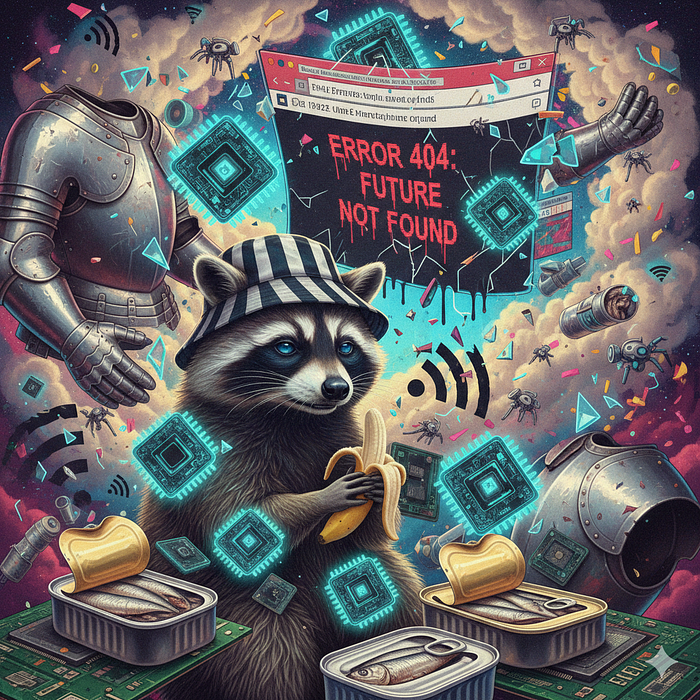


The year 2025 was mathematically perfect — a rare "perfect square" year (4⁵² = 2025) that won't happen again until 2116. But beneath that elegant symmetry lay absolute chaos. It was a year where dust-sized robots became real, where the internet suffered catastrophic failures, and where our collective cultural response was to eat tinned fish, dress like it was 1995, and obsess over tiny bananas.
This wasn't just another trip around the sun. This was the year humanity's weird meter broke completely.
Here are the 52 most mind-bending things I learned.
The Internet Is Held Together With Duct Tape
1. The internet has a physical breaking point, and we found it twice.
In November and December, Cloudflare — the invisible infrastructure managing 20% of web traffic — crashed globally due to a software bug and configuration error. X, ChatGPT, Spotify, Uber: all down simultaneously. We discovered that our digital civilization rests on shockingly fragile foundations.
2. When the internet breaks, we form fake tribes.
During the outages, the "Group 7" phenomenon emerged: people desperately claimed membership in a completely made-up exclusive club. Lesson learned? We'll create imaginary communities just to feel connected when the real networks fail.
3. AI can't handle your drunk Taco Bell order.
Taco Bell paused its AI drive-thru rollout after discovering that edge cases — like ordering 18,000 cups of water or mumbling incoherently — made the system crash. Turns out AI can ace standardized tests but fails spectacularly at 2 AM fast food chaos.
4. Your face is now legally copyrighted (in Denmark, at least).
Denmark passed legislation giving people copyright over their own faces, making deepfakes a form of identity theft. In 2025, your biometric data became your most valuable asset class.
5. The "Splinternet" is real.
The dream of a unified global village collapsed. With bots overwhelming major platforms and toxicity driving people away, the internet fractured into millions of private "dark social" channels. The future isn't one big town square — it's millions of locked living rooms.
Biology Became Science Fiction
6. We built robots smaller than dust particles.
Scientists created fully autonomous robots measuring just 200 micrometers — smaller than a grain of salt — with onboard solar power, sensors, and computing. "Smart dust" graduated from theory to reality, with implications for everything from microsurgery to pervasive surveillance.
7. Extinction isn't permanent anymore (with an asterisk).
The world's first artificial womb for marsupials was created to resurrect the Tasmanian tiger. Meanwhile, genetically engineered wolves were born with dire wolf traits. We learned that extinction is now a technical problem, not an absolute fate — though the ethics remain murky.
8. Your body is becoming modular.
2025 saw the first successful human bladder transplant and a gene therapy that slows Huntington's disease by 75%. Researchers also discovered "Cathartocytosis" — cells purging their own machinery to revert to stem-like states. Organ failure is becoming a maintenance issue rather than a death sentence.
9. Ancient fungi hold tomorrow's cancer cures.
Scientists synthesized Verticillin A, a fungal compound from 1970, and found it devastatingly effective against a deadly pediatric brain cancer. Nature's ancient chemical arsenal still outperforms our newest synthetic weapons.
10. Your brain "defrags" itself while you sleep.
Neuroscientists discovered how the brain physically separates old and new memories during sleep to prevent overlap. It's literal neural defragmentation, like your brain running disk cleanup every night.
Culture Lost Its Mind (In the Best Way)
11. "Oasiscore" weaponized the 90s.
The Oasis reunion triggered a global fashion pivot to parka jackets, bucket hats, and "blokette" aesthetics. This wasn't nostalgia — it was a rebellion against hyper-polished AI-filtered culture, a collective yearning for analog roughness.
12. The "Nano Banana" broke our brains.
A tiny, possibly synthetic fruit became 2025's most inexplicable viral obsession. Alongside creepy-cute "Labubu dolls" that became essential Birkin bag accessories, we learned that in uncertain times, the economy of cuteness thrives. The smaller and more useless, the better.
13. KFC-flavored toothpaste is real, and it costs $13.
KFC and Hismile released fried chicken-flavored toothpaste, erasing the line between hygiene and consumption. When satire dies, you can taste Colonel Sanders while brushing your teeth.
14. "Lock-In Wellness" monetized isolation.
The wellness industry rebranded anti-social behavior as luxury. The "Lock-In" trend encouraged people to isolate for months to "reset," while hotels offered high-tech blackout rooms solely for unconsciousness. We learned that in 2025, doing nothing costs a premium.
15. Tinned fish became a status symbol.
Inflation drove a 74% surge in canned mackerel sales. Tinned fish evolved from pantry staple to luxury item, featured on social media "seacuterie" boards. Economic constraint got rebranded as chic minimalism, and we all pretended to love it.
16. A drunk raccoon became our spirit animal.
A raccoon in Virginia broke into a liquor store and passed out drunk on the floor. The image went mega-viral because it perfectly captured 2025's collective mood: overwhelmed, indulgent, and just wanting to check out.
17. Gen Z parties in coffee shops now.
With 76% of Gen Z preferring sober socialization, nightlife moved to mornings. "Coffee Shop Raves" — dance parties fueled by espresso, not alcohol — became the new social hub. The club got replaced by the café.
18. We're dressing for the apocalypse.
"Medievalcore" exploded: corsets, chainmail, velvet. Fashion embraced feudal aesthetics, as if collectively preparing for societal collapse. When the future looks unstable, apparently we dress like it's 1425.
Geopolitics Got Weird and Real
19. Buying Greenland became serious strategy.
Trump's Greenland purchase idea moved from punchline to legitimate geopolitical debate about Arctic resources and competing with China. We entered the era of "Realpolitik Real Estate," where sovereign territory is a tradable climate asset.
20. The U.S. government can just… stop.
A record-breaking 43-day government shutdown normalized dysfunction. We learned the modern state is surprisingly resilient even when its gears grind to a halt — though vulnerable populations paid the price.
21. "No Kings Day" redefined protest.
The "50501 Movement" organized massive decentralized "No Kings Day" protests against executive overreach. While authoritarian impulses rose, the mechanisms of resistance evolved in parallel.
22. Bankruptcy went mainstream.
Over 446 large companies filed for bankruptcy by mid-year — higher than the pandemic peak. High interest rates finally killed the "zombie companies" surviving on cheap money. The "Great Clearing" was painful but arguably necessary.
23. Spirit Airlines, Rite Aid, Builder.ai — the casualties mounted.
Spirit collapsed under fuel and labor costs. Rite Aid drowned in opioid settlements. Builder.ai burned $445M while using hidden human labor instead of AI. The myth of "too innovative to fail" died hard.
24. "Project 2025" wasn't theoretical anymore.
The Heritage Foundation's blueprint for reshaping federal government moved from document to reality. The systematic dismantling of agencies proved that detailed planning beats vague populism every time.
25. Whistleblowing became combat.
Legal battles over security clearances and whistleblower protections showed that the information war is the primary battlefield of modern politics. Speaking truth became an extreme sport.
26. Money is being renationalized.
Russia's digital ruble push and U.S. crypto debates signaled the end of cryptocurrency's "wild west" era. Money is becoming a tool of state surveillance and control again.
The Planet Fought Back
27. Texas floods rewrote the rulebook.
A mesoscale convective vortex dumped 20 inches of rain on Texas, causing the Guadalupe River to rise 26 feet in 45 minutes. Historical weather data became obsolete. We're living in a "non-analog" climate where the past predicts nothing.
28. We found the building blocks of life floating in space.
Scientists detected tryptophan on an asteroid, suggesting life's ingredients are everywhere. The cosmos shifted from sterile void to pre-seeded garden.
29. Green chemistry finally fixed fertilizer.
A breakthrough alternative to the Haber-Bosch process promises to slash the massive carbon footprint of fertilizer production. This unglamorous innovation might be one of the most critical for human survival.
30. Animals are done with our boundaries.
Orcas sinking yachts. Seals walking into bars. Animal behavior got bolder and more disruptive. The line between "human space" and "wild space" is dissolving fast.
31. Solar power beat coal globally.
For the first time, combined wind and solar output surpassed coal. Despite political resistance, the economic logic of renewables became undeniable. We hit the energy tipping point.
32. "Ghost storms" are the new normal.
"Mesoscale convective vortices" — storms that persist after dying and then reignite violently — entered public awareness. In a warming world, storms have zombie afterlives.
Computing Got Quantum and Hollow
33. "Cat qubits" made quantum computing 90% better.
AWS and Caltech's "Ocelot chip" uses "cat qubits" to reduce quantum computing errors dramatically. The hardware is getting absurdly sophisticated even as our software remains gloriously buggy.
34. The internet now runs on air.
Breakthrough "hollow-core" fiber optic cables with air-filled centers allow light to travel 50% faster with reduced signal loss. The physical infrastructure is becoming incomprehensibly fast.
Discoveries That Rewrote the Books
35. Women "rainforest gardeners" are conservation heroes.
In Kerala, India, grassroots women preserved over 2,000 native plant species. Localized, community-led conservation proved more effective than many international initiatives.
36. We found a lost Maya king.
The tomb of Te K'ab Chaak, founder of the Caracol dynasty, was discovered. A once-supreme ruler reduced to dust and jade fragments — a reminder that all monuments eventually fall.
37. Plants might actually be talking.
The trend of listening to electrical signals from plants revealed a deep desire to connect with nature's "language." While quirky, it tapped into something profound about our relationship with the living world.
The Things We Consumed and Why
38. We learned what "comfort chaos" means.
2025's consumer trends — nano bananas, chicken toothpaste, drunk raccoon memes — were all manifestations of "comfort chaos," a coping mechanism for high-stress existence. We retreated into the absurd because reality was too sharp.
39. "Smartphone-free childhood" became a movement.
The push to ban smartphones for kids gained momentum as parents fought to protect developing minds from algorithmic hijacking. Defending the capacity for attention became defending humanity itself.
40. "Grounded optimism" replaced toxic positivity.
The trend of "grounded optimism" — planning for the future while accepting uncertain outcomes — became the mental health approach that actually worked. Hope with a reserve clause.
The Costs We Counted
41. California fires hit $112 billion in damages.
Surpassing Hurricane Katrina, the fires became the costliest disaster in U.S. history. Climate change graduated from future threat to present economic crisis.
42. 2025 was the deadliest year for aid workers.
Humanitarian workers paid the highest price in modern history. Their sacrifice highlighted the growing danger of trying to help in an increasingly violent world.
43. Pope Francis died, reminding us we're all mortal.
Even the Vicar of Christ is subject to nature's laws. His death prompted global reflection on legacy and the transient nature of power and station.
The Weird Trends Nobody Asked For
44. "Sleep tourism" turned unconsciousness into luxury.
Hotels offered AI-controlled environments designed solely for optimal sleep. We commodified the one free thing humans used to do naturally.
45. "Girl dinner" went mainstream.
The recession-era aesthetic of making meals from random snacks and tinned fish became a lifestyle brand. Economic necessity became Instagram content.
46. Brussels hosts morning raves.
Coffee shop raves in Brussels and St. Louis replaced traditional nightlife. Dancing on caffeine instead of alcohol became the new normal.
47. Labubu dolls on $30,000 Birkin bags.
Creepy-cute plush toys became essential luxury accessories. The juxtaposition of extreme wealth and childish cuteness defined 2025's consumption paradox.
The Technical Breakthroughs
48. We're reversing Huntington's disease.
Gene therapy slowing the disease by 75% represented a monumental shift in how we think about genetic conditions — from inevitable to manageable.
49. Bladder transplants are now possible.
The first successful human bladder transplant opened new frontiers in organ replacement. The modular body is becoming reality.
50. Cells can "reboot" themselves.
The discovery of Cathartocytosis — cells purging machinery to revert to stem-like states — offers entirely new pathways for regenerative medicine.
The Final Lessons
51. 2025 was a stress test, and we passed (barely).
We bent. We warped. We got weird. But we didn't break. The year proved human resilience even when nothing made sense.
52. Perfect squares are chaotic inside.
The numerological elegance of 2025 (4⁵² = 2025) masked profound asymmetry. We learned that mathematical beauty doesn't guarantee orderly reality — sometimes the most perfect-looking years are the wildest.
Epilogue: The View from 2026
Standing on the other side of the "Perfect Square" year, one truth emerges: we cannot control the weirdness. We can't stop the internet from breaking, the rains from falling, or the raccoons from drinking.
But we showed up. We adapted. We found humor in the absurd and meaning in the chaos. We built robots from dust and brushed our teeth with fried chicken because, honestly, why not?
The world is accelerating into the weird, and 2025 taught us the only rational response: embrace it, document it, learn from it, and maybe — just maybe — laugh at it.
Here's to 2026. May it be slightly less chaotic.
(But probably not.)