

It's been four months since I set off on my grand running experiment to run a qualifying time for the 2025 Chicago Marathon. After 16 weeks, it's time to transition from my base-building phase to my training phase in preparation for the Cleveland Marathon in May, where I will make my first attempt at a qualifier. It's time to dive into some numbers, and evaluate the impact of base building, and what is to come in training.
Reflections On My Base-Building Phase
The last four months have primarily focused on easy running, in what most would call Zone 2 training. Speed was sprinkled into my weekly runs occasionally, but was not a main concern of mine. I also incorporated some long runs, gradually increasing mileage so that when training began, I wouldn't be inappropriately increasing my training load. During this phase, I capped my long run at 8 miles.
So, how did all of this affect my projected race times? Let's take a look at the numbers.

Projected race times across all distances decreased over the base building phase, with the 10k distance showing the most improvement at just over 4%. This makes sense, given that the average distance per run during my base phase was 4 miles. This distance was not quite long enough to impact the longer distances, but showed promise in the 10k distances. My projected improvement at the full marathon distance improved by 3%. Based on my goal, I still need to shave 38 minutes off my marathon time.
What Does This All Mean?
I like to break the marathon into components, using a "split" race strategy, where I plan and race at the split times that will accomplish the marathon time. My Chicago qualifier attempt requires the following splits.
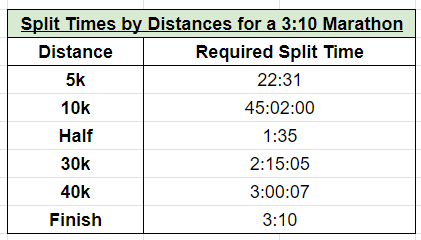
Based on the required split times, my base training has helped me improve my fitness to hit the required splits through the 10k distance. The running done over the last four months has primarily benefited the middle distance, with diminishing returns on distances over the 10k. This leaves a lot of work to be done, but I expect this to improve as I enter my training block, with more runs between 5 and 10 miles per week.
I've taken a few things away from this phase of training. First, my approach of trying to get faster from the inside out, focusing on hitting splits that contribute to the final goal time, seems to be beneficial. It also keeps me hungry and engaged, pushing to build the capacity to hit the next benchmark. Second, as stated above, to show progress in projected marathon finishing times, runners need more middle-distance runs in their training. An average of 4 miles per run will not have any benefit after a runner gets to the latter stages of a race. And third, building mileage takes a toll on the body. My bout of plantar fasciitis set me back in December, and the time off most likely held me back from additional improvements. It's important to take care of your body through proper rest and recovery because, without health, I wouldn't be able to run at all, much less chase a fast time.
The Training Phase By The Numbers
I am using the Hal Higdon Advanced 1 Marathon training plan as I prepare for Cleveland. I'll run five to six times per week, with a standard week consisting of easy runs, speed work, and a long run. Speed work comes in the form of tempo runs, hill sprints, and some runs at my goal race pace.
Over the next 17 weeks, I will be pushing my boundaries as an athlete, running over 600 miles, and preparing myself to run 26.2 in under 3 hours and 10 minutes.
Like the base phase of my training, I expect projected race times to come down during this period, but I am curious about how much. In my preparation, I learned that the number one predictor in marathon times is the average weekly volume of miles a runner puts in. Will the increases be enough to accomplish the goal?
I also am curious about what effects the speed training, particularly the hill sprints and runs at race pace, will have on my projected time. Admittedly, I did not do much speed training during the preparation for my previous two marathons. With experience, my confidence in finishing the race has grown. I am not worried about having the aerobic capacity to go the distance. Instead, I am anxious to find out if I have the aerobic and muscular fitness to cover the distance faster.
One thing is certain, is that time will tell. I am embracing the journey of it all. This is a benefit of being a data-driven runner. By looking at the numbers, I can recount my running journey, one mile at a time. We will see where these next 600-some take me.
Thanks for reading along. Be sure to check out updates on the Runner's Life publication as I prepare for an attempt at a Chicago Qualifier. You can read my previous entries about my grand running experiment here and here.