
The Growing Market of Plastic Credits: Understanding market models, ocean plastic credits, & more
The plastic credit market represents a quickly evolving sector, offering different models and solutions for combating plastic pollution. For instance, plastic credit organizations can finance capacity building for waste management infrastructure around the world, conduct plastic retrieval directly, target different kinds of plastic pollution, and more. With a patchwork of options and market players, it is important for companies to understand their options and what different plastic credit investments can achieve.
Plastic credits are a type of pollution offset and extended producer responsibility (EPR) scheme, offering companies an opportunity to reduce their waste footprints and even go "plastic neutral." Plastic credit markets are helping organizations and individuals take a more forward approach to their sustainability efforts; however, how do we untangle this new credit market?
Around the world, we produce 400 million metric tons of plastic every year — that's over 881 billion pounds of plastic! According to the OECD (2022), 22% of global plastic escapes waste management systems going into uncontrolled dumpsites, open pits for burning, or ends up in terrestrial and aquatic ecosystems. Comparatively only 9% of plastic waste is successfully recycled. These statistics map out to billions of pounds of trash and plastic entering our ecosystems every year. Annually, an estimated 17.6 to 22 billion pounds of plastic debris ends up in our global oceans (UNESCO, 2022). As plastic waste exponentially grows it poses an immense risk to environmental and human health, generating an urgent need for global solution building. One solution: the evolving market of plastic credit systems.
In order to off-set plastic use and waste that is generated through business activities, companies can purchase plastic credits.
Defining Plastic Credit Markets
A plastic credit represents a specific quantity of plastic that has been collected from the environment and potentially recycled as a result according to the World Wildlife Fund (2021). In order to off-set plastic use and waste that is generated through business activities, companies can purchase plastic credits in order to finance plastic collection and environmental clean-up initiatives. Plastic credits are emerging as an important tool for addressing both current and legacy plastic pollution by enabling waste collection and recycling infrastructure. Today, there are a number of growing companies developing and defining this market which remains in flux as market standards are being developed.
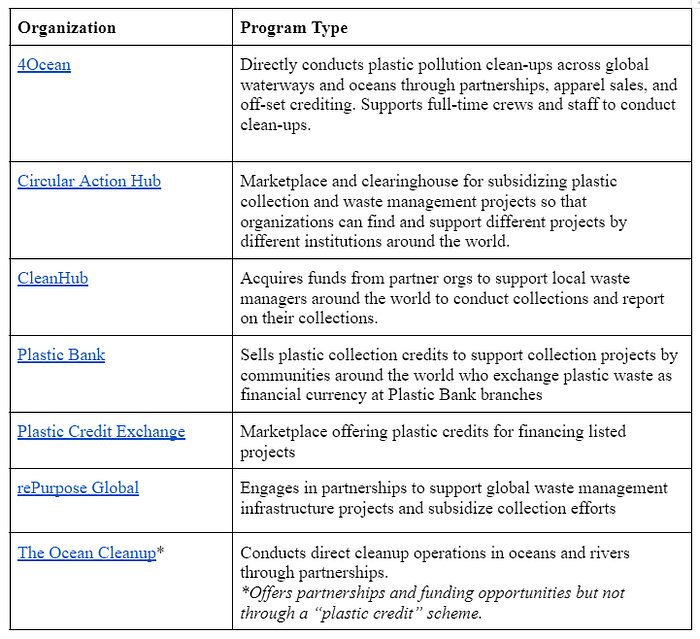
With the sale of plastic credits, two predominate organization models emerge:
- Organizations directly facilitate plastic retrieval projects with vertically integrated operations (Figure 2). This can be seen with 4Ocean and The Ocean Cleanup.
- Or, organizations financially and logistically support the development of waste management systems abroad. This contributes to collection and recycling infrastructure which remains absent or persistently weak in many developing countries. Plastic Bank, CleanHub, and rePurpose Global follow this model, acting as brokers between your organization's funds and waste management initiatives (Figure 3).
These two approaches and integration models are important to consider when deciding what kind of projects you would like to invest in. Different models require different questions about reporting techniques, worker conditions, impact measuring, and more!
Plastic credits represent an extended producer responsibility (EPR) scheme. According to the International Solid Waste Association, EPR schemes alone do not reduce waste volumes; instead, they aim to decrease the volume of materials found in final waste sinks (i.e. landfills and the environment). Therefore, in their position paper, the World Wildlife Fund outlines how the proliferation of plastic offsets and credit schemes must be matched with substantial activity by organizations to reduce their overall plastic waste. If this activity is not supported, then plastic waste will continue to grow and certifications risk sending a message that as long as a company is "plastic neutral," then there is no negative impact of their waste — this is a fallacy.
The Plastics Credit Landscape: Market Players
Ocean-Bound Versus Ocean Plastic Credits
Each year, an estimated 17.6 to 22 billion pounds of plastic debris ends up in our global oceans (UNESCO, 2022).
Ocean plastic, or marine plastic, is a type of pollution consisting of various forms of plastic debris including microplastics, shoreline plastics, sediment plastics, and sea surface plastics. According to The Circulate Initiative (TCI) there is no consistent definition of "ocean plastic," leaving companies a bit in the dark when it comes to selecting which plastic credit projects to invest in, especially given the employment of the concept of ocean-bound plastics.
Ocean-bound plastic (OBP) can be understood as land-based plastic waste that has a potential to end up in aquatic and marine systems. According to Zero Plastic Oceans, OBP is plastic that is at risk of ending up in the ocean by virtue of being "located within 50 km from shores where waste management is inexistent or inefficient." This makes "ocean-bound" a slippery term because while it sparks ideas of marine pollution and the direct endangerment of marine life, a plastic bottle 20 kilometers from the nearest shoreline can be identified as ocean-bound plastic. While all pollution is bad pollution, ocean-bound plastic marketing often relies on images of marine pollution and ocean-imbued branding which may be misleading for potential companies seeking to address pollution currently trapped in our oceans and aquatic ecosystems.
According to co-founder at rePurpose Global, Peter Wang Hjemdahl, recovering plastic currently in the ocean is 100x more expensive per ton than recovering "ocean-bound plastic."
This framing of ocean-bound plastic credits also comes down to price tags. Conducting clean-up efforts on land is considerably cheaper than actually retrieving plastic pollution from waterways and the world's oceans due to different equipment, staff, and labor demands. According to co-founder at rePurpose Global, Peter Wang Hjemdahl, recovering plastic currently in the ocean is 100x more expensive per ton than recovering "ocean-bound plastic" on land. Therefore, many organizations like rePurpose Global prioritize a mitigation framework to prevent plastic from escaping coastal regions and therefore focus plastic clean-ups efforts on land. In this framework, the drivers of ocean-based plastic are addressed, in an effort to capture pollution before it is pulled in by ocean tides.
In contrast, organizations like 4Ocean and The Ocean Cleanup are dedicated to ocean plastic clean-ups, deploying crews and technology to fish-out plastic. Specifically, 4Ocean certifies ocean plastic credits, directly pulling plastic debris from global oceans. Projects listed on clearinghouses like Plastic Credit Exchange and Circular Action Hub may have listed projects focused on ocean plastic retrieval, but this is not guaranteed nor frequent. Therefore, 4Ocean is a market differentiator when it comes to specifically offering ocean plastic credits. Currently, across position papers and other online articles, there is a disconnect in acknowledging the existence of ocean plastic credits alongside the presence of ocean-bound plastic credits. This is likely due to the current dominance of ocean-bound plastic schemes. However, these two offerings need to be further differentiated in emerging literature about plastic credits in order to best inform plastic credit pricing, standardizing language, and certification portals. While ocean-bound plastic retrievals work to prevent more waste from entering the ocean from land-based sources, tackling ocean plastic pollution directly should also remain a focal concern in order to protect ecosystems currently afflicted by pollution, safeguard food chains, combat the rise of microplastics, and more.
Benefits of Plastic Neutrality and Offsets
Plastic neutrality and plastic offsets offer innovative solutions to address the environmental challenges posed by plastic pollution. By embracing plastic neutrality, you or your organization can take proactive steps to balance the plastic footprint you generate and demonstrate your commitment to environmental responsibility and a circular economy. Both plastic neutrality and plastic offsets play pivotal roles in fostering a sense of collective responsibility, encouraging the adoption of sustainable practices, and ultimately working towards a cleaner, healthier planet. Plastic credits can also deliver on social impact when it comes to supporting the livelihoods of those working in the informal waste sector. For example, credit financing can support wages, improve working conditions, and generate more economic stability.
For your company, documented offsets and plastic neutrality certifications can serve as a market differentiator, boost brand reputation and credibility, foster new employee engagement, and even strengthen employee retention. In addition, plastic offsets can be a part of your organization's long-term strategy for sustainability-based risk management. In a world where consumers are evermore focused on environmental stability, creating a positive image as a sustainably driven company through plastic neutrality programs could be very financially beneficial in the years to come.
Carbon Credits to Plastic Credits
The concept of offsetting was made known widely to the world through carbon offset programs and the Kyoto Protocol in 1997, its objectives being to reduce GHG emissions and alleviate global climate crises (UNFCCC, 1997). The Kyoto Protocol is a first-of-its-kind international document, signed by 192 countries around the world, which requires those countries to adopt policies to mitigate greenhouse gas pollution and report back to the United Nations periodically. This protocol necessitates the creation and usage of carbon credits in order for countries–along with their largest producers and companies–to meet quotas on reducing greenhouse gas emissions (UNFCCC, 2023). Under the Kyoto Protocol, there are many options for which companies can purchase carbon credits and conduct offset programming, similar to plastic credits. Some of these projects include reforestation, expanding renewable energy use, and waste management projects. Yet, in theory, a company does not need to directly participate in these projects to qualify as a carbon-neutral company. They can purchase credits from other companies that specialize in carbon-offsetting as long as there is a viable elimination of greenhouse gasses from the atmosphere, thus creating a credit (Lee, 2021). This is similar to the developing plastic credit market with key organizations offering credits for purchase in exchange for supporting waste management initiatives.
It is important to note that plastic credits are also materially different from carbon credits because unlike carbon credits where units of carbon emissions are accepted as uniform in nature, plastic is more versatile. Plastic varies in type and durability so a "per ton" credit system for plastics may not generate equal impacts. Models for standardization are currently untangling this so that impact can be understood across industries. Plastic credits must maintain a viable measurement unit to ensure that plastic being removed offers a net positive for the environment, this also becomes murky if waste is just displaced to another area or environment (Lee, 2021).
Are there risks to the plastic credit market?
- Patchwork of standardization
- Social Risks
- Greenwashing
A new and developing market
Plastic crediting markets are developing quickly which offers potential benefits and risks. Research indicates that there has been an explosion of different guidelines, certification schemes, digital innovations, marketplaces, and standards in recent years to build out plastic credit solutions. Currently, the United Nations is working on creating member state resolutions to establish internationally binding instruments (ISWA, 2022). However, as of 2023, there is no globally aligned and recognized standard for plastic pollution reduction and credit systems. This contrasts with carbon credit markets where the Kyoto Protocol widely standardized carbon credits systems. Nevertheless, rigorous standards for this work and the plastic credit market is important. Two options for standardization include the Plastic Pollution Reduction Standard by Plastic Credit Exchange and the Plastic Waste Reduction Standard by Verra. With such a fast moving market, these standards are positive developments but remain new and have yet to see widespread deployment to certify many global projects. However, articulated in a 2022 paper published by the Deutsche Gesellschaft für Internationale Zusammenarbeit, there is a trade-off between deploying high compliance criteria and then possibly limiting the reach or activity of the market. For instance, there could be practicality issues in generating uniform plastic credits from smaller scale waste projects that would really benefit from infrastructure financing from credits.
Therefore, when you speak to different organizations, be clear about what your goals are and ask questions about transparency reporting, verification tools, and external certification models to ensure that your dollar will spark the impact you're seeking. Today, there are a number of great projects to invest in and organizations to partner with when it comes to plastic credits.
Social Risks & Greenwashing
According to a report by the Circulate Initiative (TCI), without a unifying framework for global standards, some key risks emerge from the current market including (1) unintended socio-economic repercussions and (2) greenwashing. For example, offset programs could alter local waste management sectors (for better or for worse) and may out-compete smaller existing players such as waste pickers and independent recycling groups. Therefore damaging economic opportunity in an already limited market. For horizontally integrated organizations outsourcing clean-up efforts across global projects, it will be essential for these plastic credit brokers to understand and report on the impact of their financing structures when it comes to local livelihoods, the quality and quantity of jobs created, and the conditions of new facilities. For instance, despite credit financing, will local communities only be paid if they meet a weight minimum for a day's collection efforts? These answers are not clear when reviewing many organization's websites. In addition to verifying plastic retrieval, organizations must also prioritize social transparency.
Further research must be done to understand these concerns and ensure that financing waste management infrastructure in developing countries is executed with the highest levels of due diligence. Welfare must be ensured along fragmented value chains. Communities must be protected against negative labor conditions such as forms of child labor, exposure to hazardous conditions, insufficient training, and more. Along with producing receipts of clean-ups, companies shall also document how the clean-ups occur: who is doing the collection and under what conditions. Lastly, it is critical for companies to comprehensively disclose their methods and tools for identifying, addressing, preventing, and remedying risks when it comes to their operations.
In addition to verifying plastic retrieval, organizations must also prioritize social transparency.
There are also risks of greenwashing, where companies might claim sustainability through plastic credits without supporting substantial environmental projects — undermining the market's integrity. In a similar vein, projects can suffer from impact-washing when claiming social, economic, political, or environmental impact without evidence. Therefore, it is important for companies to ensure that plastic credit impacts will be traceable, transparent, and accurate.
The Future of Plastic Credits
According to the "Breaking the Plastic Wave" report, it is estimated that by 2040 there will be a $40 billion funding gap to finance the collection and management of municipal plastic waste.
The future of the plastic credit market, though promising, is poised to encounter a variety of challenges and opportunities for development. Growing consumer awareness about environmental issues, especially plastic pollution, is set to drive demand for environmentally responsible products and services. This rising consciousness is likely to fuel a greater demand for transparency from companies that claim to offset their plastic use, thereby necessitating improvements in the plastic credit system. Consumers will continue to seek concrete proof of the impact of these credits, pushing companies towards more accountable and transparent practices. At the same time, the market faces significant challenges in the realm of auditing and assurance. A critical need exists for the establishment of unified standards for measuring and verifying plastic crediting. According to Verra, the role of independent, third-party auditors is increasingly vital to ensure the accuracy and legitimacy of claimed plastic offsets. This is essential to meet emerging challenges and maintain the integrity of the plastic credit system.
Again, for companies, participating in the plastic credits market offers a range of potential benefits, aligning with both environmental responsibility and business strategy. By matching the specific impact of their value chain, companies can purchase credits tailored to their unique environmental footprint, focusing on the polymer types and even locations most relevant to their operations. Furthermore, by financing projects that directly address the type of plastic they use and transparently communicating their involvement, companies can make credible, greenwashing-free environmental claims. Plastic credits should constitute a part of a broader plastic mitigation approach, complementing company efforts to reduce, redesign, and reuse.
Moving into the technical aspects of plastic credit verification, scholars highlight the increasing use of blockchain and other digital technologies in this domain (Budhalan et al., 2022). These innovations are crucial for enhancing the traceability and accuracy of plastic waste collection and recycling. Moreover, blockchain can leverage the inclusion of local communities in the verification process. Their active participation not only guarantees the effective execution of plastic credit projects but also ensures that these initiatives bring tangible advantages to both the environment and the local communities involved.
Regarding market growth and development, Utilities One mentions how innovations in recycling technologies are making plastic waste management more efficient and cost-effective, thereby bolstering the plastic credit market. Supportive government policies and regulations will be critical for stimulating market growth by incentivizing greater business participation and investment in plastic credit schemes. Moreover, the formation of global partnerships among governments, NGOs, businesses, and communities is vital for developing standards, building plastic credit market capacity, and tackling plastic pollution on a larger scale. Additionally, educating stakeholders about the benefits and limitations of plastic credits is imperative for the market's growth and effectiveness. This education is also critical in order to encourage robust sustainability efforts that go beyond plastic offsets.
Of all plastic ever produced, 9% has been recycled, 12% has been openly burned. The rest goes to open dumps, landfills, or the natural environment.
Transitioning to a circular economy is crucial in addressing plastic pollution and moving towards a plastic-free future. This shift entails moving away from the current linear economic model of 'take, make, dispose' to one where products are designed to be more durable, reusable, repairable, and recyclable. It also involves changing consumption patterns and rethinking societal consumerism. In a circular economy, focus will be on replacing single-use items with reusable alternatives, such as reusable coffee cups and refill stations in stores. Redesigning plastic products with recycling in mind, using single polymer plastics and eliminating toxic chemicals is also key. The European Union is at the forefront of this movement, aiming to make all plastic packaging fully recyclable by 2030.
In conclusion, the plastic credit market is at a pivotal juncture, where it is shaping and being shaped by emerging trends in sustainability, technological advancements, and international collaboration. While it faces challenges like the need for standardization and robust verification processes, the growing emphasis on environmental stewardship and innovation indicates a promising direction. Crucially, the effectiveness of plastic credits hinges on their integration into a comprehensive environmental strategy that focuses on preventing waste, reducing usage, and enhancing waste management. This robust approach is essential for ensuring the long-term viability and effectiveness of the plastic credit market in creating a cleaner and more circular global economy. Ultimately, the plastic credit market will pale if the rate of plastic consumption over time continues to grow without end.
Sources
DGB Group. (2023). The ultimate guide to plastic credits. https://www.green.earth/blog/the-ultimate-guide-to-plastic-credits
Bhubalan, K., Tamothran, A. M., Kee, S. H., Foong, S. Y., Lam, S. S., Ganeson, K., Vigneswari, S., Amirul, A.-A., & Ramakrishna, S. (2022). Leveraging blockchain concepts as watermarkers of plastics for sustainable waste management in progressing circular economy. Environmental Research, 213, 113631. https://doi.org/10.1016/j.envres.2022.113631
Jambeck, J. R., Geyer, R., Wilcox, C., Siegler, T. R., Perryman, M., Andrady, A., Narayan, R., & Law, K. L. (2015). Plastic waste inputs from land into the ocean. Science, 347(6223), 768–771. https://doi.org/10.1126/science.1260352
Lau, W. W. Y., Shiran, Y., Bailey, R. M., Cook, E., Stuchtey, M. R., Koskella, J., Velis, C. A., Godfrey, L., Boucher, J., Murphy, M. B., Thompson, R. C., Jankowska, E., Castillo Castillo, A., Pilditch, T. D., Dixon, B., Koerselman, L., Kosior, E., Favoino, E., Gutberlet, J., … Palardy, J. E. (2020). Evaluating scenarios toward zero plastic pollution. Science, 369(6510), 1455–1461. https://doi.org/10.1126/science.aba9475
Lee, M. K. K. (2021). Plastic pollution mitigation — net plastic circularity through a standardized credit system in Asia. Ocean & Coastal Management, 210, 105733. https://doi.org/10.1016/j.ocecoaman.2021.105733
OECD. (2023). Extended Producer Responsibility — OECD. https://www.oecd.org/environment/extended-producer-responsibility.htm
rePurpose Global. (n.d.). Home — rePurpose Global. Retrieved November 16, 2023, from https://repurpose.global/
The Circulate Initiative. (2021). A Sea of Plastics Claims and Credits: Steering Stakeholders Towards Impact. Circulate Initiative. https://www.thecirculateinitiative.org/projects/a-sea-of-plastics-claims-and-credits%3A-steering-stakeholders-towards-impact
The Ocean Clean Up. (2023). Ocean Plastic Explained. The Ocean Cleanup. https://theoceancleanup.com/ocean-plastic/
Toussaint, K. (2021, March 19). Plastic credits are the newest kind of pollution offset — But do they make a difference? Fast Company. https://www.fastcompany.com/90613763/plastic-credits-are-the-newest-kind-of-pollution-offset-but-do-they-make-a-difference
United Nations Climate Change. (n.d.). What is the Kyoto Protocol? | UNFCCC. Retrieved November 16, 2023, from https://unfccc.int/kyoto_protocol?gclid=Cj0KCQiAmNeqBhD4ARIsADsYfTfy5OI1KCFgyAw11Map3ig-9EdW7KsgMkMAoaDObkf6ugYL7eYLep0aArGzEALw_wcB
Utilities One. (n.d.). Circular Economy and Sustainable Solutions for Plastic Pollution. Utilities One. Retrieved December 3, 2023, from https://utilitiesone.com/circular-economy-and-sustainable-solutions-for-plastic-pollution#
Verra. (2023). Five Things You Should Know About Plastic Credits. https://verra.org/verra-views/five-things-you-should-know-about-plastic-credits/
World Wildlife Fund. (2021). WWF Position Plastic Crediting and Plastic Neutrality | Publications | WWF. World Wildlife Fund. https://www.worldwildlife.org/publications/wwf-position-plastic-crediting-and-plastic-neutrality
Zero Plastic Oceans. (2022). What Is Ocean Bound Plastic (OBP)? — Ocean Bound Plastic Certification. https://www.obpcert.org/what-is-ocean-bound-plastic-obp/
https://www.giz.de/expertise/downloads/giz2022-en-position-paper-plastic-credits.pdf
https://www.pewtrusts.org/-/media/assets/2020/07/breakingtheplasticwave_report.pdf
This article was researched and written by graduate students at the Hough Graduate School of Business at the University of Florida. Emily Lyssenko, M.S. in Business Management; Ethan Marquis, M.S. in Entrepreneurship; & Nicolas Riancho, M.S. in Entrepreneurship