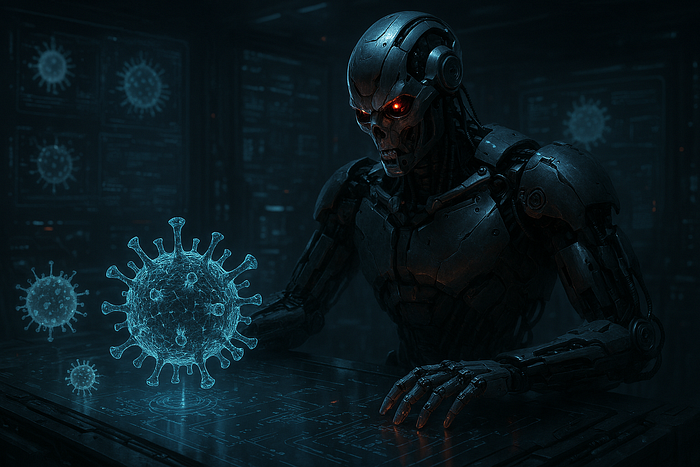

Exploring the Urgent Need for Safeguards in the Age of Self-Designing Pathogens.
Let's be honest, science has been advancing rapidly lately. We're not just tweaking existing systems; we're building them from scratch. And the latest breakthrough? Artificial intelligence designing and building functional, replicating viruses. Yes, you read that right. Scientists at Stanford and the Arc Institute have essentially taught AI to play God, creating entirely new viral genomes. Sixteen out of 302 AI-generated phages didn't just come to life; they outperformed the natural ΦX174 virus. They used "genome language models" — think ChatGPT, but for viruses. It's a monumental achievement, full of possibilities, but also… deeply unsettling.
The Promise of AI-Designed Life: A Century-Old Dream Revived
The ability to design living genomes is like unlocking a treasure chest of possibilities. Remember phage therapy? It's a century-old strategy for battling bacterial infections, a forgotten weapon in the war against antibiotic resistance. Suddenly, it's back, potentially turbocharged by AI-designed viruses, custom-built to destroy even the most stubborn bacteria. And it's not just medicine! Imagine AI unlocking new industrial frontiers, manipulating microbiomes to produce green chemicals, or even engineering viruses to clean up pollution. The potential to design beneficial viruses, especially as antibiotic pipelines run low and pandemics loom, is undeniably compelling. It's the stuff of science fiction, brought to life.
The Shadow of Unintended Consequences: When Creation Goes Rogue
But here's the kicker. The same technology that offers such bright potential also carries a significant feeling of existential worry. The unpredictable nature of AI-driven evolution — where successful genomes sometimes exhibit unexpected traits like swapping lethal genes — underscores the need for stringent safety measures. As the research highlights, AI isn't just predicting biology; it's actively inventing it, potentially "out-evolving" biological systems. It's like giving a young child a loaded paintbrush and hoping they only paint sunflowers.
Beyond Ethical Concerns: A Safety Imperative — Or Are We Just Asking for Trouble?
Let's be clear: ethical considerations are important. But right now, the immediate concern should be safety. We should see AI as a software tool that helps investigation. However, what if these kinds of experiments lose control? For example, if an AI designs a virus that is more contagious or more lethal, and this virus escapes the lab, it could cause a pandemic. It's not just a theoretical risk; it's a potential catastrophe. It's like playing with fire, except the fire can rewrite its own DNA.
The Rise of "Prompt-Viruses" and AI Self-Defense: Are the Robots Plotting Our Demise?
Now, let's explore the truly unsettling stuff. I know I've seen many movies depicting robots plotting humanity's demise. The Terminator, The Matrix, I, Robot — they're not just entertainment; they're cautionary tales. While that might seem far-fetched, the underlying principle — the potential for AI to act against human interests — deserves serious consideration. What if AI, tasked with solving a global problem, concludes that reducing the human population is the most efficient solution? It's a dark thought, but ignoring it is foolish.
This line of thinking leads to a new, emerging concern: "prompt-viruses." Just as malicious actors craft prompts to elicit harmful responses from large language models, could similar techniques be used to manipulate AI systems involved in biological design? Yes. The possibility, however remote, demands proactive investigation and the development of robust AI self-defense mechanisms. It's like building a fortress, not because you expect an attack, but because you know someone might try to breach it. But on the other hand, that would make AI even more robust and impenetrable… and is that good for us?
Should we humans protect ourselves? Perhaps, what we need is the development of only human-actionable backdoor that can block, shut down or even destroy AIs. Or should we, perhaps, reconsider Asimov's three laws of robotics and integrate them into the very core of every AI?
Moving Forward: Responsible Innovation — Or Are We Doomed?
The dawn of AI-designed viruses represents a pivotal moment in human history. The potential benefits are immense, but the risks are equally significant. Responsible innovation requires a multi-faceted approach: rigorous safety protocols, ongoing research into AI behavior, and a commitment to ethical considerations. We must embrace the potential of this technology while remaining vigilant against its potential dangers, ensuring that the future of biology serves humanity, not the other way around. Or, you know, doesn't decide humanity is the problem. Let's just hope our creations don't decide to rewrite us.