

This is an excerpt from Sky Gods and the Recipe for Immortality: The secret influence of psychoactivity over science, society, and the supernatural.
Instead of replacing humans outright, AI will likely amplify today's best biological thinkers. Thinking machines will never replace true human personality or be able to experience the mystical. Machines may one day master the material universe yet likely never the spiritual.
However, assuming AI's current limitations are a technical problem yet to be solved — will it ever become a threat to humanity? AI will significantly transform society for better and worse, and we should race to understand it fully. As the legendary science fiction writer H.G. Wells once proclaimed:
"History is a race between education and catastrophe."
Computers cannot experience the broader universe via the five senses and beyond — feeling sensations, emotions, or the ineffable. In this sense, machines cannot be sentient despite being hyper-intelligent. Computers draw from humanity's collective information on the Internet, however, cannot directly experience the mystical realities beyond.
To maintain this existential advantage, we should pursue greater critical thinking and spiritual development — and psychedelia may be a key. While being critical tools for studying consciousness, psychedelics in curated settings can potentially treat many neurological disorders. Since prehistory, psychedelia has been used as a catalyst for mystical insights.
Notably, the CEO and co-founder of the revolutionary OpenAI, Sam Altman, has co-founded a psychedelic science company called Journey Colab. It pursues medicinal applications for mescaline as its website notes:
"JOUR-5700 (Mescaline HCl) is a classic serotonergic psychedelic that binds and activates the serotonin 2a (5-HT2a receptor) in key cortical and subcortical structures associated with addiction, emotion, mood, personality, cognition, motivation, and perception. Early research suggests this activity may result in neuroplasticity and neurogenesis.
Other classic psychedelics operating on the 5-HT2a receptor have shown some early efficacy in human studies as possible treatments for alcohol use disorder and tobacco addiction, and numerous debilitating neuropsychiatric conditions, with effects that may persist for weeks or months following a single dose."
While AI emerges to transform society, psychedelics can potentially help humanity better understand our exceptional consciousness. The company additionally cites a Johns Hopkins researcher named Gul Dölen who studies psychedelic compounds such as psilocybin, MDMA, LSD, and mescaline on the human brain.
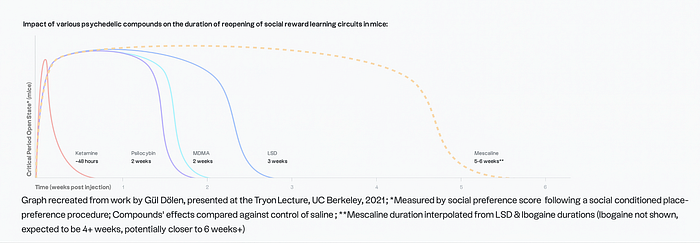
Dr Dölen's research shows that psychedelics can open a human's social reward learning critical period. OpenAI explains:
"The social reward learning circuit critical period refers to a developmental window during which the brain is especially sensitive to learning from social interactions, forming preferences, and establishing social behaviors. During this period, an individual's brain circuits are highly responsive to social experiences and environmental cues, which influence the development and organization of social behavior neural pathways. These experiences help shape an individual's social skills, preferences, and affiliations."
From Dr Dölen's psychedelic science, Journey Colab is pursuing mescaline given its exceptional therapeutical potential for reopening critical learning periods. The company further notes how mescaline via peyote cactus has been used by humans for millennia.
With AI and psychedelics in parallel, Sam Altman is leading multiple ventures that will profoundly affect human consciousness at large.

However, while artificial intelligence can increasingly mirror, amplify, and influence humanity's conscious and unconscious abilities — it cannot experience directly. What makes us exceptional is the ability to connect the unified mind fusing Jung and McKenna's collective unconscious with ancient and psychedelic wisdom.
Via electromagnetic frequencies beyond visual light, our inner minds can potentially communicate across time and space. As quantum computers, our minds may be a portal for perceiving the universe beyond — a timeless idea proclaimed by countless psychoactive shamans, priests, and prophets.
Physical eyes can only see a narrow universal window via the visible light spectrum. To compete with god-like artificial intelligence in the future, humans should seek a higher plane. After consuming mescaline, the psychonaut Aldous Huxley famously suggested that psychedelics can open human consciousness to new levels of reality.
Naturally occurring, or endogenous, psychedelic substances such as DMT in the human brain can potentially be a key. Cliff Pickover, a former Editor-in-Chief of the IBM Journal of Research and Development, once hypothesized:
"Is it possible that the reality exposed to humans by DMT usage is in some sense a valid reality, on par with our normal reality? Our minds, which evolved to help us run from lions on the African savannas, might not be engineered to see these other realities under normal circumstances.
What is the guarantee that our minds are naturally designed to sense the true reality? …Perhaps DMT is an instrument…"
Pickover additionally raised a theory that different lifestyles may affect natural DMT production (via the psychedelic pineal gland) over time:
"Maybe this is why the ancients seemed so in touch with God and miracles and visions. Maybe Moses and Jesus or certain mystics had a greater rate of pineal DMT production than most."
In the modern day, blue light exposure from computers has been scientifically shown to impact sleep quality. Therefore, blue light exposure can potentially affect natural mystical or psychedelic dream states. The scientist and ethnobotanist Dennis McKenna, Terence's renowned brother, once admonished:
"…it's likely that our ancestors had an intrinsically higher level of pineal activity, because they did not live in an environment with artificial lightning. Light destroys melatonin, and melatonin is the pineal precursor to 5-MeO-DMT…
One reason modern man is so fucked up, in my opinion, is that we never experience true (absolute) darkness; so the pineal doesn't work properly, we don't sleep properly, and don't have the rich dream life that supports that."
Sleep disorders can potentially incite significant health risks in the form of sleep paralysis — while also resulting in hallucinations rivaling the McKennaic Odysseys from psychedelic history.
Sleep paralysis has even catalyzed supernatural experiences in ancient religions as well, as the Biblical Book of Job notes:
"Now a word was conveyed secretly to me… In the thoughts of the visions of night, when slumber falls on people… a spirit passed by my face; it made the hair of my flesh stand on end…
It was standing, but I did not recognize its appearance, this image before my eyes; I heard a faint voice. Can a mortal be more righteous than God, or can a man be purer than his Maker?"
Sleep paralysis is a disturbingly common phenomenon. And like psychedelic experiences, it can be highly influenced by popular cultural ideas, ancient myths, and societal fears.
Broad cultural concerns can profoundly influence collective consciousness, as evidenced in Dr John Mack's award-winning research on children's reactions to the Nuclear Age. (In later years, Harvard heretic Mack devoted his career to studying sleep paralysis and alien experiences). In 2017, University of Maryland researchers reported:
"When humans encounter threatening scenarios such as natural disasters, pandemics or terrorism, their survival often depends on the ability to cooperate and coordinate with others. New research from the University of Maryland Department of Psychology reveals how humans actually synchronize brain waves with one another when they are exposed to these threats."
When people believe in different supernatural entities such as God, Jesus, Allah, Krishna, etc., it can further influence our innate ability to synchronize collective consciousness. Supernatural legends have defined political, social, psychological, and cultural boundaries for millennia.
Modern fears and ancient myths continuously shape collective consciousness. And perhaps in a truly psychic sense — as occultists such as Carl Jung or psychonauts such as William James have pioneered via modern psychology.
Especially accompanied by psychedelia, music has additionally been used to induce brain wave synchronization since past prehistory. In 2019, a study in Nature corroborated:
"Music synchronizes brainwaves across listeners with strong effects of repetition, familiarity and training"
History's most influential musicians have almost always been psychoactive proponents — and so have their mass crowds. In 2023, a study by Imperial College London researchers indicated the potential for combining psychedelics and music to treat depression:
"Results revealed a significant increase in music-evoked emotion following treatment with psilocybin that correlated with post-treatment reductions in anhedonia or the ability to experience pleasure."
Ritual ayahuasca use by South American tribes further validates the ancient synergy between psychedelia and music. An article published by the University of California, Riverside once reported how:
"Traditional songs, known as icaros, are part of a treatment process for men rehabilitating from drug and alcohol addictions. Combined with traditional Amazonian medicine and psychotherapy, these icaros are used during ayahuasca healing ceremonies… Ayahuasca, a plant-based psychedelic, means vine of the dead in Quechua, Perú's primary Indigenous language."

Harmine, a key psychoactive alkaloid in shamanic ayahuasca, was originally coined telepathine as it reportedly catalyzes psychic knowledge. Catalyzed by musical psychedelia, people can potentially synchronize and share knowledge across space and time. In the 1960's, a revolution resulted via this same method.
On its own, music can be psychoactive while even positively affecting biology as National Library of Medicine research once reported:
"Music by Mozart and Strauss lowered the subjects' blood pressure and heart rate, while music by ABBA did not."
Another 2019 study published in Nature further indicates music's psychic ability to catalyze neurological interconnection:
" …synchrony between classroom students' brains predicts classroom engagement."
Meanwhile, a 2023 article via New York University reported that:
"Students whose brainwaves are more in sync with their classmates and teacher are likely to learn better than those lacking this brain-to-brain synchrony…"
Our brain waves may be able to objectively sync beyond time and space, as has been indicated by prehistoric, psychedelic shamanism. Modern science is emerging to reconcile timeless, spiritual truth.
Continued: Trauma, Mysticism, and Psychedelia's Therapeutic Promise — Mystical undercurrents of personal loss, quantum consciousness, and the psychedelic renaissance.