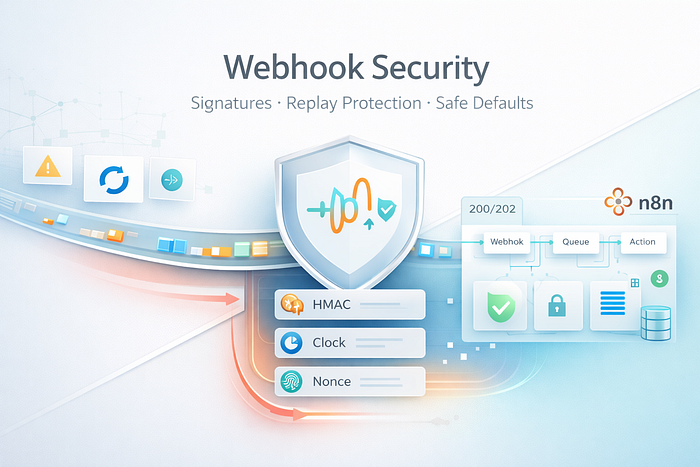

Secure n8n webhooks with HMAC signatures, timestamp replay protection, and safe defaults — plus copy-paste verification patterns you can ship today.
You might be wondering: "It's just a webhook… what's the worst that can happen?" A lot, honestly.
A webhook is basically an unauthenticated API endpoint until you prove otherwise. And n8n makes it wonderfully easy to expose one. That's the superpower — and the trap. The first time someone replays a valid payment event, or brute-forces your endpoint until your workflow queue melts, you realize "automation" is also "attack surface."
Let's fix it properly.
Why Webhooks Are a Magnet for Weirdness
Webhooks sit at the intersection of:
- the public internet (unfriendly),
- business-critical state (very friendly… to attackers),
- and "it worked in dev" assumptions (the most dangerous kind).
Common failure modes I've seen:
- A webhook URL leaks in logs or a screenshot.
- You assume POST-only, but your endpoint accepts whatever comes in.
- You verify a signature… but on the parsed body (oops).
- You handle replays accidentally (double refunds, duplicate orders).
- You return detailed error messages (free reconnaissance).
Security isn't one thing here. It's layers. Small ones. Boring ones. The kind that stay working.
Threat Model in Plain English
Before you implement anything, decide what you're defending against:
1) Spoofed requests
Someone sends a fake "order.paid" event to trigger your workflow.
2) Replayed requests
A valid request is captured and resent later (or many times).
3) Tampering in transit
Less common with TLS, but still relevant if you're validating the wrong payload.
4) Denial-of-wallet / denial-of-service
The attacker doesn't care about correctness — only about making your n8n instance busy.
5) Data exfil via responses
If your webhook responds with internal details, you're gifting context.
Now we can pick controls that map to these.
Architecture Flow: Where Security Actually Belongs
Here's a clean, production-friendly layout:
Provider ──HTTPS──> Edge (WAF / Reverse Proxy)
                      |
                      |  (rate limit, IP rules, size limits)
                      v
                 n8n Webhook Trigger
                      |
                      |  (verify signature + timestamp + nonce)
                      v
               Minimal "accept" response (200/202)
                      |
                      v
               Queue / Worker Workflow (async)
                      |
                      v
               Side effects (DB, APIs, emails)
Two principles baked in:
- Verify early. Don't run the expensive workflow until trust is established.
- Respond fast. Don't keep providers hanging while you call five downstream services.
Signatures: The Non-Negotiable Baseline
A signature answers one question: "Did the sender who knows the secret create this exact request?"
The simplest reliable pattern is HMAC over the raw request body, plus a timestamp header.
What you want in the request
X-Signature: HMAC(secret, raw_body)X-Timestamp: unix timestamp (seconds)- Optional:
X-Event-IdorX-Nonce(unique per delivery)
Common signature mistakes (aka "how it breaks")
- Signing the JSON after parsing/re-stringifying (whitespace/key order changes).
- Forgetting to include the timestamp in what you sign.
- Using
==comparison (timing leaks) instead of constant-time compare. - Logging the secret or signature in execution logs.
A good "string to sign"
Keep it stable and explicit:
string_to_sign = X-Timestamp + "." + raw_body
signature = hex(hmac_sha256(secret, string_to_sign))
This gives you tamper resistance and a replay anchor.
Replay Protection: The Part Everyone Skips (Until It Hurts)
Signatures alone don't stop replays. If an attacker captures a valid request, they can resend it forever.
Replay protection usually combines:
1) Timestamp window
Reject requests that are too old (e.g., older than 5 minutes).
2) Nonce or event-id tracking
Store a unique identifier and reject duplicates within the time window.
A simple policy:
- If
abs(now - timestamp) > 300s→ reject - If
event_idalready seen → reject - Else accept and store
event_idwith TTL (e.g., 10 minutes)
This is where people ask: "Where do I store nonces in n8n?" Let's be real — not inside the workflow if volume matters. Use Redis, a database table, or a small KV store.
Safe Defaults: Make the "Right Thing" the Easy Thing
Security wins when it's the default behavior, not a heroic effort.
Lock down the webhook surface
- POST-only (or whatever your provider uses).
- Validate
Content-Type(application/json), reject everything else. - Enforce a max body size (at the proxy if possible).
- Use a dedicated path per integration (don't reuse "/webhook/general").
Reduce information leakage
- Return a generic response:
200 OKor202 Accepted - Avoid echoing received payloads back.
- Avoid detailed error messages ("signature mismatch" is fine internally, not externally).
Rate limiting and allowlisting
If the provider has stable IP ranges, allowlist them at the edge. If not, rate limit by path and consider bot protection.
Secret hygiene
- Generate a strong secret per provider.
- Rotate secrets deliberately (support dual secrets during rotation if possible).
- Never paste secrets into nodes where they show up in logs or exports.
A Practical n8n Pattern: Verify First, Then Do Work
Here's a workflow shape that scales and stays sane:
[Webhook Trigger]
      |
      v
[Code: Verify signature + timestamp + nonce]
      |
   (valid)
      v
[Respond Immediately 200/202]
      |
      v
[Continue async: heavy processing]
Why respond early? Because many providers retry aggressively if your endpoint is slow. That turns one event into five. Then ten. Then your queue becomes a bonfire.
Code Sample: Signature + Timestamp Verification in n8n (JS)
Below is a working verification snippet you can adapt inside an n8n Code node (or wherever you validate). The key is: you must have access to the raw body. If you only have the parsed JSON, you'll need to ensure you're recreating the exact original bytes — ideally avoid that and capture raw.
const crypto = require('crypto');

function timingSafeEqualHex(a, b) {
  const aBuf = Buffer.from(a, 'hex');
  const bBuf = Buffer.from(b, 'hex');
  if (aBuf.length !== bBuf.length) return false;
  return crypto.timingSafeEqual(aBuf, bBuf);
}

const secret = $env.WEBHOOK_SECRET; // store in env, not in the node
const sigHeader = $headers['x-signature'];
const tsHeader = $headers['x-timestamp'];
const eventId  = $headers['x-event-id']; // or x-nonce if available

if (!sigHeader || !tsHeader) {
  throw new Error('Unauthorized');
}

const now = Math.floor(Date.now() / 1000);
const ts = Number(tsHeader);

// 5-minute window
if (!Number.isFinite(ts) || Math.abs(now - ts) > 300) {
  throw new Error('Unauthorized');
}

// IMPORTANT: rawBody should be the exact raw string received.
// Depending on your setup, you may need to pass it through from the webhook node.
const rawBody = $json.rawBody || JSON.stringify($json);

const toSign = `${tsHeader}.${rawBody}`;
const expected = crypto
  .createHmac('sha256', secret)
  .update(toSign, 'utf8')
  .digest('hex');

if (!timingSafeEqualHex(expected, sigHeader)) {
  throw new Error('Unauthorized');
}

// Replay protection placeholder:
// In production, check eventId in Redis/DB with TTL before proceeding.
// If duplicate → reject.
// If new → store and continue.

return [{ ok: true }];
Two comments you should not ignore:
- Raw body matters. If you can't access it, structure your signing scheme around stable canonicalization (or change how you ingest).
- Nonce storage matters. Without it, replays are still your problem.
Case Study: The "Double Refund Friday" Incident
A team wired a payment provider webhook to n8n. Everything looked fine. They verified a shared secret… but didn't implement replay protection.
A customer support agent forwarded a webhook payload in a ticket. That ticket got scraped in an internal tool. Someone curious replayed the request in Postman. Then it got replayed again during debugging. Then again.
Result: multiple refunds. A messy audit trail. A weekend spent writing compensating transactions.
What would have prevented it?
- Timestamp window (request too old → reject)
- Event-id tracking (duplicate → reject)
- Respond-fast + async processing (less provider retries)
Security isn't paranoia. It's just designing for "humans will accidentally do human things."
A Deployment Checklist You Can Actually Use
Must-have
- HMAC signature over raw body
- Timestamp window (5–10 minutes)
- Event-id/nonce replay protection with TTL
- Edge rate limiting + body size limits
- Minimal 200/202 responses, no payload echo
Strongly recommended
- Separate webhook per integration
- IP allowlist (when feasible)
- Secret rotation plan (dual-secret grace period)
- Queue heavy work; keep webhook path "thin"
- Monitor: signature failures, replay rejects, spikes in traffic
Conclusion: Secure by Default, Not by Panic
Webhook security in n8n isn't about adding one fancy node. It's about a mindset:
Verify early. Respond fast. Store nonces. Keep secrets out of the workflow.
If you've got an existing n8n webhook in production, take 15 minutes today and answer one uncomfortable question: "If this exact request is replayed 100 times, what breaks?"
Drop a comment with your webhook setup (provider + volume + freshness needs). I'll suggest a safe verification + replay strategy. Follow for more n8n hardening patterns you can ship without turning your automations into a compliance project.