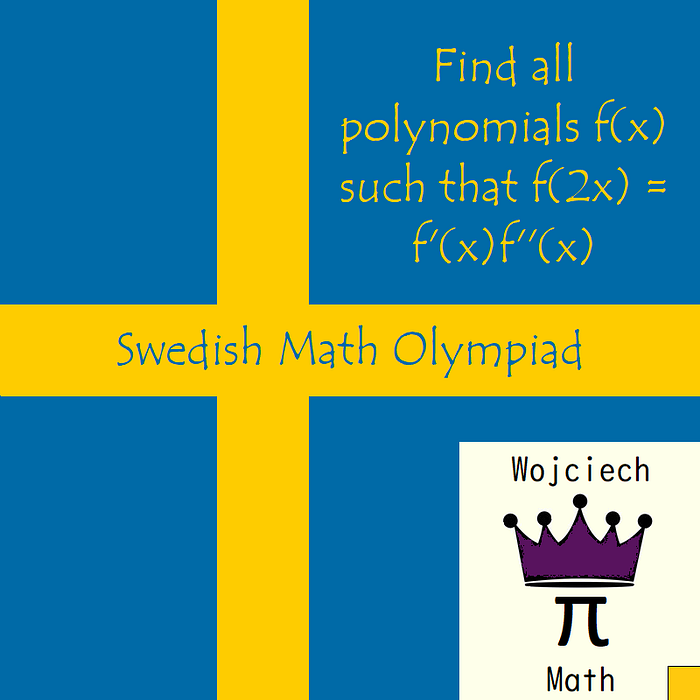


Here is a problem from the Swedish Mathematical Olympiad, sat by highschoolers in Sweden. If you've read some of my articles before, maybe you can figure this one out right away! And if not, maybe you can still figure it out? Without further ado, we begin solving this. Give the problem a try before looking at the solution!
Suppose that the polynomial is of degree n. Then comparing degrees on each side, we have that the following is true:
Which as a result means that n = 2n — 3 and thus n=3. Note that this only works if n-1 is non-zero, and so for this calculation we took n ≥ 2. In any case, we bounded the degree from above.
Before we look at the coefficients of this cubic, we point out that the solution cannot be linear, since if it was then the degree on the right would be 0, and if it is a constant a, then we have a = 0. Thus f(x) = 0 is one valid solution.
We now look at the coefficients. Set f(x) = ax³ + bx² + cx + d. Then comparing each side, we have 2³ ax³ = 18a² x³ and so a = 4/9. We carry on comparing.
The first and second derivatives are 4/3 x² + 2bx + c and 8/3 x + 2b respectively. Multiplying these, we have: 32/9 x³ + 8bx² + (8c/3 +4b²)x + 2bc. We thus have that 8b = 4b and so b = 0, consequently d = 0 which leaves us with just 8c/3 = 2c which means that c = 0 also. While this might've seemed tedious at first, it is (probably) the nicest way to do it.
Therefore, our cubic solution is just 4/9 x³, meaning we have found all of our solutions:
Did you manage to figure it out?
If you enjoyed reading the article, please consider tipping me here, it is great help!