

Simply put, advertisers compete with each other in advertising through an auction system. Advertisers with the highest bids will receive a share of the impressions on their target users. Therefore, if we are willing to place a high bid, our ads should appear to the users who are our target audience. However, it turns out that this is not entirely the case.
The formula for determining the value of our ads in an auction consists of three main matrices: the advertiser bid multiplied by the estimated action rates, plus the relevance or ad quality.

It seems quite complicated, so here is an explanation of each parameter.
First, the advertiser bid refers to the bid amount we provide to Meta to find an audience that matches our target. Since most of us do not use manual bidding, this advertiser bid amount is automatically set by Meta itself. If we are unsure of the optimal bid amount, it is better to leave the automatic bidding as is.
Next, let's discuss ad quality, as we save the best for last regarding estimated action rates. Ad quality is a factor used by Meta to optimize user experience. The explanation is as follows: Facebook, in its business, will display ads to its users. If the ads shown are poor or overly aggressive, users may leave the Meta platform, which ultimately leads to a decrease in revenue or even abandonment of the platform. Therefore, when we publish our ads, Meta will check and review them to ensure compliance with its policies. However, it does not stop there, even after our ads are approved, Meta will assign a score to our ads.
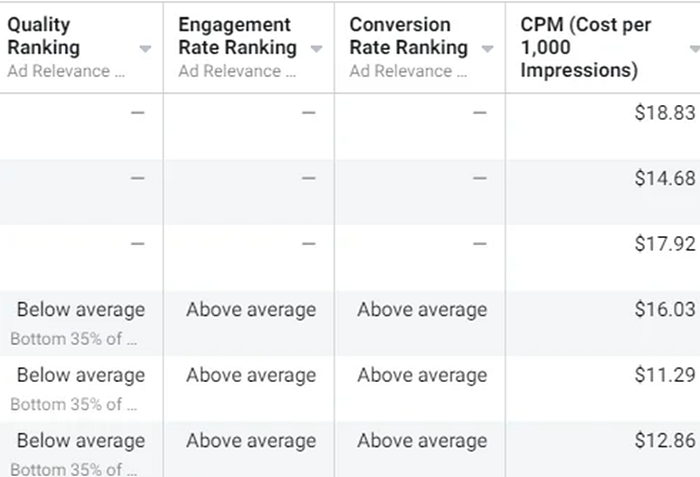
You may have seen ad metrics that provide average or above-average rankings, and there is also a feedback score based on customer feedback on our products. If our feedback score is low, the reach of our ads will be limited or may even be disabled. Thus, ad quality is closely related to interactions with the ads, such as likes, comments, watch time (for video ads), and how often our ads are hidden when displayed. Therefore, we need to create engaging content that captivates the audience. The more engagement our ads receive, the more Meta will boost our bids to help us win the auction.
The last parameter is the estimated action rate, which essentially indicates the likelihood of an action occurring as estimated by Meta. Here, it is crucial for us as advertisers to think about how to create ad content that encourages people to interact, comment, ask questions, click, or even check out from our ads. Everything should align with the objectives of each campaign.
Another important aspect is how we find the right audience for our products. For example, if we are advertising car accessories, targeting senior women would be inappropriate.
These three parameters represent three interests because, in an ad, there are three parties involved: Meta as the service provider, us as the advertisers, and finally, the users as potential buyers. Meta's interest is represented by the advertiser bid, the advertiser's interest is represented by the estimated action rate, and the user's interest is represented by ad quality. Although the weights are not balanced, the largest weights are in the advertiser bid and estimated action rate in determining the total value of our ads.
If we can win this action at the most optimal cost, the chances of achieving a winning game increase significantly. In one of its webinars. Therefore, no matter how good our content is, the ad quality score only serves as a bonus and is not a multiplier in determining the total value in an action."