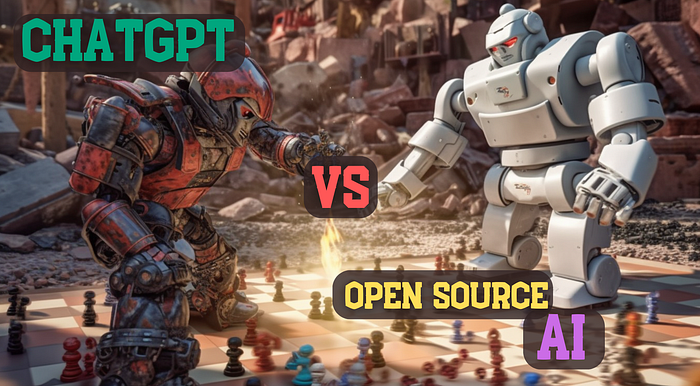

The AI Arms Race
Artificial intelligence, once a concept relegated to the realm of science fiction, has now become a defining feature of the 21st century. AI has evolved rapidly, with major tech companies like Google and OpenAI leading the charge, constantly pushing the boundaries of what's possible. However, the landscape of AI development is not solely defined by these tech giants. An often-overlooked third faction is making significant strides in the AI arms race — the open source community.
In this global quest to create intelligent machines, the stakes are high. The potential applications of AI are vast, ranging from complex problem-solving and data analysis to more creative tasks like art generation and natural language understanding. With such wide-reaching implications, it's no surprise that this has become a competitive landscape, with various players vying to develop the most advanced and adaptable AI systems.
With its collaborative nature and broad access to diverse ideas, the open source community is emerging as a potent force in AI development. Yet, the race to AI supremacy is not as straightforward as it might seem. While Google and OpenAI have undeniably made significant contributions to the field, the dynamics of the race are shifting.
This section will delve into the intricacies of this AI arms race, highlighting the competitive landscape between Google and OpenAI and how the rise of open source AI is reshaping the field. We will explore key innovations, discuss the implications for the major players, and consider the future of AI in this evolving landscape.
The Competition between Google and OpenAI
In the race towards creating the most advanced artificial intelligence, two of the most prominent contenders are Google and OpenAI. Both organizations have been at the forefront of AI research and development, consistently pushing the boundaries of what AI can achieve.
With its vast resources and deep reach into various technology sectors, Google has been a constant force in AI development. It has significantly contributed to the field, especially in machine learning, natural language processing, and autonomous systems. Google's AI arm, Google Brain, is responsible for many breakthroughs, including developing TensorFlow, a popular open-source machine learning framework.
OpenAI, on the other hand, is a younger organization that has quickly risen to prominence. Founded to ensure that artificial general intelligence (AGI) benefits all of humanity, OpenAI has made significant strides in AI research. One of its most notable achievements is the development of GPT-3, a language prediction model with impressive capabilities in understanding and generating human-like text.
The competition between Google and OpenAI is about creating the most advanced AI and defining the future direction of AI development. Both organizations have different philosophies and approaches to AI, with Google focusing on leveraging its vast resources and technology infrastructure, while OpenAI emphasizes openness and collaboration.
In early 2023, OpenAI released an advanced version of their language prediction model, GPT-3.5-Turbo. This model is capable of many of the same things as its predecessor, GPT-3, but at 10% of the price per token. It can translate languages, write essays, create poetry, summarize texts, generate ideas, answer questions, and perform specific tasks like generating Python code. OpenAI aimed to increase the utility of AI applications while allowing developers to build more economically efficient and environmentally friendly applications.
However, my research hit a few roadblocks, and I couldn't find any recent updates from Google's side to compare directly to OpenAI's advancements. Rest assured, the competition between these two giants in AI is ongoing and dynamic, with each continuously pushing the boundaries of what is possible in AI technology.
In the following sections, we'll delve deeper into the surprising revelations from the leaked Google document and the role of open source in this AI race.
How Open Source AI is Disrupting the Race
Open source AI has been making waves in artificial intelligence, challenging established players like Google and OpenAI. The notion of open source — freely available for anyone to use, modify, and distribute — is fundamentally changing the rules of the game.
The open-source community has been at the forefront of many groundbreaking developments in AI. Their philosophy of collaboration and transparency has led to rapid progress and innovation. This has resulted in open-source AI models comparable in quality to those developed by giants like Google and OpenAI. In some cases, they are even surpassing them.
At the heart of this disruption is the ability of the open-source community to quickly innovate and iterate. Open source AI models are more flexible, customizable, and, most importantly, accessible to everyone. This democratization of AI technology fosters a culture of widespread innovation and experimentation, accelerating the pace of progress in AI.
The case of Meta's LLaMA model being leaked to the public is a perfect illustration of this. Despite not having any instruction or conversation tuning, the open-source community immediately understood this capable foundation model for its potential. A flood of innovations followed, with significant developments happening within days. What was previously a considerable barrier to entry — the ability to train and experiment with AI models — was suddenly reduced to the level of an individual with a laptop and a few hours of spare time.
In the following sections, we'll explore why this rapid rise of open source AI was foreseeable, the specific techniques and strategies that have powered their success, and the implications for the future of AI development.
Open Source AI: A Third Faction
While Google and OpenAI have been dominating headlines in AI, a third faction has quietly made significant strides: Open Source AI. Open Source AI is a community-driven initiative with a fundamentally different approach to artificial intelligence development. It leverages the collective intelligence of the global community, facilitating rapid innovation and democratizing access to cutting-edge AI technologies.
In the traditional model of AI development, organizations like Google and OpenAI invested heavily in research and development to create proprietary AI models. These models, though highly effective, were often cloaked in secrecy and were not readily available for public use. This model has been a cornerstone of the AI arms race between these entities, each looking to outdo the other regarding technological advancement and market dominance.
But while Google and OpenAI focused on this competitive dynamic, Open Source AI steadily gained ground. This movement, powered by a global community of researchers, developers, and enthusiasts, has been built on transparency, collaboration, and widespread access. It represents a departure from the traditional, competitive AI development model, favouring a cooperative approach that encourages shared learning and innovation.
The promise of Open Source AI is compelling. It allows anyone from anywhere worldwide to access, use, modify, and distribute AI models, tools, and resources. This means that individuals and organizations can contribute to advancing AI technology regardless of their size or resources. It also allows for a much faster pace of innovation, as anyone in the community can make, share, and implement improvements.
The rise of Open Source AI has been driven by a combination of technological advancements, community engagement, and a changing perception of how AI should be developed and deployed. In the following sections, we will explore these dynamics in more detail and examine how they have positioned Open Source AI as a formidable player in the AI landscape.
The Rise of Open Source AI
Open source AI has been on an impressive trajectory over the past few years, and it appears to be coming to a head in 2023. The open-source community has made significant strides in natural language processing, image generation, and other AI disciplines, with several vital advancements coming from developers outside the traditional tech giants like Google and OpenAI.
In March 2023, the open-source community received a significant boost when Meta's Large Language Model (LLaMA) was leaked to the public. Despite lacking certain features like instruction or conversation tuning, the community quickly grasped the model's potential and began a rapid innovation cycle. Within a month, numerous enhancements had been made to the model, including instruction tuning, quality improvements, and even multimodal functionality. This development has significantly lowered the barrier to entry for training and experimentation with AI models, making it possible for anyone with a powerful computer to tinker with these technologies.
A key factor in the rise of open-source AI is the adoption of innovative techniques like Low Rank Adaptation (LoRA). This method, representing model updates as low-rank factorizations, allows for cost-effective and efficient model fine-tuning. This approach is compelling because it is stackable, adding various improvements incrementally to the model without requiring full retraining. As a result, as new datasets and tasks become available, the model can be updated cheaply and quickly.
Another notable trend in the open-source community is the move away from building large models from scratch. The power of iterative improvement and the lower computational requirements of smaller models drive a shift towards smaller, more manageable models that can be updated and enhanced more rapidly.
The rise of open-source AI has profound implications for the AI industry as a whole. It democratizes access to powerful AI technologies, fosters innovation, and accelerates AI development. As the open-source community continues to innovate and push boundaries, we can expect to see even more significant advancements in AI in the years to come.
Key Innovations from Open Source AI
Before we delve deeper into the discussion of foundation models on mobile devices, we must appreciate the remarkable journey that has led us to this point. The ability to run such advanced AI models on personal devices marks a significant milestone in the evolution of AI technology. It is a development that the open-source community has primarily driven.
Over the years, open source has been instrumental in breaking down barriers to AI innovation. The community has been the driving force behind many pioneering tools and algorithms that have significantly expanded the accessibility and applicability of AI. As a result, open source has democratized AI, enabling individuals and small teams to contribute to AI research and development.
The advent of foundation models on mobile devices is a testament to this democratization. By harnessing the collective intelligence of the open-source community, we are witnessing the transformation of AI from an esoteric technology accessible only to tech giants to a ubiquitous tool available to anyone with a smartphone.
The convergence of AI and mobile technology promises to revolutionize how we interact with our digital devices and has the potential to reshape various sectors, from healthcare to education and beyond. This transition symbolizes the power of open source and sets the stage for our subsequent discussion: the game-changing potential of foundation models on mobile devices. Let's delve deeper into this exciting development.
Foundation Models on Mobile Devices
One of the most remarkable breakthroughs achieved by open source AI is the implementation of Large Language Models (LLMs) on mobile devices. Users can now run foundation models on their smartphones, such as a Pixel 6, at a reasonable rate of 5 tokens per second. This advance brings AI closer to everyday users, making AI functionality accessible to a much broader audience.
But it's not just about accessibility. The convenience of having such powerful tools at our fingertips can't be overstated. The potential applications of AI are vast, from enhancing productivity tools to providing personal assistants and even transforming how we interact with our devices. As we rely more on our mobile devices, having a sophisticated AI that understands context and can respond to complex prompts becomes increasingly valuable.
Scalable Personal AI
Open source developers have also made strides in scalable personal AI. With the right tools, individuals can now fine-tune a personalized AI on their laptops in a single evening. This shift toward personal, customizable AI experiences empowers individuals, levelling the playing field in AI development.
Scalable personal AI represents a significant leap in democratizing access to AI technology. It's no longer the exclusive domain of tech giants with vast resources. Today, hobbyists, students, researchers, and small businesses can build and customize their AI models to serve their unique needs. This is causing a paradigm shift from a model where AI is a service provided by tech companies to a future where AI is a tool that's accessible to everyone.
Responsible Release
The open-source community is also pushing boundaries in the responsible release of AI models. With entire websites full of art models with no restrictions and text models not far behind, open source AI is challenging traditional models of AI deployment and raising important questions about AI's ethical and responsible use.
The open-source community's approach to the responsible release of AI models has several implications. Firstly, it democratizes access to AI, breaking down barriers and opening up opportunities for innovation. Secondly, it prompts us to rethink our assumptions about control and restriction in AI. This new paradigm emphasizes freedom, collaboration, and shared benefits over secrecy and competition. However, it also underscores the importance of responsible AI use and the need for clear guidelines and regulations to prevent misuse.
Multimodality
Finally, the open-source community has made impressive strides in multimodality — the ability for AI models to understand and generate multiple types of data, such as text, images, and sound. For instance, the current multimodal ScienceQA state-of-the-art was trained in an hour, showcasing the speed and agility of open-source AI development.
Multimodality in AI models can revolutionize how we interact with technology. As these models become more sophisticated, they can understand and respond to various inputs, from spoken words to images and gestures. This could make our interactions with technology more natural and intuitive. For example, instead of typing a search query into a search engine, you could simply show an AI model a picture and ask a question about it.
These innovations underscore the power and potential of the open-source AI community. By fostering a culture of collaboration and innovation, the open-source community is pushing the boundaries of what is possible with AI and shaping the industry's future. This has profound implications for large tech companies like Google and OpenAI, challenging them to rethink their strategies and adapt to this new landscape.
The Significance of Open Source Foundation Models: Meta's LLaMA
Foundation models like Meta's LLaMA have demonstrated the power and potential of open source AI. The model's availability started a wave of innovation and development, with new advancements emerging in just days. LLaMA leaked to the public and lacked instruction or conversation tuning and Reinforcement Learning from Human Feedback (RLHF), yet the open-source community immediately understood its significance.
Foundation models like LLaMA have an immense impact on the open-source AI community. They provide a strong base for others to build, iterate, and innovate. These models have been pivotal in developing new AI capabilities, including instruction tuning, quantization, quality improvements, human evaluations, and multimodality. These enhancements have primarily been built upon each other, creating a compounding effect that has accelerated the pace of innovation.
Another crucial factor is the democratization of AI training and experimentation. With the release of foundation models like LLaMA, the barrier to entry has dramatically decreased. Previously, such endeavours required the resources of a major research organization, but now, one person with a capable laptop can tinker with these models. This significant change has made AI experimentation accessible to more individuals, including students, hobbyists, independent researchers, and small businesses.
The success of LLaMA and other foundation models indicates a broader trend in the AI world: the move towards more open, collaborative, and community-driven development. As more and more organizations choose to open source their models, we can expect to see an even greater flurry of innovation and development in the AI space. This open-source trend will likely continue to disrupt the AI landscape, challenging traditional AI development and deployment models and creating new opportunities for innovation and collaboration.
This shift towards open-source foundation models also underscores the importance of responsible AI deployment. As AI becomes more accessible and powerful, it's crucial to consider ethical implications, such as privacy, bias, and misuse. The open-source community, emphasizing transparency and collaboration, is ideally positioned to lead the conversation on these critical topics, setting standards and best practices for the responsible use and deployment of AI.
This new era of open-source AI is marked by rapid innovation, broad accessibility, and a focus on ethical and responsible AI deployment. The rise of open-source foundation models like Meta's LLaMA signifies a fundamental shift in the AI landscape. As we look to the future, the significance of these models — and the community that supports them — cannot be overstated.
The Implications for Google and OpenAI
The rise of open source AI has profound implications for industry giants like Google and OpenAI. Despite their significant contributions to AI research and development, these organizations face a new challenge from the open source community, rapidly closing the gap in AI capabilities.
Firstly, the reality is that both Google and OpenAI are not the only players in the field anymore. The open-source community is producing AI models that are more customizable, more private, and more capable in many ways. Furthermore, these models are developed and improved rapidly, presenting a significant competitive threat.
The speed at which the open source community can iterate is a concern. With tools like low rank adaptation (LoRA), model fine-tuning can be done at a fraction of the cost and time compared to traditional methods. This means that open-source models can be updated and improved quickly, often by anyone with a capable computer and the necessary knowledge.
Another implication is the shift in the value proposition. As open-source alternatives increase in quality, potential users may not be willing to pay for restricted models. Google and OpenAI must reassess their strategies, considering where their real value add lies. This could mean a shift towards providing services or integrations that leverage their AI models rather than the models themselves.
The rise of open-source AI also brings to light the limitations of large models. While Google and OpenAI's models still hold a slight edge in quality, the document suggests that giant models could be slowing them down. In the long run, the best models are the ones which can be iterated upon quickly. This might necessitate a shift in strategy towards smaller, more agile models, which can be rapidly improved and adapted.
The overall message is clear: Google and OpenAI must adapt to this changing landscape. They must learn from and collaborate with the open-source community to stay competitive. This might involve more integrations with third-party developers, a shift in strategy towards smaller, more adaptable models, or even the release of their own open-source models.
The intensification of open source AI is not just a trend but a paradigm shift in the AI landscape. It's a wake-up call for industry giants like Google and OpenAI to adapt and innovate or risk being left behind.
The Closing Quality Gap between OpenAI/Google and Open Source AI Models
The landscape of artificial intelligence (AI) is rapidly evolving, with a significant shift in momentum toward open source AI models. These models gradually close the quality gap with the sophisticated, proprietary models developed by tech giants like Google and OpenAI. This evolution isn't a matter of chance; it's fundamentally rooted in the inherent attributes of open source projects. Let's delve into how these attributes are naturally enabling open source projects to surpass the approaches adopted by Google and OpenAI.
Community-driven Innovation
One of the most significant advantages of open source projects is the community-driven approach to innovation. Open source projects invite contributions from developers and researchers worldwide, fostering an environment of collaboration, creativity, and rapid innovation. This collective intelligence can outpace the research and development efforts of even the largest tech companies.
In the context of AI models, the open source community's diverse perspectives and expertise can lead to more innovative problem-solving strategies and model designs. For instance, an anonymous Google researcher pointed out in a leaked document that significant innovations that solved problems Google was still grappling with came from the open source community.
Speed of Development and Iteration
Another significant attribute of open source projects is the speed of development and iteration. Open source projects can integrate improvements and new features faster than large corporations, which often have to navigate through several layers of decision-making processes. A recent example is the case of LoRA (Low Rank Adaptation), a cost-effective fine-tuning mechanism enabling open source developers to quickly iterate on AI models and keep them up to date without the cost of a complete training run.
This rapid iteration can lead to the continuous improvement of AI models, enabling them to catch up with and surpass the quality of proprietary models. The leaked Google document emphasizes this point, stating that the pace of improvement from these open source models, in terms of engineer hours, vastly outstrips what can be achieved with the large models used by Google and OpenAI.
Accessibility and Scalability
Open source models have also solved the scalability issue, making it possible for anyone with an idea to tinker with AI models. The barrier to entry for training and experimentation with AI models has dropped significantly, from the total output of a major research organization to one person, an evening, and a laptop.
This accessibility and scalability not only democratize AI development but also allow for more extensive testing and improvement of models. As more individuals and organizations get their hands on these models, they can identify and rectify issues, optimize performance, and generate innovative applications that a single organization may not have considered.
The Future of AI Development
As we move forward, the advantages of open source projects in fostering innovation, accelerating development, and promoting accessibility and scalability become more apparent. These attributes have profound implications for the future of AI development, suggesting a potential shift in the AI landscape from proprietary, centralized models to open source, decentralized ones.
However, it's essential to recognize that this doesn't mean an end to the relevance of organizations like Google and OpenAI. Instead, it presents an opportunity for these organizations to learn from and collaborate with the open source community, leveraging the strengths of both approaches to push the boundaries of AI technology further. As the leaked Google document suggests, Google's best hope may be to learn from what others are doing outside the company and prioritize enabling third-party integrations.
In conclusion, the closing quality gap between OpenAI/Google and open source AI models is a testament to the power of open source projects. Their inherent attributes naturally help them out-develop the proprietary approaches, marking an exciting turn in the AI development landscape. If this trend continues, it will change how we develop AI models and potentially democratize access to high-quality AI, creating a more inclusive and diverse AI ecosystem.
The Challenge of Giant Models
Developing large-scale AI models has been embraced by tech giants such as Google and OpenAI, driven by the belief that more extensive models can offer better performance and capabilities. However, recent developments and observations have cast doubt on this strategy's long-term viability. Let's explore the challenges associated with giant models and how they might impact the future of AI development.
Resource Intensity and Inefficiency
One of the foremost challenges associated with giant models is their significant resource requirements. Training large AI models can consume enormous computational power and time, contributing to high costs and environmental concerns. Furthermore, maintaining these large models requires substantial infrastructure, making it inefficient and cost-prohibitive for many organizations and developers.
Moreover, a significant proportion of the resources invested in training these models can be wasted if improvements or updates are needed. Any iterative improvements made on top of the original model are discarded when a new model is trained from scratch. In contrast, open source projects have adopted techniques like LoRA (Low Rank Adaptation) that allow for cost-effective fine-tuning of models, preserving and building upon previous improvements.
Slowed Pace of Innovation
Giant models can also impede the pace of innovation. Due to their large scale, these models are often slower to train and fine-tune, leading to more extended development and iteration cycles. This contrasts smaller models in the open source community, which can be rapidly updated and improved, enabling them to catch up with and surpass the quality of larger models over time.
Limited Accessibility and Scalability
The large scale of these models can also limit their accessibility and scalability. Training and fine-tuning large models require specialized hardware and infrastructure that may not be accessible to many developers and organizations. This can create barriers to entry and limit the potential for widespread adoption and innovation.
On the other hand, the open source community has made significant strides in making AI models more accessible and scalable. The leaked Google document pointed out that they have solved the scalability problem so anyone can tinker with AI models.
The Path Forward
While these challenges might seem daunting, they also present opportunities for reevaluation and innovation. The increasing difficulties associated with giant models should prompt organizations like Google and OpenAI to reconsider their strategies and explore more efficient and accessible approaches.
For instance, they could consider adopting techniques like LoRA for fine-tuning their models or invest in more aggressive forms of distillation that allow them to retain as much of the previous generation's capabilities as possible. They could also seek to learn from the open source community, which has demonstrated the potential of smaller, more agile models.
Giant models have played a crucial role in pushing the boundaries of AI capabilities. Their associated challenges raise important questions about the sustainability of this approach. Looking forward, the AI community will need to balance the pursuit of large models with considerations of efficiency, accessibility, and pace of innovation, potentially marking a shift towards smaller, more adaptable models.
Reimagining the Competitive Advantage: Drawing Inspiration from Open Source AI
As the landscape of AI continues to evolve rapidly, tech giants like Google and OpenAI are prompted to reassess their strategies and competitive advantages. With its culture of collaboration and rapid innovation, the open source community offers valuable insights that can help redefine these organizations' 'secret sauce'.
Embracing Collaboration Over Competition
One of the defining features of open source projects is their collaborative nature. The open source community thrives on sharing knowledge and building upon each other's work, leading to an impressive pace of innovation. This contrasts with the traditional competition model, where organizations independently develop their proprietary technologies.
The recent developments in open source AI models have highlighted the power of this collaborative approach. By building upon a foundation model, the community could quickly introduce various improvements, from instruction tuning to quality enhancements, in weeks. This fast-paced innovation suggests that collaboration, rather than competition, could be a more effective strategy for advancing AI capabilities.
Organizations like Google and OpenAI can benefit from adopting a more collaborative stance by actively learning from and integrating open source projects into their work. As the leaked Google document suggested, their best hope is to learn from what others are doing outside of Google and prioritize enabling third-party integrations.
Learning from Open Source Innovations
Open source AI projects have demonstrated impressive advancements in model fine-tuning techniques and scalability, outpacing the developments of Google and OpenAI. For example, the Low Rank Adaptation (LoRA) technique allows for cost-effective and efficient model fine-tuning, enabling rapid updates and improvements to model.
These innovations provide valuable lessons for Google and OpenAI. Rather than focusing on developing large models, these organizations could consider embracing techniques like LoRA that allow for cheaper and faster model fine-tuning. They could also learn from the open source community's solutions to scaling problems, such as making AI models accessible and tinker-friendly for anyone with a beefy laptop.
Reconsidering the Value Proposition
The rise of open source AI models also calls for a reassessment of the value proposition of tech giants like Google and OpenAI. As the quality gap between proprietary and open source AI models closes, users are less likely to pay for a restricted model when free, unrestricted alternatives of comparable quality are available.
Moving forward, these organizations must consider where their value-add lies. This could involve providing value-added services on top of the base AI model, such as specialized applications, user support, or data privacy and security measures.
In summary, as the open source AI community advances rapidly, Google and OpenAI can reimagine their competitive advantage by drawing inspiration from open source innovations, embracing a collaborative approach, and redefining their value proposition. The future of AI development may well be defined by a more relaxed and collaborative model, driving faster innovation and broader accessibility.
The Transformation of the AI Landscape: A Retrospective
The AI landscape has transformed dramatically, driven by groundbreaking advancements, paradigm shifts, and the rise of unexpected players. Understanding this transformation can inform the way we navigate the future of AI. In the constantly evolving realm of artificial intelligence, a retrospective look at the journey so far can offer invaluable insights.
Over the past decade, we've witnessed a shift from proprietary, closed-source models developed by tech giants to open source models created, refined, and shared by a global community of developers. This democratization of AI technology has enabled rapid advancements and unprecedented accessibility.
From the release of sophisticated models by organizations like Google and OpenAI to the democratization of AI through open source projects, the transformation of the AI landscape has been profound. However, the journey has not been without its challenges. The shift toward open source AI has raised questions about the role of large tech organizations, the value of proprietary models, and the ethical considerations surrounding AI technology.
In this section, we'll delve into the key milestones that have marked the evolution of AI, the pivotal role of open source projects in propelling AI advancements, and the implications for the future of this exciting field. We'll also reflect on the challenges and opportunities this transformation has presented to established tech giants and the broader open source community.
The LLM Renaissance: Following the Path of Image Generation
The rise of large language models (LLMs) has been a transformative event in artificial intelligence, echoing the earlier renaissance witnessed in image generation. While distinct, these two areas of AI share similar trajectories and turning points that have shaped their evolution and impact on the world.
In the past, image generation was the exclusive domain of high-end graphic designers and specialized software. However, the advent of open-source image generation models, like StyleGAN and its successors, has democratized the ability to create stunningly realistic images. A pivotal moment in this journey was the development and open-sourcing of the Stable Diffusion model, which propelled the image generation field forward with a flurry of new ideas, user interfaces, and product integrations from individuals and institutions around the world. This rapid innovation in the open-source community outpaced the proprietary models, like Dall-E from OpenAI, shifting image generation's cultural impact and relevance.
Today, we are witnessing a similar renaissance in the realm of LLMs. The open-source community's access to a high-quality foundation model, like Meta's LLaMA, has sparked an outpouring of innovation comparable to the Stable Diffusion moment in image generation. Similar to the image generation field, a flurry of ideas and iteration from the global community has quickly outpaced the advancements made by large tech organizations, including Google and OpenAI.
The open-source LLMs, enhanced with new capabilities such as instruction tuning, quantization, and quality improvements, have brought AI technology into the hands of ordinary people. These advancements have lowered the barrier to entry, allowing anyone with a computer and an idea to experiment with LLMs. This democratization of AI technology is significantly changing the dynamics of the AI landscape, much like the transformation witnessed during the image generation renaissance.
Furthermore, the breakthroughs in scale, such as the Chinchilla model for LLMs and the latent diffusion technique for image synthesis, combined with fine-tuning mechanisms like low rank adaptation (LoRA), have played a crucial role in both image generation and LLM renaissances. These techniques have significantly reduced the cost and complexity of fine-tuning, thereby enabling low-cost public involvement and rapid advancements.
In sum, the renaissance in LLMs follows a similar path to the previous renaissance in image generation. The similarities between these two journeys underscore the transformative potential of open-source AI models and the pivotal role of the global developer community in driving rapid innovation and democratization in AI. As we look toward the future of LLMs, we expect to see even more groundbreaking advancements inspired by the path forged by image generation.
The "Stable Diffusion Moment" for LLMs: A Comparative Analysis
The "Stable Diffusion moment" is a term that has emerged from the AI community to encapsulate a specific point in the trajectory of an open-source AI technology when it starts to outpace and eclipse proprietary models in terms of innovation, accessibility, and cultural impact. It's a nod to the point when open-source image generation models, specifically the Stable Diffusion model, began to dominate the field, leaving behind proprietary models like OpenAI's Dall-E. This moment marked a shift towards a more democratized and rapid pace of development in the AI image generation space. Many believe we are witnessing a similar moment for Large Language Models (LLMs).
To understand the significance of this moment, we must first understand the transformational impact of the Stable Diffusion model in the image generation field. The release of the Stable Diffusion model into the open-source community was a watershed moment. It triggered a cascade of innovation, with individuals and institutions worldwide iterating on the model. This led to unsuccessful product integrations, user interfaces, and novel applications with Dall-E. The open-source nature of the Stable Diffusion model allowed for rapid experimentation and improvements, leading to a proliferation of high-quality image generation applications.
The "Stable Diffusion moment" for LLMs is the point at which the open-source community's access to a high-quality foundation model, such as Meta's LLaMA, and its subsequent iterations outpace the proprietary models of Google and OpenAI. This moment is marked by a rapid surge of innovation from the open-source community, characterized by advancements in instruction tuning, quantization, quality improvements, and more, many of which build upon each other.
Moreover, this moment in LLMs is powered by a significant breakthrough in scale, the Chinchilla model, which mirrors the role of latent diffusion in the image generation field. Similarly, adopting low rank adaptation (LoRA) for fine-tuning, a vastly cheaper mechanism that enables low-cost public involvement is a common factor in both these moments.
In the "Stable Diffusion moment" for LLMs, the models become more accessible, customizable, and innovative. They begin to dominate the AI landscape regarding cultural impact, much like the Stable Diffusion model did in image generation. This moment underscores the powerful potential of open-source AI, where the global community of developers, armed with the right tools and a high-quality foundation model, can rapidly innovate and democratize AI technology.
In conclusion, the "Stable Diffusion moment" for LLMs signifies a turning point in the AI landscape. It marks the transition from proprietary models dominating the field to open-source models driving the pace of innovation. The comparison to the image generation field provides a blueprint for what we can expect as LLMs evolve in the open-source community, including rapid advancements, broad accessibility, and a significant cultural impact.
Technological Innovations and Their Impact
As we delve further into the transformative potential of open-source AI, it's crucial to understand the technological innovations that have enabled these dramatic shifts. Each advancement, each new algorithm, and each novel approach to problems can have profound effects, often shifting the landscape of AI development and pushing the boundaries of what's possible. From the release of powerful foundation models to the development of fine-tuning techniques like low rank adaptation (LoRA), the open-source community has introduced a wave of innovations that have challenged established norms and redefined the trajectory of AI. This section will explore key technological innovations that have shaped the current AI landscape and their significant impacts on the open-source community and the broader AI field.
The Role of Low Rank Adaptation (LoRA) in Fine Tuning AI Models
One of the most impactful innovations in the current AI landscape has been developing and adopting Low Rank Adaptation (LoRA). This technique has redefined how we fine-tune AI models, significantly reducing the cost, time, and computational resources needed and democratizing the process like never before.
LoRA works by representing model updates as low-rank factorizations, dramatically reducing the size of the update matrices by a factor of up to several thousand. This means that the resources required for model fine-tuning, which used to be a significant barrier to entry, are drastically reduced. The result? Model fine-tuning can now be executed at a fraction of the cost and time, even on consumer hardware.
This has led to a seismic shift in the AI landscape, as AI fine-tuning is no longer the exclusive domain of major research organizations. Now, with a beefy laptop and a few hours to spare, even a single individual can fine-tune and personalize a language model. This development has enormous implications for AI applications that incorporate new and diverse knowledge in near real-time.
LoRA's impact extends beyond just the democratization of AI fine-tuning. As an example, it has proven to be incredibly effective because, like other forms of fine-tuning, it's stackable. This means improvements like instruction tuning can be applied and then leveraged as other contributors add on dialogue, reasoning, or tool use. The individual fine-tunings might be low rank, but their sum need not be. This enables full-rank updates to accumulate over time, keeping the model updated with new datasets and tasks without ever having to pay the cost of an entire run.
In the open-source world, this approach has allowed for rapid iteration and the compounding of improvements, putting these models on a fast track to outperform larger models trained from scratch. In terms of engineer hours, the pace of progress of these models vastly outstrips what larger organizations can achieve with their giant models.
The adoption of LoRA has been a transformative factor in the open-source AI community. It's a testament to the power of innovative thinking and the benefits of a community that can quickly adopt and implement new ideas. LoRA and similar innovations will continue to play a crucial role in shaping the AI landscape as we move forward.
Why Retraining Models from Scratch Might Not Be the Best Approach
The traditional approach of training AI models has often involved starting from scratch each time a new application or idea is to be implemented. This requires significant computational resources and discards the invaluable insights and iterative improvements made on the pre-existing models. Recent developments in the AI landscape have shown that this might not always be the most efficient or effective approach.
One of the key reasons why retraining models from scratch may not be ideal lies in fine-tuning techniques like LoRA. The stackable nature of these fine-tunings allows for improvements to be built upon one another, resulting in cumulative, full-rank updates to the model over time. As new datasets and tasks become available, the model can be updated quickly and cheaply without needing an entire run.
By contrast, training giant models from scratch discards the pre-existing model's base and the iterative improvements made. In the open-source world, it doesn't take long before these iterative improvements dominate, making a full retrain highly costly. Moreover, the time and resources required to retrain large models from scratch can significantly slow the pace of innovation and limit the ability to respond swiftly to new developments.
A more efficient approach might be considering whether each new application or idea needs a new model. Suppose significant architectural improvements are required that preclude directly reusing model weights. In that case, more aggressive forms of distillation that retain as much of the previous generation's capabilities as possible should be considered. This approach not only preserves the insights gained from previous iterations but also allows for more rapid adaptation and evolution of the model.
Ultimately, the goal is to find a balance between preserving the value of past work and embracing new ideas and approaches. As the open-source community has demonstrated, quick and iterative improvements often lead to faster progress and superior results than starting from scratch each time. This lesson is worth learning as we continue to innovate and push the boundaries of what AI can achieve.
The Advantage of Rapid Iteration on Small Models
A counterintuitive yet powerful reality has emerged in the AI world: smaller models, when iterated upon quickly, can outpace their larger counterparts regarding capability and performance. This is a direct result of the open-source AI community's ability to rapidly iterate on models, fine-tuning and improving them through a series of low-cost, stackable updates.
Techniques such as LoRA updates to smaller models can be produced at a fraction of the cost of training large models, making them more accessible to a broader range of developers. This democratization of AI development has led to a surge in innovation, with many diverse ideas being tested and implemented. The result is a fast-paced cycle of improvement that, over time, can rival and surpass the capabilities of much larger models.
The ability to iterate quickly on smaller models also means that they can be kept up-to-date with the latest datasets and tasks, enhancing their performance and relevance. Importantly, these models can also be personalized, allowing them to be adapted to specific applications or user needs, increasing their utility and effectiveness.
Furthermore, the rapid pace of iteration reduces the risk associated with each update, as any issues or problems can be quickly identified and rectified in the next iteration. This contrasts with the high-stakes nature of extensive model development, where issues can take longer to surface and be more difficult to resolve due to the complexity and size of the models.
Moreover, the pace of improvement from these small models, in terms of engineer hours, vastly outstrips what can be achieved with more significant variants. The best smaller models are already essentially indistinguishable from larger models, such as ChatGPT, suggesting that the quality gap is closing at an astonishing rate.
In conclusion, the rapid iteration of small models represents a paradigm shift in AI development, providing a more efficient, flexible, and dynamic approach to enhancing AI capabilities. As the AI landscape continues to evolve, it is increasingly clear that the key to success lies in the models' size, development speed, and agility.
The Future of AI: A New Paradigm
As we look to the future of artificial intelligence, it is clear that the landscape is evolving in ways that challenge some of the traditional paradigms of AI development. The rapid progress of open-source AI projects, the closing quality gap with large corporations like Google and OpenAI, and the shifting focus towards rapid iteration and smaller, more flexible models are all indicators of a new era in AI. In this new paradigm, the power dynamics are shifting, with open-source projects and the broader AI community playing a more significant role. In this section, we will delve into what this new paradigm might look like and how it might shape the future of AI.
Predicting the Next Shift in the AI Landscape
As the adage goes, "Change is the only constant," which rings true even in artificial intelligence. Predicting the precise trajectory of such a rapidly evolving field is a formidable challenge. Still, some key trends provide insights into the possible shifts we may witness shortly.
- Decentralization of AI Development: The democratization of AI technologies, spurred by open-source models and tools, signifies a shift from the monopoly of tech giants to a more decentralized ecosystem. This new paradigm will likely foster increased innovation, as a diverse pool of developers worldwide will be able to contribute their unique perspectives and expertise.
- Rapid Iteration and Customization: The rise of low- Rank Adaptation (LoRA) that allows for rapid model fine-tuning and customization will continue transforming AI development. With the ability to refine models quickly and cost-effectively, we can expect a surge in novel AI applications tailored to specific use cases or user needs.
- Sustainability and Efficiency: As the industry reckons with the environmental impact and computational cost of training large AI models, there will be a stronger push towards more sustainable and efficient practices. This shift might involve embracing smaller models that can be iterated upon quickly or exploring alternative training techniques that reduce the need for massive compute resources.
- Collaborative Learning: Learning from and collaborating with the broader AI community will be crucial as the AI landscape becomes more diversified. Corporations will need to move away from a proprietary mindset and embrace the collective intelligence of the open-source community, which will result in a more robust and innovative AI ecosystem.
- Ethics and Responsibility: With AI technologies' rapid development and deployment, ethical considerations will play an increasingly important role. Open-source projects can lead the way in developing and implementing robust ethical guidelines, fostering a culture of responsibility in AI development and use.
These trends point towards an AI landscape that is more inclusive, dynamic, and sustainable. While the path ahead is rife with challenges, it also holds immense potential for innovation and growth. As we navigate this new era of AI, embracing change and fostering collaboration will be key to unlocking the full potential of artificial intelligence.
The Continued Impact of Open Source on AI Development
The open-source paradigm has already left an indelible mark on the AI landscape, transforming how we develop, distribute, and use AI technologies. Looking ahead, the influence of open source on AI development is set to continue and possibly intensify.
- Increased Innovation: The open-source community is a hotbed of innovation, where countless developers and researchers contribute their unique perspectives and expertise. This collaborative environment, coupled with the open nature of the code and models, will continue to fuel rapid innovation in AI technologies. We can anticipate new methods, applications, and tools emerging at an accelerated pace, driven by the collective intelligence of the open-source community.
- Democratization of AI: Open source has made AI technologies accessible to a broad array of users, from hobbyists to small businesses, breaking down barriers to entry. This trend will likely continue, fostering a more inclusive and diverse AI landscape. As a result, AI technologies will not only be shaped by the few but will reflect the needs and perspectives of many, leading to more versatile and inclusive AI systems.
- Standards and Best Practices: As the open-source community grows and matures, it will play an increasingly important role in establishing standards and best practices for AI development. These could include guidelines for model training, fine-tuning, deployment, and ethical considerations. The open nature of the community fosters transparency and accountability, which are crucial for building trust in AI systems.
- Resilience and Adaptability: The decentralized nature of open-source development contributes to the resilience and adaptability of AI technologies. Rather than relying on a single entity, the development and maintenance of open-source AI projects are distributed across a global network of contributors. This decentralization allows for swift adaptation to new challenges and trends, ensuring open-source AI technologies' continued evolution and relevance.
- Education and Skill Development: Open-source projects provide valuable learning resources for those looking to develop their skills in AI. As more individuals and institutions turn to open source for education and training, we can expect a growing talent pool equipped with the latest knowledge and skills, further propelling the advancement of AI.
In short, the continued impact of open source on AI development will be multifaceted, driving innovation, democratization, standardization, resilience, and education in the AI field. As we move forward, the open-source ethos of collaboration, transparency, and inclusivity will be more vital than ever, shaping the future of AI in ways we can only begin to imagine.
Conclusion: Embracing the Open Source AI Revolution
As we reflect on the rapidly evolving landscape of AI, the rise of open source is a transformative trend that cannot be overlooked. Open source is not just a movement; it's a paradigm shift changing how we approach AI development, distribution, and usage.
The open-source community has already demonstrated strength in driving innovation, democratizing AI technologies and fostering a culture of collaboration and transparency. Its role in the future of AI is poised to be even more significant. As we have explored in this article, the open-source approach has the potential to outperform traditional proprietary AI models in terms of quality, speed of development, and adaptability. The key lies in the strength of collective intelligence, the ability to iterate quickly, and the freedom to experiment and innovate.
It's also clear that major AI players like Google and OpenAI can learn valuable lessons from the open-source model. Embracing open source does not mean abandoning proprietary models but rather augmenting them with the open-source community's innovative spirit and collaborative ethos. Rather than viewing open source as a threat, it can be seen as a wellspring of ideas and a catalyst for growth.
AI's future is exciting, and it is increasingly evident that open-source principles will heavily influence this future. As we look ahead, we must remember that AI is not just about technology. It's also about the people who create, use, and are affected by it. By championing open source, we can ensure that the future of AI is shaped by diverse voices and perspectives, fostering a more inclusive, innovative, and impactful AI landscape.
In conclusion, the open-source revolution in AI is well underway. It's an exciting time to be part of this dynamic field, and we all have a role in shaping its future. Let us embrace the opportunities that open source presents and continue to push the boundaries of what is possible with AI.