

This is the fourth of what I expect will likely become a long series of posts about fake quotes attributed to famous philosophers.
I started with one focused on things that Aristotle never said, and then followed up with another going through some egregiously fake Plato "quotes". The next one was on fake quotes from Marcus Aurelius. After that, I decided we should look at another Stoic philosopher who often gets attrbituted things he didn't say (including by people and organizations that claim to be "Stoic"). That's Epictetus
Here's the video I produced going through the ten Epictetus fake quotes discussed below.
There's an important difference between the earlier fake quotes videos — where all of those made up passages or misattributions are precisely that — and some of the fake quotes in this video.
Strictly speaking, they are "fake quotes", since they're not passages that we find in the actual works of Epictetus's teachings recorded by his student Arrian, i.e. the Discourses and Enchiridion (a number of the "Fragments" are kinda sketchy, as is the mishmosh that gets called the "Golden Sayings"). But they sometimes do have some basis in some things Epictetus did say.
You see, they're what we can call glosses or paraphrases. And they all come from one book relatively recently published, Sharon Lebell's The Art of Living: The Classical Manual on Virtue, Happiness, and Effectiveness. Lebell read Epictetus, found his teachings useful, and then decided to write a book that adds a lot of her own ideas and phrases into the mix. It's not a faithful translation of Epictetus by any means. It's rather a "new interpretation", as it says right on the book cover. And at times, it is quite an inventive interpretation.
Unfortunately, a lot of readers seem to have assumed that Lebell's book accurately conveys what Epictetus actually taught, and then they quoted Lebell, never bothering to actually check those passages against the real texts we possess. So a number of fake quotes, many of which are clearly things that — given the mindset conveyed by what he did say — are at odds with Epictetus' own Stoic teachings. And they rely upon late modern sentiments, assumptions, and language that tells you it's not Epictetus, but rather Lebell.
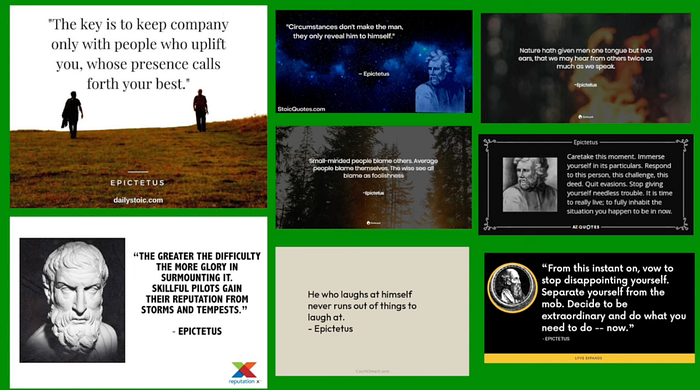
Here are the ten fake quotes that strike me as the most eggregious and commonly quoted.
- "The greater the difficulty, the more glory in surmounting it. Skillful pilots gain their reputation from storms and tempests"
- "Either God wants to abolish evil, and cannot; or he can, but does not want to"
- "Circumstances don't make the man, they only reveal him to himself"
- "Nature has given to men one tongue, but two ears, that we may hear from others twice as much as we speak"
- "He who laughs at himself never runs out of things to laugh at"
- "The key is to keep company only with people who uplift you, whose presence calls forth your best"
- "Caretake this moment. Immerse yourself in its particulars. Respond to this person, this challenge, this deed. Quit evasions. Stop giving yourself needless trouble. It is time to really live; to fully inhabit the situation you happen to be in now"
- "From this instant on, vow to stop disappointing yourself. Separate yourself from the mob. Decide to be extraordinary and do what you need to do — now."
- If you want to live a wise life, live it on your own terms and in your own eyes"
- "Small-minded people blame others. Average people blame themselves. The wise see all blame as foolishness"
The first two of these fake quotes are rather funny, because they both derive from literature that is either inspired by, or citing (in order to argue against) someone who founded the single philosophical school that Epictetus displays the most contempt for, the Epicureans! Incidently, because the two names are rather similar, lazy or sloppy writers on the internet will often mix up Epictetus and Epicurus, and use the hedonist philosopher's image in place of the Stoic who lived centuries later.
Who is the first quote from? Charles de Saint-Évremond, who wrote a work called An Essay on the Vindication of Epicurus and his Doctrine. What about the second quote? It's right out of the early Christian thinker Lactantius' work On The Anger of God, who attributes an argument from the existence of evil to Epicurus (which could very well be the case, since we have lost nearly everything Epicurus wrote).
The third fake quote is from an early 20th century self-help book, As A Man Thinketh, authored by James Allen. As we have seen with the earlier videos on Plato, Aristotle, and Marcus, it's common enough for passages from 19th and 20th century self-help works to somehow get morphed and misattributed into quotes that supposedly derive from ancient authors. And once it happens, as these quotes wend their ways through the internet, hardly anyone who shares them bothers to check the supposed sources.
The fourth fake quote is at least from a source that is a member of the Stoic school. In fact, it is attributed to the founder of the school himself, Zeno of Citium, a fragment preserved by the anthologist Joannes Stobaeus. Unfortunately, George Long in translating those fragments mistakenly attributed the passage to Epictetus. Why? Who knows? But it's Zeno, not Epictetus. And now that you know. . .
We don't know where the fifth fake quote originates from, but you're not going to find it in the works of Epictetus. It seems like the sort of witticism that would have been popular and then circulated around anytime during the 18th to the 20th century.
And now we come to the fake quotes that Sharon Lebell bears indirect responsibility for. Ideally, what we would see that author doing is claiming them as her own, and telling people who attribute them to Epictetus that they've got things wrong. Numbers six through ten are all from her paraphrases and additions contained in The Art of Living. Or, at least it seems they are. . . (see number 8 below).
In his Enchiridion, Epictetus does tell us that who we choose to keep company with is important, but his emphasis is upon avoiding the influence of those who will bring us down. He certainly doesn't use aspirational, new-agey jargon like people who uplift you" or "whose presence calls forth your best". Number six is all Lebell.
Similarly in the Enchridion, Epictetus says something tangentially related to the seventh fake quote. He notes that the time to improve oneself is now, and asks how long his interlocutor will keep on delaying. There's no way Epictetus, or any ancient Stoic would suggest we "caretake this moment" or "fully inhabit the situation". Again, this idea is all Lebell. Or perhaps if you wish to cast the net wider, it expresses self-helpy, new-ager, crunchy-granola sentiments of certain segments of late modern culture.
Number eight sounds like something along those lines as well, doesn't it? But this one is a bit different, because "decide to be extraordinary and do what you need to do — now" sounds a bit like the passage "people do not decide to become extraordinary. They decide to accomplish extraordinary things". That latter one comes from a Rolex advertisement. It is attributed in that ad to the famous mountain-climber Edmund Hillary. Did he actually say it? I don't know. But I do know that none of this stuff in fake quote number eight comes from Epictetus
I'm starting to sound a bit like a broken record at this point, but I'll point out once again that in fake quote number nine, once again, Lebell places in Epictetus mouth ideas that he might have gagged on a little and spit out. There's nothing about living a life "on your own terms and in your own eyes" that guarantees you're going to live a "wise life", an expression, by the way Epictetus never uses. In fact, unless you are already wise, you're pretty likely to screw your life up worse than it already is by insisting on your own terms!
And finally, we come to number ten. This one at least is derived from something Epictetus does say in the Enchiridion, since he does tell us that an uninstructed or uneducated person will blame others for their own bad condition, that someone making progress will blame themself. And an educated or wise person will not blame others or themself.
Lebell either mistranslated, misunderstood, or deliberately distorted this passage in her book, changing it to this: "Small-minded people habitually reproach others for their own misfortunes. Average people reproach themselves. Those are are dedicated to a life of wisdom understand that the impulse to blame something or someone is foolishness". And then someone else came along and abbreviated her own mistaken reinterpretation in the shorter fake quote: "Small-minded people blame others. Average people blame themselves. The wise see all blame as foolishness"
Now you could perhaps argue that an uneducated person will be "small-minded", but that isn't what Epictetus actually says. And it would be weird from a Stoic perspective to equate being a person making progress with being "average". And Epictetus doesn't actually say "the wise", but rather "the educated", perhaps because for actual Stoics, there aren't a lot of wise people around. In fact, there's a debate about whether there are in fact any!
So there you go. Ten more fake quotes that are unfortunately circulating and getting continually reshared all over the internet. But now you know, and since you do, you can avoid falling into the foolishness of relying upon them as if they were real.
If learning about these fake quotes that are definitely not from Epictetus has you now interested in Stoicism, and you would like to know what texts by and about the ancient Stoics are out there where you can find all sorts of real passages, well, then, this piece might be helpful for you!
Gregory Sadler is the president of ReasonIO, a speaker, writer, and producer of highly popular YouTube videos on classic and contemporary philosophy. He is co-host of the radio show Wisdom for Life, and producer of the Sadler's Lectures podcast. If you'd like to support his ongoing work, bringing philosophy to the broader public, he has a Patreon site where you can donate. You can also donate at Buy Me A Coffee.