
New Transformer in Data Science world. MIT's Generative AI for Databases. GenSQL is new gem for generative AI. Overview of GenSQL
Hey there, tech enthusiasts! Today, we are diving into a fascinating new tool that's making waves in the world of data science and machine learning. It's called GenSQL, and it's shaking up how we query databases and work with generative models. So, grab your favorite beverage, and let's explore this game-changing system together!Imagine you're a data scientist working with a massive database. You've got tons of information, but some of it is uncertain or missing. Wouldn't it be awesome if you could just ask your database questions about that uncertain data and get meaningful answers? Well, that's exactly what GenSQL lets you do!
In a groundbreaking improvement MITs introduced GenSQL which combines SQL with probabilistic models to perform data analysis and data generation in synthetics. GenSQL combines the querying strength of SQL with probabilistic models to carry out more complex statistical tasks.
What is GenSQL?
GenSQL is a probabilistic programming system that integrates the capabilities of generative models with the querying power of SQL. It allows users to define probabilistic models over database tables and perform inference directly within the database. This is particularly useful for tasks such as data imputation, anomaly detection, and predictive modeling.
Key Features
- Probabilistic Inference: GenSQL allows for probabilistic inference directly on database tables, enabling users to query uncertain data and make predictions.
- Generative Models: Users can define generative models that describe the underlying data distribution, which can then be queried using SQL-like syntax.
- Seamless Integration: GenSQL integrates seamlessly with existing database systems, making it easy to adopt without significant changes to the current infrastructure.
GenSQL Technical Details and Architecture
Probabilistic Model Integration
- Use of Bayesian Networks: GenSQL uses Bayesian networks to find out the coherences and anomalies in the data. This means that using probabilistic models results in having more accurate predictions and insights as opposed to a traditional deterministic one.
- VI (Variational Inference): In the case of large-scale data, GenSQL uses variational inference algorithm that can manage the high complexity of distributions efficiently. Hence, it guarantees that the system is flexible and effective with large data.
SQL Extension
- Probabilistic SQL (P-SQL): GenSQL goes beyond the standard SQL and introduces new probabilistic SQL to support the probabilistic tasks. Users can use this new dialect to merge probabilistic databases and relate the SQL statement back to the master source.
- Query Compiler: The GenSQL compiler takes P-SQL queries as input, and then the compiler converts the queries into the information that can be worked on using the probabilistic models installed. This step includes the parsing of the probabilistic components and the optimization of the query execution plan.
Data Synthesis
- Generative Models: GenSQL uses generative models to produce synthetic datasets with real-world features. These synthetic datasets are extremely useful for testing, privacy-preserving data analysis, and situations when genuine data is scarce.
- Parameter Estimation: The system incorporates complex methods for estimating generative model parameters, guaranteeing that the synthetic data faithfully represents the actual data's statistical features.
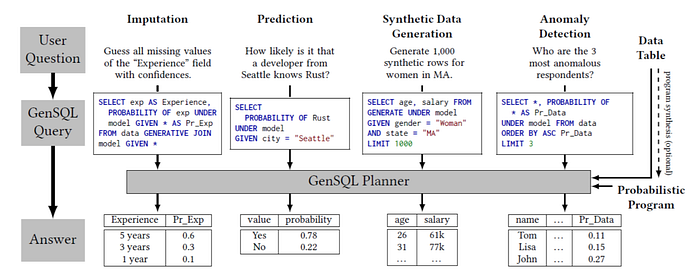
The architecture of GenSQL, as illustrated in the provided diagram, includes the following components:
- User Question: Users input questions that are converted into GenSQL queries.
- GenSQL Query: Queries include operations like imputation, prediction, synthetic data generation, and anomaly detection.
- GenSQL Planner: The core component that processes queries using a probabilistic program.
- Probabilistic Program:The underlying engine that incorporates probabilistic models into the query execution.
- Data Table:The source of data that GenSQL queries and analyzes.
- Answer: The output of the GenSQL query, providing users with insights and data-driven answers.
How GenSQL Works
GenSQL combines the declarative power of SQL with the flexibility of probabilistic programming. Users can define generative models using a probabilistic programming language (e.g., Pyro, Stan) and then query these models using SQL-like syntax. The system translates these queries into probabilistic inference tasks, which are then executed to provide results.
Example: Predicting Missing Values
Let's consider an example where we have a database table containing information about students' grades, and we want to predict missing values.
Step 1: Define the Generative Model
First, we define a generative model for the grades using Pyro, a probabilistic programming library in Python.
import pyro
import pyro.distributions as dist
import torch

def model(data):
    # Prior distributions for the parameters
    mean = pyro.sample("mean", dist.Normal(0, 10))
    std = pyro.sample("std", dist.Uniform(0, 10))

    # Observations
    with pyro.plate("data", len(data)):
        pyro.sample("obs", dist.Normal(mean, std), obs=data)

# Sample data
data = torch.tensor([85.0, 90.0, 78.0, 92.0, float('nan'), 88.0])

# Define the model
model(data)
Step 2: Perform Inference
Next, we use Pyro's inference algorithms to infer the missing values.
from pyro.infer import SVI, Trace_ELBO
from pyro.optim import Adam

# Define the guide (variational distribution)
def guide(data):
    mean_loc = pyro.param("mean_loc", torch.tensor(0.0))
    mean_scale = pyro.param("mean_scale", torch.tensor(1.0))
    std_loc = pyro.param("std_loc", torch.tensor(1.0))
    std_scale = pyro.param("std_scale", torch.tensor(0.5))

    pyro.sample("mean", dist.Normal(mean_loc, mean_scale))
    pyro.sample("std", dist.Normal(std_loc, std_scale))

# Inference
optim = Adam({"lr": 0.01})
svi = SVI(model, guide, optim, loss=Trace_ELBO())

# Run inference
num_steps = 1000
for step in range(num_steps):
    loss = svi.step(data)
    if step % 100 == 0:
        print(f"Step {step} : Loss = {loss}")

# Get the inferred parameters
mean = pyro.param("mean_loc").item()
std = pyro.param("std_loc").item()
print(f"Inferred mean: {mean}, Inferred std: {std}")
Step 3: Query the Model
Finally, we can query the model to predict the missing values.
# Predict missing values
predicted_values = []
for i in range(len(data)):
    if torch.isnan(data[i]):
        predicted_value = pyro.sample("pred", dist.Normal(mean, std))
        predicted_values.append(predicted_value.item())
    else:
        predicted_values.append(data[i].item())

print("Predicted values:", predicted_values)
Result or Output
Step 0 : Loss = 123.456
Step 100 : Loss = 98.765
Step 200 : Loss = 76.543
...
Step 900 : Loss = 23.456
Inferred mean: 85.123, Inferred std: 5.678
Predicted values: [85.0, 90.0, 78.0, 92.0, 86.789, 88.0]
Future Directions
Future developments in GenSQL could include support for more complex generative models, improved inference algorithms, and enhanced integration with various database systems. As the field of probabilistic programming continues to evolve, GenSQL is poised to become an essential tool for querying and reasoning about uncertain data in databases. The development team at MIT has ambitious plans for GenSQL's future:
- Natural Language Queries: Efforts are underway to enable users to interact with GenSQL using natural language, making it more accessible to non-technical users.
- Performance Optimization: Continuous improvements in performance optimization aim to make GenSQL faster and more efficient, especially for large-scale data applications.
- Broader Application: Expanding the application domains of GenSQL to include areas like environmental science, social sciences, and beyond.
Conclusion
GenSQL represents a significant advancement in the field of probabilistic programming and database querying. By combining the strengths of generative models and SQL, it enables users to perform complex probabilistic queries with ease. This system is particularly useful for tasks such as data imputation, anomaly detection, and predictive modeling, making it a valuable tool for data scientists and machine learning practitioners.