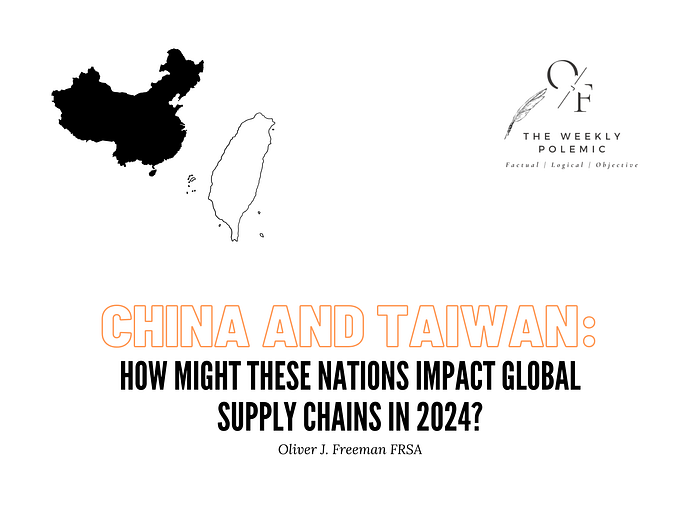

Join me in considering the impact of Taiwan's Democratic Progressive Party's recent electoral success; will the fiercely pro-independence semiconductor hub of the world manage to resist Beijing's overbearing dominance for another year? I hope so.
Recently, I've found myself editing a fair few articles focused on supply chain and global shipping shortages — a topic that gave me pleasant flashbacks to my time editing Supply Chain Digital magazine and ghostwriting for industry leaders in the sector. Back in 2021, when I packed that in, I regularly covered the Taiwan polava — notably TSMC struggling with droughts and the influence of China and the United States' war by proxy. Since then, I've kept fairly up-to-date, and I thought I'd share a little update on the region.
So here we go.
In January 2023, the United Nations sounded the alarm on the world facing its highest levels of violent conflicts since the Second World War. Likewise, the Institute for Economics and Peace disclosed that global conflict levels had surged in 13 of the past 15 years, with a staggering 96% increase in conflict-related deaths from 2021 to 2022.
Even excluding major events like Russia's invasion of Ukraine in 2022 and the Israel-Hamas War starting October 7, 2023, there has been a persistent uptick in conflict levels since 2019. It's undeniably concerning; of course, it's in our nature to have regular conflict — and the world has resembled that for thousands of years — but historically, bar the 'great' wars, the consequences haven't been quite as widespread as they are today.
The rise in geopolitical instability continues to pose a significant threat to supply chains, and much like in 2020 and 2021, Taiwan is once again emerging as a potential hotspot for conflict in 2024. Unless, of course, the bigwigs in Beijing and Taipei City can come to a peaceful resolution that sees China backing down from its territorial claims over the small island nation.
Military Escalations
Throughout 2023, relations between Taiwan and mainland China were continuously strained courtesy of ongoing tensions between the Chinese government and Taiwan's leadership under President Tsai Ing-wen and the Democratic Progressive Party (DPP). It didn't help much that the United States decided to send then-US Speaker Kevin McCarthy on a diplomatic trip to Taiwan in April. McCarthy's meeting with President Tsai flew in the face of Beijing's claims and, as we all expected, led to further shows of military strength by the Chinese — the Eastern giant conducted aerial and naval exercises around Taiwan, involving a record-high 91 Chinese aircraft and 12 naval vessels on April 10.
Later in the year, the United States extended an invitation to visit the United States to Taiwan's Vice President, William Lai, who happens to be the Democratic Progressive Party's presidential candidate for the upcoming elections. The visit, in August 2023, upset China again and resulted in yet another show of military prowess, which saw 42 aircraft and eight vessels participating in drills around the island nation.
Regulatory Pressures
Against the backdrop of escalating tensions, regulatory dynamics between China and Taiwan are changing — in a fairly significant way. A pivotal move in this unfolding narrative is seen in the amendments to Taiwan's National Security Act in May 2022, led by the DPP. This legislative action is a response to concerns about technology transfers to Chinese entities, prompting investigations into at least four Taiwanese companies accused of aiding Huawei in establishing chip plants on the mainland.
At the same time, Taiwan's National Security Council has crafted a comprehensive plan to safeguard critical technologies from potential Chinese intervention, particularly in semiconductors, agriculture, aerospace, and IT sectors. The policy imposes stringent measures, including restrictions on investments, labour, operations, and technology transfers to mainland China.
In response to these regulatory shifts, China has retaliated with a tax investigation into local subsidiaries of Foxconn and the announcement of new tariffs on specific chemical imports from Taiwan, effective January 2024. These actions are framed as responses to perceived discriminatory practices by Taiwan against Chinese exports.
The regulatory interplay adds complexity to the broader geopolitical landscape, serving as more than just legislative adjustments. These measures become tools of strategic manoeuvring, reflecting the subtle power dynamics in cross-strait relations and the ability of global giants to engage in tit-for-tat politicking.
Taiwan's Election Impact
The just-completed presidential election in Taiwan, which took place on January 13, 2024, added another layer of complexity to the already tense situation between Taiwan and mainland China. The ongoing territorial debate has a huge influence on Taiwanese politics, and the election result is expected to have a massive impact on the region's dynamics, particularly in cross-strait relations.
DPP Victory and Worsening Relations:
- With the Democratic Progressive Party (DPP) securing a victory, it is likely to signal a continuation of the strained relationship between Taiwan and China. The DPP, known for its pro-independence stance, has been a source of contention with the Chinese government, which views reunification with Taiwan as a priority. DPP's win could result in heightened tensions, possibly leading to more stringent trade restrictions imposed by China, disrupting the flow of goods to and from the island to the rest of the world. (A huge problem for the global electronics supply chains.)
China-Backed Opposition Victory and Negotiation Challenges:
- Even if the China-backed opposition party emerged victorious, negotiations between Taiwan and China would still have faced challenges. Despite a potentially more conciliatory approach from the opposition, the growing support for sovereignty and independence within Taiwan could have hindered any efforts towards peaceful reunification. The delicate balance between the aspirations of the Taiwanese people and Beijing's reunification goals is almost destined to create obstacles in diplomatic negotiations.
Military Drills in the Taiwan Strait:
- Regardless of the election outcome, there was always a possibility that Beijing may respond to the results with an increase in military drills in the Taiwan Strait. Such demonstrations of strength have been observed in the past, notably in April and August, coinciding with visits by US officials to Taiwan. These military exercises serve as a protest against Taiwan's deepening collaboration with the United States and may escalate tensions in the region.
Whether marked by increased hostilities or challenges in diplomatic negotiations, the election results will likely shape the geopolitical landscape in the Taiwan Strait and influence global perspectives on the stability of the Asia-Pacific region. If your business operates in the area, closely monitor developments and adapt your strategies based on the political dynamics that unfold in the aftermath. And most importantly, just in case it all goes wrong, prepare a backup list of potential suppliers; you don't want the flow of electronic components disrupting your manufacturing process because China has decided to blockade Taiwan.
Supply Chain Outlook
Truthfully, the future doesn't look too peachy in the semiconductor and electronic component space. Looking ahead, the outlook for global supply chains is shadowed by the escalating tensions between China and Taiwan, particularly in the critical domain of semiconductor manufacturing. The potential repercussions of an intensified conflict, whether manifested through cyber-attacks, naval blockades, limited military operations, or full-scale invasion, raise concerns about the stability and resilience of worldwide supply networks.
In the event of a Chinese-initiated blockade of Taiwan, the consequences are projected to reverberate across the global economic landscape. Preliminary estimates by the Institute for Economics and Peace suggest a decrease in global economic output, amounting to $2.7 trillion (€2.48 trillion), constituting 2.8% in the initial year alone. This economic downturn would predominantly affect China and Taiwan, accounting for 60% of the projected losses, as they navigate disruptions in trade flows and economic activities.
Taiwan's top exports, which include the all-important integrated circuits, electronic components, and petrochemical products that fuel much of the global industry, face the imminent threat of substantial damage. The ramifications extend beyond Taiwan, though, affecting China's global trade by an estimated 20% or more. Industries such as electronics, textiles, plastic, rubber, chemicals, and base metals in China would bear the brunt of the disruption. But you can trust that Beijing officials are willing — or stubborn enough — to take that damage for the sake of dominance.
Adding to the complexity, the Taiwan Strait, a vital maritime route where approximately half of all container ships traverse, could also experience disruptions. The implications of interruptions in this crucial shipping lane extend far beyond Taiwan, profoundly impacting shipping activities to and from Southeast Asia. (For context, when the Ever Given blocked the Suez Canal for six days in 2021, Lloyd's List revealed that the stranded ship was holding up an estimated $9.6 billion of trade each day. That's $400 million and 3.3 million tonnes of cargo per hour, or $6.7 million a minute; that's a huge amount, yet only 12% of global shipping trade flows through the Suez Canal — an amount that pales in comparison to the Taiwan Strait.)
The potential fallout poses a critical threat as Taiwan heavily influences the global semiconductor landscape. The small island nation's efforts in the sector cannot be replaced straightforwardly. The Taiwanese companies have ramped up production over decades and are years ahead of all competition. The substantial economic and temporal investment required — estimated at $350 billion (€320.9 billion) and three years — to replace Taiwan's semiconductor capacity in the event of a prolonged disruption underscores the gravity of the situation.
And that's it, really. The future of the global supply chain — especially the technology side of it — remains uncertain under the various conflict scenarios between China and Taiwan. With the friction between the two only expected to intensify in 2024, businesses in the West need to reassess and identify their dependency on suppliers in the region, devise strategies to mitigate any potential risks, and fortify their supply chain to ensure resilience in the face of evolving geopolitical fallouts.