


I have never believed in the practice of meditation. Sitting in one place for a long time, sometimes for hours at a stretch, made little sense to me.
My mantra has always been — move daily, move often. It's unhealthy for your body to stay in one position for so long.
Things changed when I visited the forested hills of Mcleod Ganj in India for a 10-day Buddhist meditation retreat. I learned from the Buddhist practitioners about the various meditation techniques and contemplated how they could be applied to real life.
Here are the three meditation techniques I learned.
1. Calm Abiding Meditation
It is the most popular form of meditation. When someone talks about meditation, it is usually the Calm Abiding technique.
We develop focus which is a by-product of relaxation.
The mind becomes restless and wanders when it is stressed. So, we allow our thoughts and emotions to flow without engaging with them and try to focus on one object to relax.
How to do it?
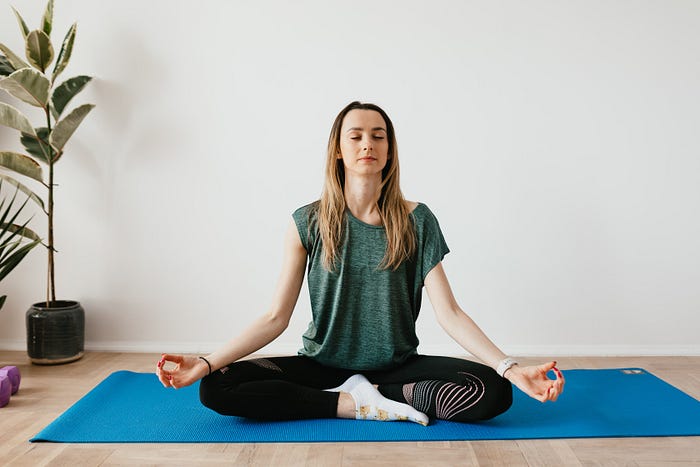
- Sit cross-legged on a yoga mat with a meditation cushion or a folded pillow that will help support your back.
- Keep your spine erect with a relaxed body. Keeping your spine straight during meditation helps you develop mental and physical self-control.
- Make sure you are in a quiet room with minimal noise.
- Keep your hands on your thighs (as shown below).
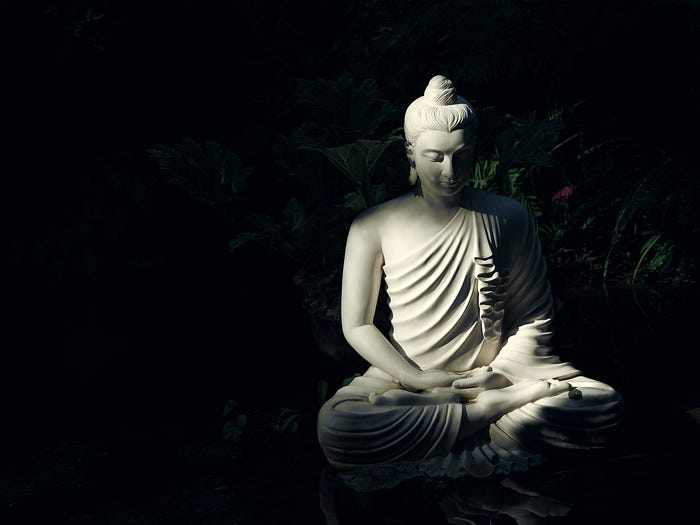
- Alternatively, you can keep your hands close to your abdomen with the back of your right palm on top of the left and palms facing upwards (as shown in the Buddha's image below)
- Close your eyes and breathe normally while focusing on your object of interest.
The objects of interest include:
- Breath: Allow your belly to expand as you inhale through your nose and slowly exhale. Focus on your abdomen as it expands and contracts. Alternatively, you can focus on the sensation of the air moving in and out of your nostrils. I prefer focusing on my belly.
- Body sensations: Scan your body from bottom to top and try to relax every muscle. Notice if there is tension anywhere and if there is, consciously try to relax that body part.
- An object of visualisation: Visualise the image of God, a person you love, an imaginary thing or anything else you like.
- Mantra: I've never tried this myself, but you can also recite a mantra in a low quiet voice to concentrate. The most auspicious Buddhist mantra that is popular in Tibetan culture is OM MANI PADME HUM.
- Focusing on a static object: You can also experiment with keeping your eyes slightly open and focusing on an object such as a point on a wall, candlelight or an image of Buddha.
Your concentration or focus will drift away from your object of interest every 5–10–20 secs.
Sometimes, you will get distracted by outside noise, such as birds chirping, traffic, someone coughing, etc. Other times, it will be random thoughts and emotions.
Know that it is a typical challenge for most beginners and part of the process of learning meditation. Allow your thoughts and emotions to flow without engaging with them.
A common misconception is that when your mind drifts, it is a sign of failure. But the important part is that you continue to refocus on your object of interest (breath, body sensation, etc.).
A huge component of improving your ability to focus, by way of brain rewiring (i.e., neuroplasticity), is a repeated return to a state of focus from a state of non-focus or diminished focus.
Research suggests that the practice of this type of meditation is associated with neuroplasticity phenomena, reducing age-related brain degeneration and improving cognitive functions.
2. Analytical Meditation
We all love solving problems, but most of the time, we are distracted by artificial, short-lived sources of dopamine such as fast food, alcohol, drugs, porn, Netflix, and mindless scrolling on social media.
It is where analytical meditation can help, where you bring stillness in this chaos and use your mind actively to contemplate questions.
It has the potential to change your habitual thought patterns.
I've been doing this type of meditation unknowingly, although not as often as I should. Now and then, I sit in my room without any electronics or phone and try to talk to myself. The intent is to understand more about what I want. And that's what you can do with the help of analytical meditation.
How to do it?
The process is the same as the calm abiding meditation, as discussed in the previous section. The only difference is instead of focusing on an object of interest, we focus on contemplation and questioning our assumptions in life.
Contemplate questions we otherwise avoid due to millions of known and unknown distractions. It can be any question, even questions related to your professional life.
Here are some examples:
- Am I happy with the status quo?
- What makes me happy?
- Should I take this new job offer? Why or why not?
- Am I happy in my relationship? What can I do to improve it?
- What is my life purpose?
- Why do people get angry or experience jealousy?
- What makes me sad?
Sherlock Holmes' mind palace is essentially a deep meditative state where he can think and deduce clearly.
When Gautam Buddha left home to meditate, he contemplated the topic of why we suffer and came up with the Four Noble Truths that are part of Buddhism teachings.
Analytical meditation helps improve self-awareness and allows you to think deeply about things that matter to you. I did analytical meditation when I quit my job to follow my heart. It allowed me to think through rationally and make a decision.
3. Mindfulness
It is a culmination of focus, mental flexibility, and movement.
Mindfulness is similar to a flow state, where you experience the present moment and the task at hand and do not get lost in your thoughts.
It's what we feel while doing something enjoyable, such as playing a sport or engaging in a hobby such as painting, writing, etc.
Doing daily chores is an excellent example of when we tend to experience mindfulness from time to time — Washing utensils or clothes, cooking, shopping for groceries, etc.
I often experience mindfulness while working out or running.
How to do it?
Unlike the other two meditation techniques, mindfulness doesn't require you to sit in a relaxed, peaceful state. One can perform mindfulness meditation while doing activities during the day.
The goal is to consciously be in a state of mindfulness in the different activities we do throughout the day.
Mindfulness helps improve memory, and proprioception and allows us to be aware of our emotions and sensations.
Nowadays, whenever I feel a negative emotion such as jealousy or anger, the mind automatically becomes aware of it after a few minutes, and commentary starts running in my head that says — "Hey! You are experiencing jealousy. It is not good for your mental peace, so you must get over it."
Believe it or not, it works. However, it takes years of practice to experience this kind of awareness. I have been fortunate to practice it for a long time after listening to prominent yoga gurus and Hindu priests such as Dandapani.
Signs of Progress
Measure progress from time to time to inspire yourself and maintain your habit. It also gives you the confidence that you are moving in the right direction. Here are some signs of progress in your meditation practice.
- People around you start to notice changes in you.
- You develop better concentration and focus.
- You have intriguing meditation experiences.
- There are fewer aches and pains or posture issues during meditation.
- You make conscious choices rather than reacting to situations.
- You have more awareness of your actions.
- Better self-awareness.
- You feel calmer and more at peace with yourself.
- You often get feelings to change and improve yourself — a growth mindset.
Final Thoughts
Meditation is an excellent tool to develop laser focus and get to know yourself. It allows you to bring stillness to your wandering mind by removing unwanted distractions. The 10-day meditation retreat made me realise the importance of meditation and that anyone can learn it.
Lastly, it is critical to remove all forms of expectation from yourself and the meditation practice, while doing it, so you can focus on the present moment and immerse yourself in the experience.
Meditation is exercise for the mind. The more you do it, the better you get.
If you enjoyed reading this, check out I Went to the Mountains to Learn Meditation — Here's What Happened
Why not join Medium? You'll get unlimited access to all my articles and thousands of other writers. If you sign up using my link, I'll earn a tiny commission. Thanks in advance. Wishing you love and inner peace.