


We have all committed this programming sin.
You have a massive dataset. Maybe it is a list of stock transactions, server logs, or user IDs. You need to know if one specific item is in there.
So, what do you do? You write a for loop. You create a found = False variable. You iterate through every single line.
But guess what? That is the old way.
Python has a much more elegant and direct way to handle this. It is called Membership Operators.
This is not just syntactic sugar. This is the Python philosophy of working smart, not hard. These operators are designed specifically to test if a sequence is presented in an object.
Let's break down the secret.
The Problem with the Old Way
Imagine you are analyzing global economic data. You want to check if a specific tech stock is in your portfolio.
The beginner way usually looks like this:
# The Old Way (PLEASE DON'T DO THIS)
for stock in portfolio:
    if stock == "NVDA":
        print("Found it!")
This takes up space. It is hard to read. And honestly, it looks amateur.
Membership Operators exist to solve this problem without loops and without temporary variables.
Your 2 Secret Weapons
You only need to remember two simple keywords:
- in
- not in
It sounds simple, right? But the implications for your code cleanliness are massive.
- The
inoperator returnsTrueif the specified value is present in the object. - The
not inoperator returnsTrueif the specified value is not present in the object.
Let's see how this works in the real world with data that actually matters.
Case Study 1: Crypto Portfolio Check (Lists)
Let's talk about future assets.
Let's say you are a Gen Z investor monitoring crypto assets. You have a list of safe "Blue Chip" coins. You want to make sure your portfolio is healthy.
# List of safe assets (Blue Chip)
safe_crypto = ["Bitcoin", "Ethereum", "Solana", "BNB"]

# Check if 'Bitcoin' is in the safe list?
print("Bitcoin" in safe_crypto)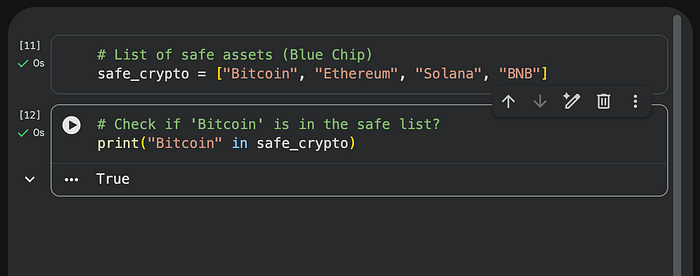
With just one line: print("Bitcoin" in safe_crypto), Python does all the hard searching work for you. The logic is simple: it returns True if the value sequence is present in the object.
What if we want to ensure we are avoiding a problematic coin? Use not in.
# Check if 'Luna' is NOT in the safe list?
print("Luna" not in safe_crypto)

# Result: True (Because it is not there)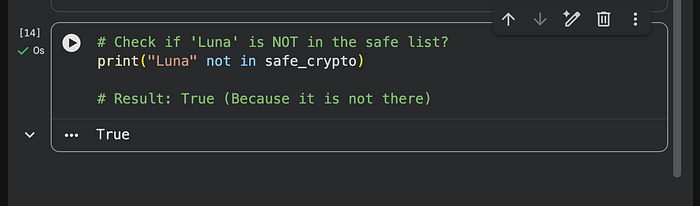
This operator will return True because the value is indeed not in the object.
Case Study 2: News Sentiment Analysis (Strings)
This is where things get interesting. These membership operators also work on Strings (Text).
Imagine you are building a bot to detect social issues or climate crises from the latest news headlines. You do not need to split the sentence into words. Just ask the sentence directly.
Let's take a headline about the climate crisis:
news_headline = "Climate crisis causes extreme heatwaves in Southeast Asia"

# Detecting specific issues
print("heatwaves" in news_headline)
print("economy" in news_headline)
print("pollution" not in news_headline)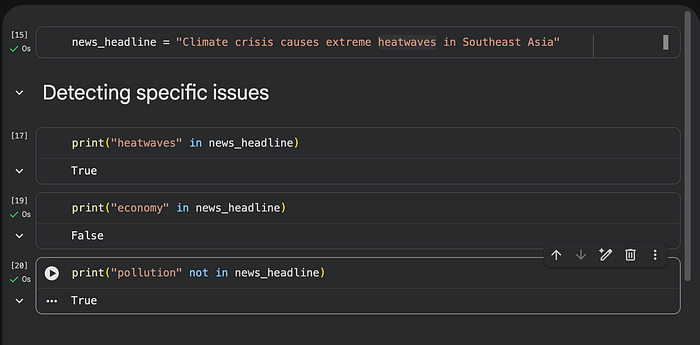
The results will surprise you:
- True (Because the text "heatwaves" is right there).
- False (The word "economy" was not found).
- True (The word "pollution" is indeed missing from that sentence).
Why Should You Care?
Your code is a reflection of how you think.
Using in and not in shows that you understand Python deeply. It makes your code read like human language: "If 'Bitcoin' is in 'Wallet', then sell."
Stop making things difficult for yourself with complex logic.
Use these 2 operators, and watch your code transform from "student project" to "production-level engineering" instantly.
Are you a perfectionist (and) or a flexible person (or) when making decisions? Let me know in the comments!