

Just days before the tragic killing of Dr Refaat Alareer by an Israeli airstrike on December 6, 2023, in the al-Daraj neighbourhood of Gaza City— an attack that flattened his sister's apartment and claimed the lives of his brother Saleh, sister Asma, and their children — the esteemed and deeply beloved poet, professor, and lifelong advocate for Palestinian resistance shared a poignant reflection during an interview with Electronic Intifada. He stated that his only weapon against the brutal Israeli occupation and the genocide of his people was his Expo marker.
'I am an academic and probably the toughest thing I have at home is an Expo marker. But if Israelis invade, if they charge at us to massacre us door to door, I'm going to use that marker and throw it at the Israeli soldiers.'
In the words of his student Yousef M. Aljamal, Refaat Alareer was 'Gaza's pen and sword,' whose Expo marker symbolised the enduring spirit of Palestinian resistance, honouring the courageous Palestinian youth who have time and again stood against the military might of Israeli forces armed with nothing but stones. This defiance was also vividly reflected in the actions of Gaza's resistance leader Yahya Sinwar, who in his final moments, hurled a stick at a drone — a striking gesture of resistance against overwhelming odds.
Yet the profound legacy and body of literature Dr Refaat Alareer leaves behind exemplifies the enduring power of the pen to challenge dominant narratives and ultimately drive the dismantling of the structures of occupation.
More than anyone, Dr Refaat Alareer truly believed in the power of words and storytelling, to liberate people of falsehood and injustice. From the numerous tributes shared by his students since his assassination, it is evident that Alareer inspired profound admiration and affection as a teacher and a friend. Deeply passionate about literature and always seen carrying a book, he encouraged his students to believe in the power of stories and to harness storytelling to amplify Palestinian narratives that had been silenced for far too long.
'We live in a world that punishes the oppressed whenever they reclaim their basic right of telling their side of the story. We live in a world that murders the voices of truth. We live in a world that arrests writers who use their pens in the quest for justice. We live in a world that shushes the wretched when they cry. Still, we must keep telling stories.'
Born and raised in Gaza, Dr Refaat Alareer (1979–2023) dedicated his life to preserving and amplifying the voices of his people through literature, teaching, and advocacy. Alareer earned a BA in English from the Islamic University of Gaza and went on to complete an MA at University College London in 2007. He later earned a PhD in English Literature from Universiti Putra Malaysia. As a professor of English literature at the Islamic University of Gaza, Alareer specialised in resistance literature, inspiring countless students to use storytelling as a means of preserving Palestinian identity and countering oppression.
He was deeply committed to mentoring young writers and making English accessible to all. He viewed learning English as a way to overcome the physical, intellectual, and cultural barriers imposed by the occupation, seeing it as an act of defiance.
As a co-founder of the We Are Not Numbers project, he empowered Gaza's youth to share their stories with a global audience, giving voice to their experiences and struggles. He edited influential anthologies such as Gaza Writes Back: Short Stories from Young Writers in Gaza, Palestine (2014) and co-edited Gaza Unsilenced (2015). These collections captured the human cost of occupation and aggression while celebrating the resilience and creativity of Gazans.

As a passionate admirer of Shakespeare, whose lectures on the playwright are available on his YouTube page, Dr Refaat Alareer marked the 400th anniversary of Shakespeare's birth in 2014 with a poignant gesture. During a visit to the Folger Shakespeare Library in Washington, D.C., he draped a kaffiyeh — a powerful symbol of Palestinian identity — around a statue of Shakespeare and posed for a photograph.
In his TED Talk, Stories Make Us, Alareer emphasised the transformative power of storytelling, highlighting how narratives shape our identities, resistance, and understanding of the world. Through his own experiences and the stories of those living under occupation, he illustrated how storytelling can challenge dominant narratives and give voice to the marginalised.
'Chinua Achebe teaches us something. This is a lesson for us all. If the lions do not have their own historian, the history of the hunt will always glorify the hunters, will always glory the occupier, will always glorify the coliniser, rather than the colonised, the oppressed, the indigenous, the rightful people of the land, and believe me, people out there are looking forward to our stories.'

As Israel's genocide of Gaza escalated and the relentless bombardment intensified, Alareer made the resolute decision to remain in northern Gaza, his home. Despite the loss of several family members, friends, and countless fellow Gazans, he chose to stay, determined to continue telling the story of Gaza and its people. He remained behind to document the daily realities of life under siege, offering the world a glimpse into the harrowing atrocities unfolding in his homeland. He picked up his pen in the face of overwhelming adversity.
"I'm only an academic, a civilian, at home. I'm not leaving."
Despite his untimely death, his legacy endures through the body of literature he created, the students he inspired, and the generations of writers he nurtured. Dr. Alareer remains a symbol of the unyielding Palestinian spirit — a beacon of hope, resistance, and the enduring power of words. 'The day he was killed, he told a close friend that if he survived the genocide in Gaza, he would dedicate his entire life to storytelling and narration.'*
Dr Refaat Alareer leaves us with a powerful and poignant poem 'If I Must Die,' urging the reader to continue to tell his story, to resist by keeping hope alive, and to share the truth. A believer in the power of words to outlive and inspire generations, Alareer's poem went on to become the language of resistance. Translated into multiple languages, Alareer's words continue to resist, inspire, and bring hope.
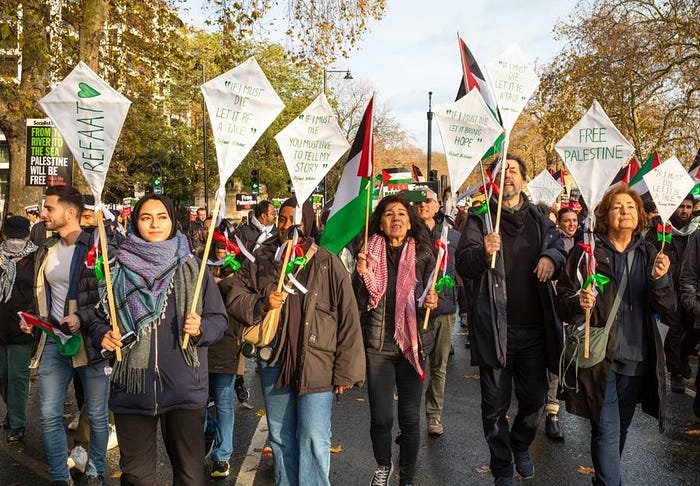
IF I MUST DIE
If I must die, you must live to tell my story to sell my things to buy a piece of cloth and some strings, (make it white with a long tail) so that a child, somewhere in Gaza while looking heaven in the eye awaiting his dad who left in a blaze — and bid no one farewell not even to his flesh not even to himself — sees the kite, my kite you made, flying up above and thinks for a moment an angel is there bringing back love If I must die let it bring hope let it be a tale
"Palestine is always one story away, one stone away. Palestine is not a distant concept but a living, breathing reality that is constantly shaped and reshaped by the stories and actions of us, its people."
*Aljamal, Y. M. (2024). Remembering Refaat Alareer: The Legacy of Gaza's Storyteller. Journal of Palestine Studies.