On its seventy eighth birthday, India is in many ways an old man. Since our independence, we've achieved growth, development, and international power. In other ways, our country is young and hungry; a man in its twenty-somethings with unfulfilled aspirations. While urban India has staggered forward, it has largely left its rural women behind. We often think of gender inequality as an impermeable barrier: too great an enemy to break in a generation. We look at women's empowerment in rural communities as some sort of economic figure, attempting to quantify women's empowerment by establishing that it 'creates a middle class' and 'more productivity'. For an issue so entrenched in the experiences of human beings, feminism is viewed in a strangely quantitative and impermeable way. By placing data at the forefront of empowerment, we bury stories.
I sit on a small chair in a cooled office. The girls' laughter at recess breaks through the largely soundproof walls. I'm interviewing women at Avasara, an NGO girl's school outside Pune, about gender inequality in their villages. I'm expecting that they'll confirm what I already know: it's almost impossible to create women's empowerment in rural communities. Without even considering the lives behind gender inequality, I'm painting a quantitative image in my head of what India could look like if more girls went to school. I begin the conversation, asking Anjali for her story.
Anjali's story surprises me. She's full of life as she recounts the pride she felt when her daughter, Saanvi, won a full scholarship to Flame University, making her the first in her family to receive a college education. Her eyes dance as she tells me how Saanvi has inspired some of the more liberal parents in her community to encourage their daughters to apply to Avasara. However, her expression changes when I pivot the conversation to her own story.
Hesitantly, she tells me that her family has a long history of domestic abuse and alcoholism. She recounts her own childhood. Like her husband, her father was also physically abusive and an alcoholic. He married her off when she was fourteen to an equally abusive, alcoholic husband. Her husband has always been uninvolved with their childrens' life, which enabled Anjali to enrol Saanvi into an English-medium school and eventually Avasara. She tells me, then, something even more surprising: the female teachers at the school advocated for her and helped her find a job as a bus auntie. With the income, she bought herself an apartment so that she could get away from her husband, and took out loans to afford her son's education.
By this time the meeting ends, Anjali, me, and our translator are all on the verge of tears. Anjali tells me that this is the first time she's been able to tell her story, and it's largely because she feels that she's in such a good place right now. In thirty short minutes, she's completely broken down my preconceived notions about inequality. While we think of gender inequality as a concrete barrier, Jayshree's story likens it to dominoes falling. Women's empowerment comes from breaking expectations of what women 'can' and 'can't' do. Traditional expectations of gender in rural communities are dictated by century-long patterns of men and women being designated to different spheres, so without some sort of external stimulus, generations live in a constant loop of suffering the same obligations. A single woman with a leadership position, the teacher, fundamentally changed a mother and daughter's life. The mother and daughter's stories consequently inspired an entire village to value female education. Saanvi was the outlier to traditional gender expectations, she placed enough external force on the loop to break it. The village ecosystem can create its own women's empowerment, as long as female leaders exist within it to to be inspirational outliers. By giving girls a holistic, high quality education led by women, Avasara is a microcosm of this.
At the end of this interview, I'm not sure whether I should feel more heartbroken or hopeful. In part, Anjali's story humanises women's empowerment. Empowerment is not an imperative just because it benefits India, but because it saves lives. This phenomenon is not isolated to Avasara. Female leadership is a catalyst for women's empowerment internationally. In innumerable schools, villages, and families, women uplift women.
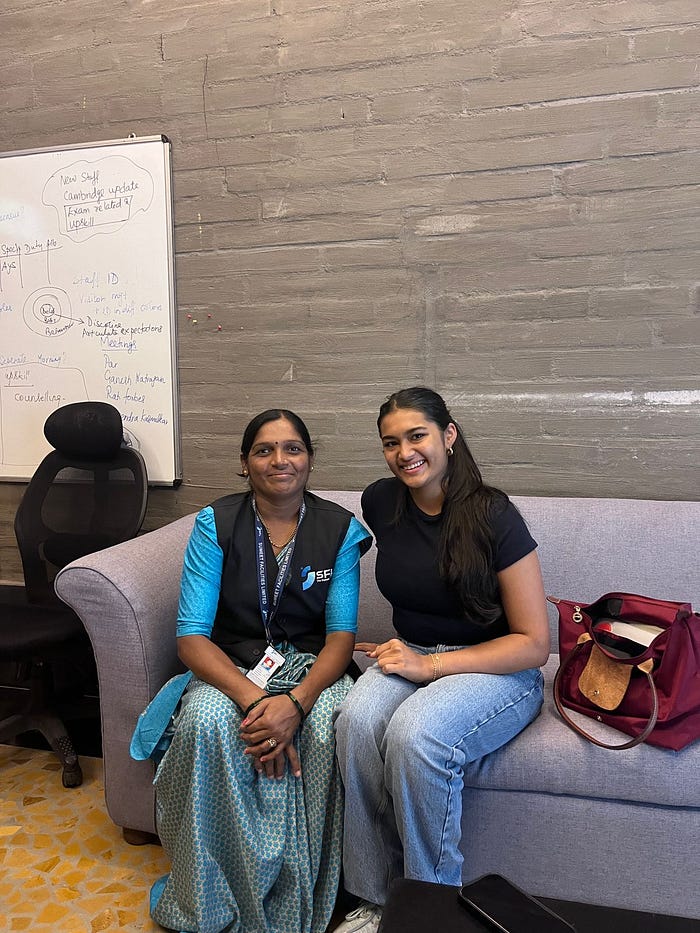
I'm in the same room as last time, energised and touched from my conversation with Anjali. This time, I'm talking to Bhairavi, and she tells me her story.
Her family is much more progressive than Anjali's. Both her and her husband are firm believers in education. Suja describes her daughter as energetic and bubbly. Teach for India, a different NGO, recommended her to apply for Avasara. She recounts with a smile how other girls in the village beg her daughter to help them study. They look up to her in awe and sat for the Avasara exam.
As I speak with Bhairavi, I realise how much she shares those traits with her daughter. When we pivot into her background, she tells me always wanted to be a police officer, but she was forced to get married when she took a gap year before college to save money. When she was in tenth grade, her daughter realised how capable Bhairavi is, and administrators at Avasara encouraged her to study. She couldn't attend a formal college, but saved up to join a program and sit exams. Now, she has a degree in both psychology and Marathi and will be a teacher after her son is done studying.
Perhaps the most interesting part of her story is the impact she's had on young girls in her villages. The first year after her daughter enrolled in Avasara, several girls from their village sat the exam. However, none of the other girls were able to clear it. Bhairavi personally went to teachers in the village and convinced them to teach from 12 to 5pm every week day. The next year, 17 girls gained entry into Avasara. Now, her village sends the highest number of students to Avasara each year. After about half an hour of conversation, I ask Bhairavi how she thinks her community is changing. She tells me that there are now older role models (like her daughter) and the younger generation is now believing that women can be highly educated and contribute to their families. In the end, inequality in some rural communities stems from a cost-benefit analysis the parents have to make. Without role models and outliers that prove women can be successful, the cost of a daughter's education is too high and the reward is a mystery.
This interview feels different. At the end of it, we're all smiling at the possibility of Bhairavi becoming a teacher. Anjali and Bhairavi have starkly different stories, but they're both case studies on the importance of female role models. In very different ways, they're both outliers in their communities.
Anjali and Bhairavi's stories are not isolated cases; they reflect a much larger societal reality — one where deeply ingrained gender roles shape the opportunities available to women in rural India. Their lives reveal the systems of inequality that have kept women confined to the margins, but they also show how a small shift in perspective can disrupt these centuries-old patterns. They both represent a step forward in a young, hungry India's achieving aspirations.
*names have been changed to reserve privacy