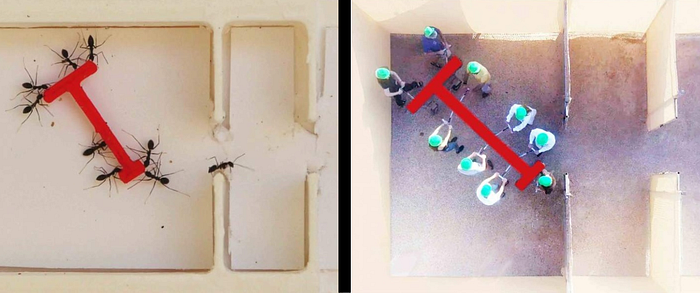


When ants go marching into a new challenge, like squeezing an oversized dead bug into their nest for dinner, they cooperate in wildly successful problem-solving ways that don't always come natural to groups of humans. So revealed a series of new experiments in which humans and ants were recruited for a competition to see who, or which, could move an odd-shaped object through a maze designed in each case to mimic real-life challenges.
In the new experiments, scientists recorded videos of individual ants and people, then groups of each, navigating cleverly constructed mazes — one huge, one tiny. The competition was based on a variation of the so-called piano mover's puzzle, a challenge involving how to get an irregular-shaped object from here to there in a complex environment, such as a small apartment or the tunnels in an ant nest.
It's not that individual ants are smarter than individual humans, said study team member Ofer Feinerman, PhD, who runs an ant research lab at the Weizmann Institute of Science in Israel. But in groups, ants get really savvy at solving difficult puzzles.
"When ants cooperate, they actually gain some human-like cognitive traits that help them solve the puzzle," Feinerman told me. "And, despite the huge gaps between ant and human smarts, we found that the top performing groups of ants outperformed the worst performing groups of people. This finding indeed amazed us."
People worked to solve the puzzle because they were asked to do so. The ants were coaxed into participating because their odd-shaped object was made to seem "a juicy edible morsel." The study, led by Tabea Dreyer, a researcher in Feinerman's lab, was detailed recently in the Proceedings of the National Academy of Sciences.
Revealing the perils of human ignorance
Ant's superior methods of cooperation are thought to stem, in a bit of irony, from their individual cognitive simplicity. One human beat one ant every time. But…
The results confirm two previously known psychological thorns in the side of successful human cooperation, stuff we'd all be wise to avoid:
- Group think, in which people seek consensus and harmony and therefore opt for an evident solution instead of choosing the path they might've felt was correct.
- Pluralistic ignorance, whereby individuals mistake a viewpoint held by a few to be the majority outlook.
"In a group context, people tend to forsake their well-thought opinion and instead pull towards the direction they think most others will want to pull," Feinerman said.
This pull was actually measured, using "force meters" installed on the object being moved by the humans. In some of the experiments, the humans wore masks and sunglasses and were instructed to navigate the maze without speaking or gesturing, in an effort to better mimic the push-pull communication relied on by ants.
"People in a group put consensus above every other choice," Feinerman explained, making most of their decisions within a mere second to choose what they deemed the most evident option, even if they thought it wrong. "The non-communicating human groups paid a price for these decisions and solved the puzzle more slowly than individuals," he said. Even the groups of people that were allowed to communicate couldn't outperform individual human efforts.
"Groups of ants acted together in a calculated and strategic manner, exhibiting collective memory that helped them persist in a particular direction of motion and avoid repeated mistakes," the researchers concluded. "Humans, on the contrary, failed to significantly improve their performance when acting in groups."
Superorganism psychology
On its own, an ant is not without wits.
An individual ant is quite capable of choosing between two options, an earlier study at Arizona State University found. But several options induce cognitive overload, similar to what happens with humans.
The ants therefore share the investigative tasks and then lean heavily on group decision-making to lighten the mental load. The researchers observed this in ants seeking a new nest: "In whole colonies, each ant assesses only a small subset of available sites, and the colony combines their efforts to thoroughly explore all options," they concluded.
Subsequent study, also out of ASU, discovered that one species of ants has a distinct division of labor among four types of workers: primary, secondary, passive and wandering. Each contributes different information toward a collective decision.
The ASU research, led by Stephen Pratt, PhD, has found that just like humans, ants often act irrationally. But there's a collective "psychology to the superorganism" that cultivates teamwork and sharing of information that can lead to more logical decisions in ant societies compared to human societies. Ant communication is bidirectional, Pratt's team has found: Leaders lead, but when a follower pauses, the leader listens.
Advice from ants
We probably should not take a lot of moral, ethical or behavioral clues from ants. They eat their dead, and even their injured. They're among the most warlike of any creatures, and tend to stop only at total extermination of a rival colony, the late evolutionary biologist and author E.O. Wilson writes in his book, Tales from the Ant World. Ant colonies are completely dominated by females, which do all the work, and all the fighting. "Males are little more than flying sperm missiles," Wilson wrote. When they get old, the females take on ever-more dangerous tasks—like standing sentinel outside the nest in the interest of supporting the colony.
"There is nothing I can even imagine in the lives of ants that we can or should emulate for our own moral betterment," Wilson wrote.
No argument here. But we might eek out some lessons regarding more productive cooperation.
So I asked Feinerman what we humans might learn from his team's experiments, in terms of our relationships to others — in groups or society-wide. His answer is rooted in the fact that ants live in tightly knit societies, in which cooperation wins out over competition.
Ants make sure all their interests are aligned, he said, a step we humans fail at miserably. Once full trust is established, one lead ant—a female, always—pulls in her own direction while all the other leader ants follow. The leader, however, doesn't cling to power. She steps down after about 10 seconds, letting another ant take the lead.
"This allows the ants to avoid wasteful tug-of-wars, to explore a diversity of ideas," Feinerman said. "It grants extra attention to minority opinions — and it is proven (at least for the case of ants) to yield robust results over a huge variety of situations."
Your support makes my reporting and writing possible. To make your days better, check out my book: Make Sleep Your Superpower. And if you're a writer, see my Writer's Guide newsletter. — Rob