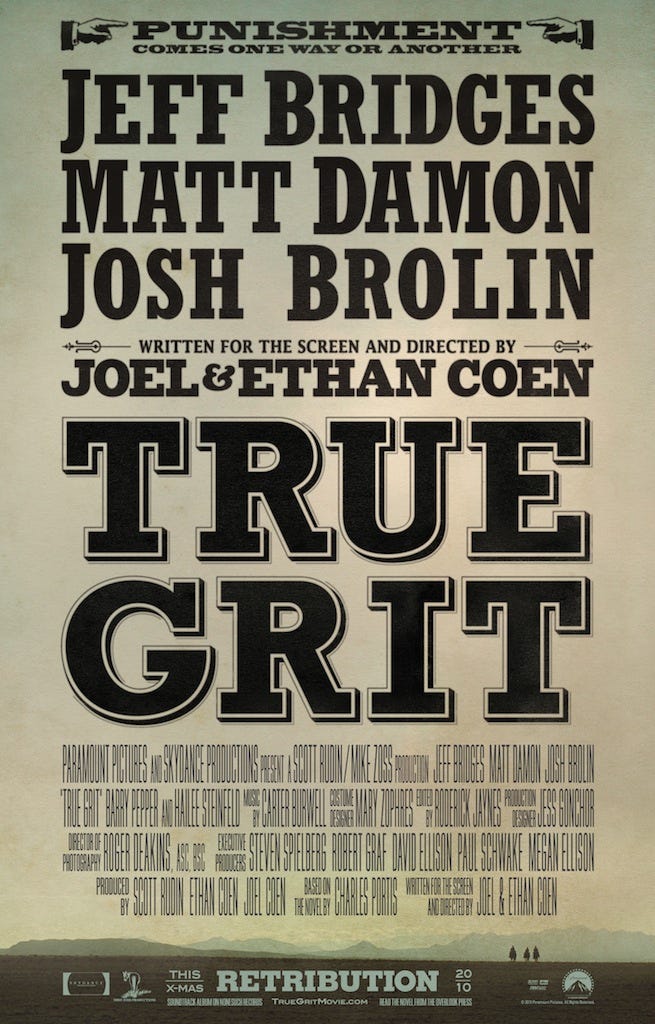


The story of Mattie Ross, a young girl on the hunt for her fathers killer, True Grit first made its way to the big screen in 1969. Based on the Charles Portis novel of the same name, True Grit is as much about the tonalities and intricacies of revenge, perseverance and justice as it is about the adventurous journey into the dangerous land that forms the location of the films setting. The material proves to be the perfect source for the Coen Brothers, who made waves within the Western genre in 2007 with No Country For Old Men. The premise also proved to be perfect for a reunion between the Coen's and their most popular player, Jeff Bridges, in a role that may just define his later career. Yet make no mistake, Bridges is not the star of True Grit, that honour falls upon another…
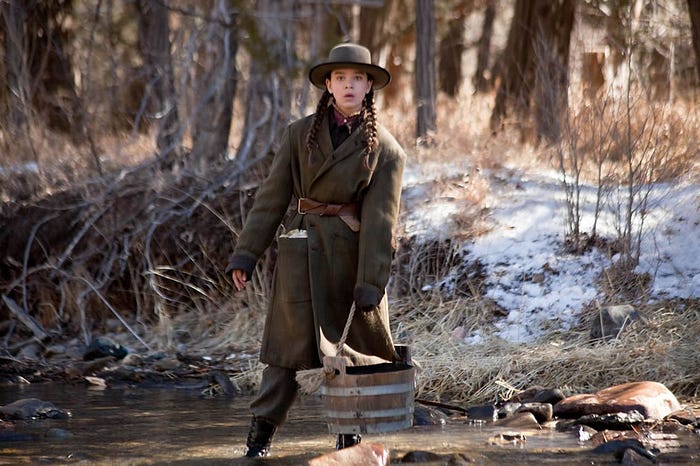
Newcomer Hailee Steinfeld, appearing in every scene in the film as the protagonist Mattie Ross holds the film together, in a manner far more accomplished than her young years would have you expect (In spite of what Paramount might have you believe, but more on that later). Mattie's perspective guides the film wholly. Bookended by her voice-over narration the journey is hers, her seeking of justice/revenge being the character arc that forms the brunt of the movie. As a result of this there are moments were we are drawn away from the action of a scene, and forced to view things from afar. Sequences such as the band's encounter with a pair of outlaws holed up inside a shack, which we view from Mattie's vantage point on the roof of said shack constantly remind us of who's story it is that we are viewing. The films big set-piece, if it could be called that is viewed entirely from "at least 400 yards" away (according to one characters estimation), such is the stringency by which the Coen Brothers stick to this forced perspective angle. It's a heavily effective creative decision, working perfectly.
Jeff Bridges, filling the weighty boots of the big screen's previous Rooster Cogburn assignee John Wayne, achieves what many would have deemed the impossible, and takes Wayne's iconic Cogburn and makes him his own. The surly Marshall with a well-hidden heart of gold is given a second life with Bridges. If only the Academy hadn't thrown away their obligatory Bridges Oscar last year he would have been a shoe-in this time around. Matt Damon, in his second of three performances in as many weeks proves a wonderful sparring partner for Bridges, the two bouncing off of each other like old friends. Damon's character, a Texas Ranger by the name of LaBoeuf has the choicest of lines too. Barry Pepper, as the aptly titled Ned Pepper makes his first relevant on-screen appearance since underrated modern Western The Three Burials of Melquiades Estrada, alongside No Country For Old Men alumni Josh Brolin in the very brief, but pivotal role of Tom Chaney. Pepper does a great job of a role made famous by Robert Duvall, and Brolin is suitably menacing as the epitome of evil at the heart of the world of the movie.
As mentioned before Hailee Steinfeld's lack of a public presence is truly baffling. A marketing campaign laden with ageism at best and sexism at worst. It's a similar affair over at the Academy, with Steinfeld relegated to the supporting category, revealing that the matters of sexism and ageism are still rife within the Hollywood elite. It's nothing short of disgraceful.

The film opens with a slow drift into the body of a man, which is soon to be revealed to be that of the protagonist's father. A technical marvel, Roger Deakins's always solid photography sets the tone for the picture that follows. A stunning reveal of Fort Smith, the township at the centre of True Grit, follows, widening the frame and injecting an air of the particular brand of nostalgia familiar with this line of cinema. We have written extensively on the Western here at Hope Lies at 24 Frames Per Second, with it fair to say that the genre taps into Hollywood's longing for a mythology heavily informed by a yearning for something bordering on schmaltz (regardless of the subject matter/content). As the train that has brought young Maddie Ross to Fort Smith departs from the frame, the scope of the former military outpost is fully revealed, accompanied by Carter Burwell's elevating score. Mere seconds after this moment the film's true colours once again rear there head, as the public hanging of three convicts brings the pleasant pace to an abrupt end. It's a rough, harsh scene, yet still manages to be filled with humour, courtesy of the treatment of one of the three. The film starts as it means to go on.
While True Grit initially stemmed from the pen of Charles Portis in the late 1960's, the trademark off-kilter drama that stands at the centre of the majority of their weeks are apparent all over the film. A chance encounter with a bear-skin covered dentist breaks up the mid-section of the film, in an appearance that will surprise no one to know came from the mind of the brothers Coen. The most apparent external influence on the Coen's take on True Grit might just be Charles Laughton's The Night Of The Hunter. Most obviously through the use of the hymn Leaning on the Everlasting Arms, and during a beautifully starlit race for life towards the end of the film, the influence of Laughton's film can be felt over the whole of the picture. Be it through the overbearing sense of doom or of its concepts of fate, the fairytale-spun style of The Night Of The Hunter clearly informs the language of the Coen brothers work.

The eventual fate of Rooster hints at an end to the old West hero that is far removed from the heroic sacrifice of the tradition. As America developed, and law caught up with the wilds of the west country, the role of the likes of Rooster Cogburn developed, with their ultimate fate in travelling fetes and road-shows marking a distinctive shift from their lives of old (although being placed in a position of entertainment did predict the early years of the cinema, with the likes of The Great Train Robbery and the films of Broncho Billy Anderson). As the films closing imagery, an the announcement of "In loving memory" upon that most typical icon of Western idol, the tombstone, makes clear, the Coen's film is their love letter to the American cinema, utilising its most beloved son, the low-down dirty outlaw.
True Grit opens on 12th February.