COVID levels detected in US wastewater declined in the first week of January, as expected. COVID activity levels are still high across the nation, and they remain very high in many states. The reasons to protect yourself aren't just to avoid an acute illness, but to prevent chronic health issues. Meanwhile, RSV, flu and norovirus are also at moderate or high levels.
This week's update:
The Winter Surge is Easing
It is no surprise that the winter surge of COVID-19 began to ease once holiday travel and socializing ended. According to new National Wastewater Surveillance System (NWSS) data, COVID is declining in all four US regions, but it remains in the High category, in aggregate, across the US. Regionally, COVID viral activity remains highest in the Midwest, high in the Northeast, and Moderate in the West and South.
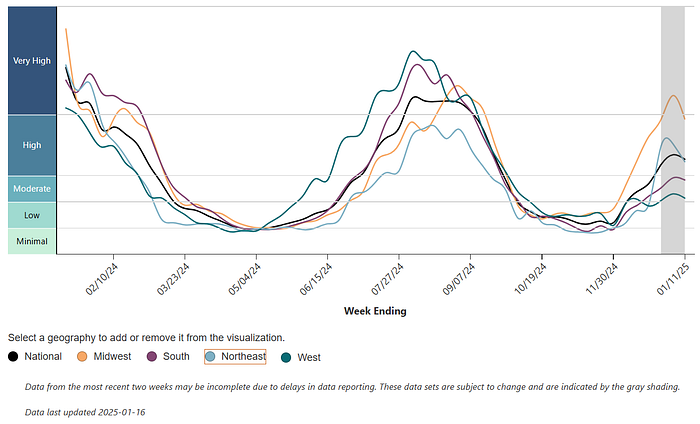
As predicted, the winter surge did not surpass the summer peak we experienced in 2024, outside a few select locations. This is the first year of the pandemic in which the December/January surge was lower than the summer wave. While it would be nice to think this portends a future trend, most experts caution against optimism. COVID continues to evolve at a rapid clip, vaccination rates remain low, reinfections are common, and we can expect multiple waves of infections in 2025. Just as the sizable summer surge contributed to a lower winter surge (since much of the population had short-lived immunity following a midyear infection), the low winter surge could mean an unusually high spring or summer surge.
Although the winter wave has peaked and is declining, COVID risks remain significant in much of the nation. At a state level, COVID viral activity is High or Very High in more than half the nation. The CDC categorizes viral activity as Very High in significant parts of the Northeast and Midwest, along with South Carolina, Arizona, and Oklahoma.
The NWSS also monitors other viral threats in wastewater. The current level of Influenza A is High and RSV is Moderate. Meanwhile, the WastewaterSCAN dashboard ranks concentration of COVID, Flu A, RSV and Norovirus as High. Risks should continue to decline, but a little caution this weekend can help prevent acute illness or the risk of chronic health problems.
Studies of COVID's Long-Term Risks Are Growing
Periodically, someone tries to pick a fight with me about my COVID updates. They point out that hospitalizations and deaths are down considerably from earlier in the pandemic, and they're correct. As of the weekend ending December 28, 2024 (which is the last full week of data), COVID hospitalizations in the US are down 60 to 90% from prior pandemic years. COVID deaths are also down considerably.
These trends are welcome, but they tend to obscure the real reason people should remain on guard about COVID infections: Each time we get COVID, that increases the risks of cardiac, neurological and other chronic health concerns. I track new research on COVID's longer-term impact, and in just the past week, studies have found:
- "Long-lasting retinal vascular alterations even after 1 year in recovered COVID-19 patients." This suggests "other organs and their vascular networks may have long-term damage."
- "Neurologic PCS (Post-COVID Syndrome) patients had more complaints with significantly higher fatigue scores as well as higher levels of depressive and anxiety symptoms compared to HC (healthy controls)… and demonstrated "impaired mental flexibility as an executive subfunction, verbal short-term memory, working memory and general reactivity (prolonged reaction time)."
- An "adverse impact of SARS-CoV-2 infection on pregnant women, characterized by increased maternal comorbidities and adverse birth outcomes…" including "higher occurrences of postpartum depression, gestational diabetes, cesarean section rates, and preeclampsia."
- "The incidence rate of ME/CFS (encephalomyelitis/chronic fatigue syndrome) in participants followed from time of SARS-CoV-2 infection was 2.66 per 100 person-years while the rate in matched uninfected participants was 0.93 per 100 person-years: a hazard ratio of 4.93."
- Long COVID "is associated with a pro-atherogenic lipid profile," highlighting "potential heightened risk for cardiovascular complications in LC patients."
- "ChP (choroid plexus) volume enlargement… associated with cognitive dysfunction, grey matter volume reduction in frontal and subcortical areas, white matter integrity and diffusivity changes and functional connectivity changes."
- "Significantly larger volumes in the left hippocampal subfields of both long COVID and ME/CFS patients compared to HC (healthy controls)… with significant associations between hippocampal subfield volumes and severity measures of 'Pain', 'Duration of illness', 'Severity of fatigue', 'Impaired concentration', 'Unrefreshing sleep', and 'Physical function'."
- "Dysphonia (voice disorders) caused by COVID-19 infection is common, both in the acute and chronic phases of the disease. The main causes include vocal fold paralysis, inflammatory laryngitis, and muscle tension dysphonia."
- "Otorhinolaryngological Post/Long COVID symptoms have a high prevalence worldwide among both children and adults. The most important are persistent hyposmia (loss of smell) and anosmia (loss of taste)."
That is a sample of the COVID studies published in the past seven days. Another new study is worth noting. It found a "significant association between the risk of experiencing PASC (post-acute sequelae of COVID-19 or Long COVID) and multiple SARS-COV-2 infections." The risks for Long Covid were 41% higher in those with multiple infections. This is just the latest of more than three dozen studies that have uniformly found health risks increase with each reinfection.
Early in the pandemic, we locked down and wore masks to protect the capacity of hospitals. But, as partial and temporary vaccine and infection immunity grew, the risks to hospitals declined, and that caused many to believe COVID was "gone" or "safe." Instead, we must realize risks have shifted away from severe acute illness and toward the long-term threats associated with repeated infections.
It will take us years to understand the impact of the many COVID infections people are accumulating. A single HIV or Epstein-Barr infection can result in AIDS or cancer ten or more years after an infection. We won't know what happens a decade after a single COVID infection for five more years (and long-term impact of three to five infections won't be evident for another five years after that). Nothing in our available data and research suggests we should be taking repeated COVID infections so lightly, so please consider small steps to reduce your risks of infection and transmission.
Be safe, friends.