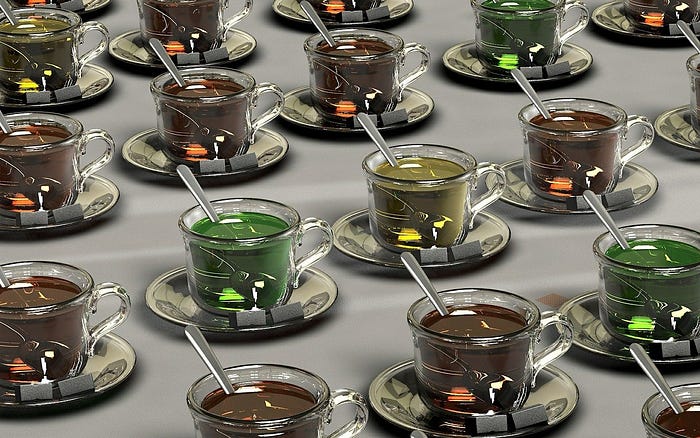

What do the cups of green, yellow and brown liquid make you think about? They make me think about delicious liqueur teas at the Mad Hatter's party in Alice in Wonderland! If you dreamt about these colourful concoctions, your associations would tell you something about the meaning of the dream.
Dreams are mostly produced by your imagining brain or by your sub-conscious mind as compensation for what you are not conscious of.
When you have issues to sort out, or puzzles, or when you've repressed (subconsciously pushed aside or forgotten something) or suppressed (purposely forgotten something) — -whadda, bing, bang — — your thoughts will manifest in your dreams, quite likely.
Dreams are visual and can include sounds and other sensations. Dream elements are reflections of symbolic thinking. We perceive how the world and our lives operate through under-currents common to humanity across the history of humankind, through archetypes and symbols.
Surprisingly, your strange dreams often include elements and meaning, which when you get to the nitty gritty, are common to many.
A dream is spontaneous self-portrayal, in symbolic form, of the actual situation in the unconscious.
A symbol can be an image accessible from the unconscious mind, that the conscious mind can perceive. A symbol is beyond the obvious, i.e. is something with deeper meaning.
Archetypes are expressions of deeper unconscious patterns of instinctual meaning and wisdom. Archetypes are universal or mythic characters or patterns of behaviour. For example, the "mother figure" usually has caring qualities —she is dependable and compassionate.
An archetype is the original pattern or model from which all things of the same kind are copied or on which they are based. It is a model or a first form or a prototype in the collective human psyche.
If you want to read about the 4 to 5 main archetypes (the Self, the Anima, the Animus, the Shadow, and the Persona) according to Carl Gustav Jung, the following article explores them. Sometimes the Anima and the Animus are put together as one archetype, that of "the Anima or Animus."
Dreams can be "big" or "little."
The smaller dreams (not so significant in their impact upon you) can be related to a niggling worry or to wishful thinking or to an enjoyable thing that you did, or can be a "commentary" upon something routine in your life.
"Big dreams revolve around powerful archetypal images from the collective unconscious. Such dreams are guideposts along the path of individuation." [ source: Psychology Today ]
The collective unconscious is a concept originally defined by psychoanalyst Carl Gustav Jung or C.G. Jung. [Note: Jung is pronounced "Yoong"].
It refers to the idea that a segment of the deepest unconscious mind is "genetically" inherited and is not shaped by personal experience. It is responsible for a number of deep-seated beliefs and instincts across all of humankind since the beginning of Homo sapiens (human beings)
An Example of a Big Dream
Giant Spider Transforms into Many Mes
[give the dream a title which makes sense to you ]
There was a lot of action going on — a busy scene. My child-hood home was involved. I knew that a bomb was going to hit an area on the lawn and I wanted to get there and be in the firing line, and be blown up. I was a little bit worried about whether this was the right thing for me to do, but I wanted a way out or relief from something, and was instinctively drawn to the bomb site. I got there, but just before the bomb exploded, someone or something grabbed me and whisked me away through the air.
I then found myself in an old, neglected sort of laboratory. I felt better about myself now, and decided that I should stay around for awhile and see what happens. There was a long narrow corridor or hallway and I walked down to one end to the exit.
But, to my surprise, there was a pit of fire there and I obviously could not leave the laboratory that way. So, I turned and went down to the other end. But at the other end, there was a giant black spider blocking the door-way. I was dismayed and thought I don't want the end to come that way — by being bitten by a spider.
Then I got an idea. I had a sort of weapon (can't remember exactly what it was) and I hurled it at the spider. The spider broke apart and a whole lot of clones of me spilled out of the spider. There were about fifteen mes, all dressed like me, in trousers and shirt, same colours, everything the same.
The dream shifted once again. I was in a big room, standing at the front with a lectern in front of me, giving a lecture. There was a small attentive audience and scattered amongst the audience were the 15 or so mes.
Having "mes' in the audience made me feel more confident. I knew, in the dream, that the "mes" were there in the audience, to help people understand what I was saying, but I can't recall anything at all that I said. The dream ended.
Analysis
Associations
*Childhood home
Hurts or issues from the past still have to be faced, i.e. those things from my personal past which are hindering or dampening my current self-beliefs should be identified.
*Bomb
A change or transformation. A way out — escape.
*Rescue
Someone / something is looking after me.
*Old Laboratory Life is a series of well used experiments.
*Pit of fire The output or results of the bomb — pain and agony.
*Spider The archetype of the "Great Mother".
*Defending myself Realisation that I have a choice. Choosing to live.
*The clones of me Power and potential. New ideas and activities.
*Classroom The class-room of Life where lessons are being learned by all of us.
*At the pulpit lecturing I have got something to offer others.
*Audience with "mes" in the audience There are people wanting to listen to me, and my passion and my "charisma" will help get the message across.
The Dream Message –
I am the Teacher and the Taught and the Teacher's assistant
I feel that this dream was a personal dream about me yearning for good things, in the form of change, whether that change literally be my exiting this world (by being blown up) or by my undergoing a spiritual transformation.
I am very passionate about making our world a better place, and sometimes impatient about such. While on one hand, I am concerned about being all that I can, in order to bring peace and justice to Earth, I also personally need encouragement or acknowledgment and understanding of what I do.
This need was represented by the setting being my child-hood home, where such things were often missing during my earlier years.
In the dream, I was drawn to the "bomb" — I wanted to be blown up — to be rid of the shackles of, and the lack in the 3-D world, but on a deeper level, it was also a wish for transformation.
Dream symbols have deeper meanings than what seems apparent or obvious. The ultimate theme, symbolised by the bomb, was a wish for a "change for the better."
I was whisked away from the danger zone, which means that I was not yet ready for the quick "spiritual transformation" or the escapism that I was seeking.
Everything moves according to its own time, and the dream indicated that I could not yet take the step toward either escape or "full enlightenment". I had other steps to take before that.
The details of the room with the hall-way are very hazy, but I associate a "feeling" or a sense of it being an old, dis-used laboratory.
The word "laboratory" came easily into my mind upon looking back at the dream. To me, this symbolises the experimental nature of existence.
In my dream, I could choose to go through the pit of fire, where I would be burned and hurt.
This is the dream illuminating one pathway offered to me. The pit of fire symbolised a pathway of difficulties and hardships, which I avoided in the dream (having already been "burned" enough in my personal past).
The Spider symbolises creativity and connecting the past with the future (because its web can be said to be spun in the "past" as it connects to its food in the "future").
It can also symbolise possession by the Great Mother.
The "Great Mother" archetype is different to the "Mother" archetype.
If an actual motherly figure appears in a dream, it is likely to represent the principles of positive mother-hood, i.e. caring, nurturing, feeding, listening, helping, etc.
The Great Mother, in a positive light, symbolises the capacity for loving, understanding, helping, and protecting all that is, Life and non-Life, on a global, even a cosmic level.
But some women, possessed by the Great Mother, can become destructive to others, counter-active to the actual intent, by smothering and controlling others too much
I feel, that in my dream, the spider represented my skills or powers in weaving together possibilities (symbolised by the spider's web) and also represented my tendency to think of others before myself, to my own detriment.
The latter association came to my mind, upon analysing the dream, because in the dream it was a scary, large spider. I associated the huge spider with the possessive Great Mother because it felt to me, upon waking, that the spider was overwhelming me.
The archetype of the possessive or devouring Great Mother appeared in my dream as a message from the collective unconscious, that putting others first was "devouring" (me).
But in my dream I transformed the pattern-weaver (i.e. the old me with the tendency to not focus upon self) into something creative and wholesome.
The spider was transmuted into 3-D people, clones of myself — which I believe are wholesome fresh, new ideas, beliefs, feelings and actions emanating or arising from "me".
The clones of me in the dream represent my potential.
The classroom with "mes" in the audience, and me at the pulpit, symbolises that I am the teacher and the taught and the teacher's assistant.
The dream was a powerful dream and had a happy ending, because in the dream-world I chose to empower myself and I chose new Life (or new projects, frameworks, etc.) in order to fulfil my passions
This dream was a "big" dream for me personally, because I saw it as both a "wake-up call" to me, to look at my child-hood/earlier issues and sort them out, and a message to me from the collective unconscious, that there is hope yet to become whole, by looking after oneself as much as anyone else.
I had this dream in 2007 when I was 44 years old. I took heed of the dream and the year after it, I was confident enough to apply for a promotion and I got a paid job that I liked.
The point of me sharing it is to show how the dream elements can be identified and "assessed".
If you have a "big" dream you will probably know it, because you will wake up energised or feeling that you would benefit from working out the messages from your dream. So you should write out your dream as soon as you awake.

Steps to working out the meanings of your dreams
Step One
Write out the dream images, actions, settings, characters, timeline, colours, and all details. Capture these as they happened without trying to make any sense of them, and then ask yourself, "is there an overall theme or plot for your dream?"
You are the best "barometer" or measure of how significant your dream is. Ask yourself, "Is it a small dream or a big dream?
Step Two
Give time to yourself to get in tune with your feelings about your dream. Do you feel happy, worried, sad, neutral, or bewildered over the dream?
If it's a small dream, it may be simply trying to let you know about deep-seated feelings and/or thoughts that you can claim and work on changing.
Often dreams leave you feeling anxious, but don't make/feel yourself "wrong" for this. Instead, consciously work out and acknowledge what your sub-conscious is telling you, and then consciously make changes which will steer you away from anxiety-laden dreams. It's okay to have happy or neutral dreams. In fact, this is what you can aim for!
Step Three
Think about or write down or talk to someone about what you immediately thought the dream was related to. Don't worry over whether what you think or write makes sense.
Give each distinct element in your dream possible meaning(s) by thinking about what is naturally or personally associated with that item, then look for archetypes and symbols (see Step Five).
If you write down your dreams, you may see a pattern or repeat dreams.
You can work with your dreams over time. Mulling over a dream for a few hours or a day can bring up new insights or messages. Let the dream message gently unfold.
Step Four
If nothing clearly comes to mind, treat the dream elements as —
Messages / Replays of similar events / Wants or Desires / Worries or Fears
Step Five
Reflect upon or look up archetypes and dream symbols.
Highlight dream text that you've written that could be an archetype or a symbol. These can be happenings, characters, settings, or other things in your dream.
A symbol is an image accessible from the unconscious mind that the conscious mind can perceive.
A symbol is a character, glyph, image, object, movement, or mark (including sounds) representing an idea or a concept, which doesn't exist in the physical world. A sign is a token of meaning that stands for a known identity, for example, the alphabet constitutes signs for basic sounds.
A symbol is beyond the obvious, i.e. is something with deeper meaning, e.g. a house (an object) can represent the Self. The Self is an archetype which can be represented by the following symbols: mandalas, a house, a God or a Deity, themes of wholeness, and even by a lamb as in "the Lamb of God".
Symbols speak to transcendent truth.
An archetype is a universal pattern of thought or behaviour. Archetypes in dreams can appear as people, animals, objects, or happenings. An archetype cannot be completely expressed in words.
An archetype manifests as a symbol or symbols in your dreams and in the real-world. There are an innumerable number of archetypes, with C.G. Jung focusing on 12 of them.
The "Society of Analytical Psychology" website explains that a dream can be objective (i.e. related to an actual happening) and symbolic and archetypal. Consider the following dream that one of Jung's patients told him.
She is about to cross a wide river. There is no bridge, but she finds a ford where she can cross. She is on the point of doing so, when a large crab that lay hidden in the water seizes her by the foot and will not let her go. (She wakes up in terror).
The symbols are the river, crossing a river, a ford, a crab, and the foot. After talking to the dreamer about her personal associations (e.g. the river symbolised a boundary to her), Jung amplified the dream. See the section below on amplification.
Jung linked the foot with the myth of Osiris and Isis and concluded that "the foot, as the organ nearest the earth, represents in dreams, the masculine nature. Jung thought that the dreamer should embrace her "masculine side" (her ambition and authority and presence).
When looking at your dream, don't get hung up on whether a dream element is an archetype or not.
Draft initial meaning(s) for your dream, based upon your associations, feelings, and current knowledge about working with dreams. The message (s) can be altered upon further work on your dream, including looking at repeat dreams and dreams over time, and pondering upon symbols and archetypes.
Jungian analysts are trained in the field of analytical psychology, founded by Swiss psychiatrist, Carl Gustav Jung. They use amplification to look at dream messages.
Amplification uses mythic, historical, and cultural parallels in order to clarify a dream's meaning.
For example, a spider is associated with webs, so could symbolise patterns you are caught up in. It is an ancient and powerful symbol, that could signify a Creator or a Destroyer, depending upon the context of the rest of the story.
Western society regards spiders as creepy and associate entanglement with spiders. A huge spider or a lot of spiders in your dream could represent the Great Mother archetype in a positive or a negative light, depending upon the context.
North Americans regarded the spider as a helper and the ancient Chinese thought of spiders as good luck. So if your dream had a Chinese background or element and the spider in your dream made you feel energised and happy, it could be a symbol of fortune.
Look up the meaning of archetypes and dream symbols in good sources. I suggest the following 2 references, to begin with.
6. Package it altogether. Give your dream a title as if it is a story, or sum it up with a few words. Incubate your ideas — never rush to work out what a dream is telling you.
The more you study about dreams, the more ease you will have with "interpreting" your dreams. The meaning could be as simple as that in your waking hours you have pushed aside feelings of worry or neglect over a particular thing.
So, for example, if you keep dreaming about not completing a task at work, it could signify that subconsciously you feel a lack of worth regarding your workplace. What is is that you think others expect of you?
When you really think it over consciously, do you actually meet expectations, and have you have been sabotaging yourself? If your inner critic has told you that you don't do things right, your subconscious may give you a dream about not completing something.
Dreams may reflect guilt and worry. The things that you feel guilty and worried about must be fully addressed, and not continually be pushed aside or relegated to being of minor interest or no help.
The gem in the dream is that if you learn to pay attention to it, you will become conscious of your hidden feelings and thoughts, and this bringing to the light of awareness can help you transform it.
A dream can have a symbolic meaning or a literal meaning, or be prophetic by tapping into events in the subconscious plane of space-time (where there is no linear time). Nightmares usually reflect chronically unresolved fears.
A dream can be little or big. I love dreams and have always used them as a tool to help me grow. I am fortunate to have attended a two day screening of 12 hours of interviews of Marie- Louise von Franz by Fraser Boa for "The Way of the Dream" series, in 1990. You can read about that experience at the end of the page, linked below, if you like.
Let your "aha" moment/feeling tell you when you've clearly received the message(s) of your dream. Dreams are one of your best friends, if you let them be!
Last but not least, if you don't remember many of your dreams or rarely have any dreams, don't worry.
Science shows that most of us do have dreams during REM (rapid eye movement) sleep, but don't need to remember them, for good health.
Even if the dream story vanishes before you can write it down, take a moment to absorb the feeling from the dream, and try to remember just one point from the dream. For example, you wake up and your one point is "Oh no, I had that dream again about moving desks at work."
Putting together your conscious thoughts and experiences and other related dreams, you can still ask yourself questions like, "does this dream show that I want a change at work" or "does it show that I feel that work is shoving me around?" What else is happening, or what are you thinking about, at that time in your life, that could illuminate the message(s)?
Your first impressions count. The process of dreaming is emotional therapy. Dreaming is a way of re-prioritising information that we are bombarded with throughout our waking day. Dreams help people de-escalate emotional reactivity, even if you don't consciously recall your dreams upon waking.
Carl Gustav Jung said that:
"Dreams are impartial, spontaneous products of the unconscious psyche, outside the control of the will. They are pure nature; they show us the unvarnished, natural truth, and are therefore fitted, as nothing else is, to give us back an attitude that accords with our basic human nature when our consciousness has strayed too far from its foundations and runs into an impasse.
It can take time and effort to decipher your dreams, but I think it is worth it.
Dreams are not always scary or unpleasant. Dreams can be wonderful and uplifting. They are simply nature's way of speaking to you, from the subconscious, or some say, from the Soul.
© Celine Lai, 2021