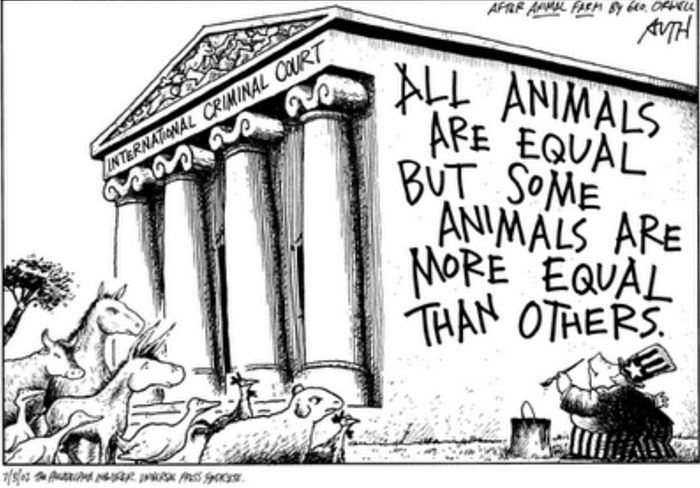
The barn was never meant to bow to the farmhouse. That was the promise carved into its walls after the rebellion: this place would belong to the animals alone, governed by commandments, not by men's whims.I have lived long enough to know that nothing lasts on this farm. Donkeys live a long time; none of you has ever seen a dead one.
So when the barn was declared sacred, separate from the farmhouse, ruled only by the words painted on the wall, I kept my silence. The young ones brayed with hope, but I knew chalk fades quickly in the rain.
For a while, the pigs in the barn played their part. They weren't saints, but they worked with a kind of dignity, and the others believed them. Snowball, they thought, would inherit this burden. Even Boxer, blind in his loyalty, whispered to me once that perhaps the barn would remain ours. I did not answer.
Then one morning, the commandments changed. Not smudged by weather, but rewritten with a firmness that smelled of decree. Snowball was cast out, the elders stripped of their places, and in their stead rose Napoleon. Napoleon was lifted into place, not by toil in the barn, but by dogs at his heel and men at his table. Authority, it seemed, could be manufactured. The line between barn and farmhouse vanished overnight. Squealer, with his silver tongue, addressed the animals: 'Comrades, what we embark upon is a noble cooperation, a togetherness that secures our future!' The animals wanted to believe. They always want to believe. 'Togetherness,' they echoed, when the walls themselves bent toward the farmhouse. In the silence that followed, I thought of Squealer's words. 'Coordination,' I muttered, 'a fine word for obedience.'
I remembered Snowball's plans for the windmill, drawn up in careful lines, promising light, warmth, and ease for all. The sheep bleated him down, Napoleon chased him out, and yet, when the dust settled, the windmill was declared Napoleon's vision. But he had no gift for it, no plan beyond slogans. So the animals were driven harder than ever, breaking their backs to raise stone upon stone, while the pigs feasted and the farmhouse men clinked glasses. What was meant to be a symbol of progress became a monument to exhaustion, covering Napoleon's lack of capacity with the sweat of others.
The elder pigs, the ones who had spent years carrying the barn on their backs, were stripped of their places. Some were cast aside, others sent off on "duties" that silenced them. I watched as they shuffled off, some with bowed heads, some with clenched jaws. And when they dared to raise their voices, the dogs growled, and Squealer's tongue turned their protests into crimes.
But then, something I had not expected: the silence broke. The elders, worn but not yet broken, carried their grievances before the Council. For the first time, the barn's quarrels spilled into the open, no longer whispered in shadows. Even I lifted my head from my trough that day. Never had pigs dragged one of their own into the light, especially one cloaked in the farmhouse's favor.
And yet, I do not fool myself. The wall still says all animals are equal, but I have read enough words in my life to know how easily they are repainted. The animals wait, restless, wondering if the barn will once again stand apart, or if it has become just another room in the farmhouse. As for me, I keep my silence.
Donkeys live a long time. I've seen how stories end.
Author's Note: This piece is a work of literary allegory, written in the tradition of George Orwell's Animal Farm. It reflects timeless themes of power, governance, leadership, and the fragility of collective ideals. The narrative voice of this piece is inspired by Benjamin, the donkey in George Orwell's Animal Farm and is drawn from how I understand the world around me.