
When Linda McMahon, Trump's Education Chief and former WWE executive, took the stage at the ASU+GSV Summit in San Diego — a flagship event exploring the future of learning — attendees expected a mixture of insight, policy perspective, and bold commentary.
What they didn't expect was a strange twist in the form of a repeated error: McMahon continually referred to artificial intelligence not as "AI," but as "A1."
It might seem amusing, even innocuous. But in an era when AI is fundamentally reshaping how we learn, teach, and think about knowledge, this kind of mistake raises an important question:
What happens when the people shaping the future of education don't speak the language of the future?
Because this isn't just a funny flub — it's a revealing moment about how seriously our leadership takes innovation, and how prepared they are to guide us through it.
A Small Mistake, or a Major Disconnect?
Let's not be too quick to dismiss McMahon's repeated "A1" references as a harmless slip. AI is no longer a futuristic buzzword — it's the engine driving everything from personalized learning paths to automated grading and data-driven school operations.
Calling AI "A1" in a national education forum is more than an outdated misstep. It suggests a disconnection from the core technologies driving tomorrow's schools.
Imagine a Secretary of Energy misidentifying nuclear fission as "fiction." Or a Transportation Secretary calling electric vehicles "electro vans." It's not just embarrassing. It undermines credibility and raises real questions about competence.
So what does it mean when the figurehead of education policy misunderstands a foundational concept shaping education's future?
Policy, Perception, and the Price of Ignorance
In politics, perception often matters as much as policy. McMahon's "A1" error immediately went viral — not because it was offensive, but because it was emblematic.
To critics, it confirmed long-standing fears: that our national education leadership lacks a deep understanding of the technologies they're expected to govern.
This isn't just about AI — it's about a larger disconnect. Education leaders must navigate complex issues like student data privacy, algorithmic bias, edtech regulation, and classroom automation. A superficial understanding simply isn't enough.
And yet, these roles continue to be filled based on political alignment, not technological fluency or educational experience.
If we expect students to be future-ready, shouldn't their leaders be too?
What If the Future Arrives Before We're Ready?
Let's consider a scenario that's already unfolding in pockets around the world.
A middle school in Chicago uses AI-powered platforms to adjust assignments in real time based on each student's learning curve. In Shanghai, a virtual teaching assistant answers student questions 24/7 using a localized AI model. In Helsinki, AI tools help teachers detect early signs of learning disabilities before they escalate.
Now imagine an education secretary who can't articulate how these technologies work, let alone develop policies to guide their ethical use.
That gap — between technological innovation and policy understanding — can be dangerous. It can slow adoption, increase risk, and deepen inequities.
What if students in wealthier districts get access to high-quality AI tutoring while others are left with outdated textbooks and overworked staff?
What if unregulated AI tools reinforce racial, gender, or learning biases?
What if education policy becomes so disconnected from real classroom technology that it's essentially irrelevant?
The Uncomfortable Truth: AI Is Advancing Faster Than Education Policy
AI is evolving rapidly, often faster than traditional educational structures can respond. School boards, unions, and curriculum developers are playing catch-up, while edtech companies race ahead with new products every month.
This creates a complex dynamic. On one hand, AI has the potential to transform education — making it more personalized, accessible, and effective. On the other, it brings risks around data privacy, surveillance, algorithmic bias, and teacher displacement.
Who should be guiding these conversations? Ideally, someone with both educational experience and technical fluency.
Instead, we have leadership that mistakes AI for A1.
A Department Meant to Be Dismantled?
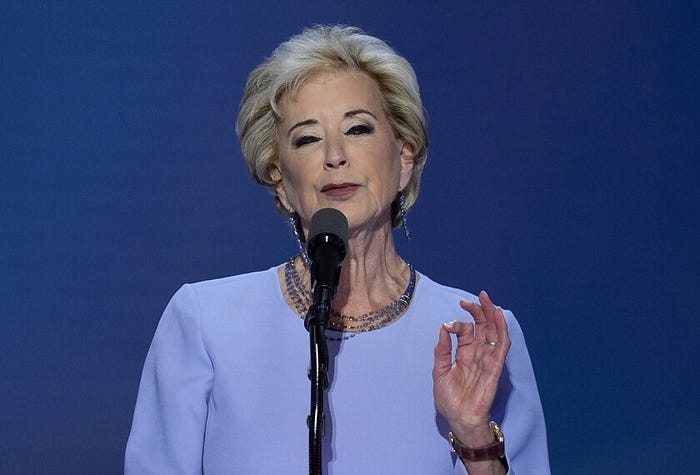
McMahon's appointment came with another layer of controversy. Reports suggest she accepted the role with the explicit intention of dismantling the Department of Education — a goal shared by former President Trump.
While abolishing the department entirely requires congressional approval, the administration did what it could to weaken it through budget cuts and strategic rollbacks.
The irony is stark. At a time when education needs more investment, oversight, and innovation, the focus from leadership has been on scaling back, not scaling up.
What if instead of gutting the department, its leadership had committed to reimagining it — investing in AI integration, digital equity initiatives, and teacher training?
What could American education look like if we took the digital revolution seriously?
AI in the Classroom: Present Tense, Not Future Tense

It's easy to talk about AI in education as a future issue, but the reality is it's already here.
- Adaptive learning platforms are tailoring instruction to individual student needs.
- AI teaching assistants are answering routine questions and managing feedback loops.
- Predictive analytics are helping schools identify students at risk of failing or dropping out.
These tools aren't theoretical — they're active, functioning, and, in many cases, outperforming traditional methods.
So what happens when the people making decisions about AI in schools don't understand how these tools work?
There's a growing risk that innovation will be shaped not by thoughtful policy, but by private interests. Without informed regulation, the most powerful players in AI education will be corporations — not educators.
Rethinking Leadership in the Age of Intelligent Education

Let's reimagine what qualified education leadership could look like in a world transformed by AI.
What if the next Secretary of Education had a background in both classroom teaching and AI ethics?
What if policy decisions were informed by technologists, child psychologists, ethicists, and students themselves?
What if AI literacy was a core requirement for any national education leader?
It's not about age. It's about mindset. There are 70-year-olds building machine learning models and 30-year-olds struggling with TikTok.
The key difference isn't demographic — it's intellectual agility.
The AI Literacy Gap Is a National Risk

Whether we're talking about ChatGPT writing essays, Midjourney being used in art class, or machine learning models predicting student performance, the reality is clear: AI is now part of how students learn and teachers teach.
But the AI literacy gap — between those who understand these tools and those who don't — is growing.
And that gap exists not just among students or teachers, but at the very top.
Closing it requires more than workshops or online courses. It requires a cultural shift: one that values curiosity, innovation, and continuous learning among leadership as much as it does in the classroom.
Five Steps Schools Can Take Without Waiting for Washington
National leadership may lag behind, but local districts don't have to. Here are five actionable ways schools can start bridging the gap now:
1. Provide professional development in AI for teachers. Not just what AI is, but how to use it meaningfully and ethically in classrooms.
2. Create AI use policies grounded in ethics. Draft guidelines that respect student data, avoid bias, and promote transparency.
3. Audit existing edtech tools. Many already use AI. Understand how — and whether — they're aligned with your values.
4. Empower students to lead. Form student-led tech councils to guide AI integration and offer peer training.
5. Collaborate with communities. Engage parents, local tech companies, and universities to support responsible AI use.
A Teachable Moment, If We Choose to Learn
McMahon's "A1" moment is, ironically, a perfect example of what educators call a teachable moment. We can choose to dismiss it as a harmless gaffe — or we can see it for what it is: a mirror reflecting deeper gaps in our leadership and our system.
Because the real issue isn't that one official got the acronym wrong.
It's that too many people in positions of power are still treating AI like a side topic, when it's actually becoming the central nervous system of modern education.
GAME CHANGER MOMENT
Artificial intelligence is not a trend — it's a transformation. And education, more than any other domain, stands at a crossroads.
We can either lead with vision, empathy, and intelligence — or we can stumble into the future with outdated frameworks and uninformed leaders.
Linda McMahon's mistake at the ASU+GSV Summit might feel like a meme, but it's also a message.
If we want students prepared for a world defined by AI, we need leaders who understand AI. Not as a catchphrase. Not as a buzzword. But as a tool with immense power to build — or break — the future.
The next generation deserves nothing less.
Follow for more articles on the intersection of AI, education, innovation, and leadership. Stay informed, stay curious, and stay ahead.