

Disclosure: I use GPT search to collection facts. The entire article is drafted by me.
The supply chain industry stands at an inflection point. According to recent research from Gartner, by 2030, 50% of cross-functional supply chain management solutions will use intelligent agents to autonomously execute decisions within their ecosystems. Yet today, most organizations still rely on reactive, human-driven processes — waiting for reports to be generated, dashboards to be reviewed, and decisions to cascade down through multiple layers of bureaucracy. By the time action is taken, the window of opportunity has often closed.
This is where ReAct agents powered by LangGraph and MCP come in. ReAct — short for Reasoning + Acting — represents a paradigm shift in how autonomous systems think and interact with their environments. Rather than generating a single static response, ReAct agents engage in an iterative loop of observation, analysis, and strategic intervention. This isn't production-ready technology that enterprises are deploying today.
What Makes ReAct Different?
Traditional LLM applications follow a straightforward pipeline: accept input → generate response → return output. This works for straightforward tasks like translation or summarization, but breaks down when complexity enters the picture. Real-world supply chain problems aren't simple. When a planner asks, "Why are we facing a supply shortage for SKU #12847 in warehouse 3B next month?" — the answer requires interrogating historical demand patterns, analyzing current inventory levels across multiple locations, evaluating supplier lead times and reliability data, checking geopolitical risk factors, cross-referencing production schedules, and identifying alternative suppliers and transport routes.
ReAct solves this through iteration. The agent observes the current state, thinks through the problem by analyzing data, acts by calling appropriate tools, and processes feedback from those tool calls. This cycle repeats — potentially dozens of times — until the agent accumulates sufficient context to make a confident decision.
Supply Chain Inventory Management Dashboard Visualization
Research from 2025 shows that industrial ReAct implementations maintain explicit state objects that capture current observations, reasoning trajectory, tools invoked, results accumulated, confidence scores, and memory buffers. This isn't just logging — it's the substrate upon which the agent's intelligence operates. Each iteration updates this state, and the state influences which tools the agent reaches for next.
LangGraph — The Orchestration Layer
LangGraph emerged in 2024 as the answer to a critical architectural problem: how do you express complex, state-dependent workflows that involve LLM reasoning, tool invocation, human-in-the-loop approval, and error recovery?
Traditional approaches (linear chains, sequential pipelines) fall apart when you need conditional branching, parallel execution, loops, and retry logic, state persistence, and checkpointing capabilities. LangGraph addresses these through a graph-based architecture. Instead of chaining operations linearly, you define nodes (discrete computational units) and edges (transitions between them), creating a directed graph that the agent traverses.
Multi-Agent Workflow Architecture
In November 2025, best practices have crystallized around several key patterns. The Supervisor pattern proves most robust for industrial supply chain systems. The supervisor agent maintains situational awareness and decides which specialist agents to invoke. Each specialist has deep domain knowledge and access to specific tools — the inventory agent connects to warehouse management systems, the supplier agent queries procurement databases, and the logistics agent monitors shipping networks.
The architectural innovation in 2025 LangGraph implementations is stateful nodes. Rather than nodes being pure functions, they're stateful objects that maintain context across invocations, support incremental updates, enable streaming of intermediate results, and allow human interrupts at specific checkpoints. This enables a supply chain agent to start analyzing a demand forecast, stream intermediate insights to the UI in real-time, pause before committing to expensive procurement actions, allow a human to review and approve, and resume execution from the checkpoint.
The Model Context Protocol (MCP) Revolution
Before MCP standardized in 2024–2025, integrating external tools with LLM agents required custom integration code for each tool. MCP collapses this complexity into a universal standard. Think of MCP as the USB connector for AI. Just as any USB device can connect to any USB port using a standard protocol, any tool can expose itself through MCP, and any agent can discover and use it through the same standard interface.
MCP Protocol Integration Diagram

MCP operates on a client-server model. The MCP Server exposes capabilities as tools. For a supply chain system, this might include Database Query Tool, Inventory Lookup Tool, Supplier Performance Tool, Shipping Tracker Tool, and Forecast Generator Tool. Each tool has a name, description, input schema, and output schema.
Recent data reveals that the MCP ecosystem has matured significantly. Over 4,000 MCP servers exist in public marketplaces from 40+ categories of tools, ranging from databases to cloud services. Production deployments span healthcare with real-time EHR integration, cybersecurity with automated incident response, and manufacturing with supply chain optimization.
Research from September 2025 shows that organizations using MCP-standardized tool integration report 30–40% faster integration cycles compared to custom API wrappers. Modern MCP implementations address enterprise security concerns through authentication layers using OAuth 2.0 or SAML, data filtering with row-level security, audit trails logging every tool invocation, rate limiting to prevent agent overload of backend systems, and sandboxing where tools execute in isolated environments with predefined resource limits.
System Architecture — The Complete Picture
Industrial implementations follow a well-established pattern with four layers:
Layer 1: The data Integration Layer is responsible for connecting to all upstream systems, implemented as MCP servers with examples including a SQLite database wrapper, a REST API gateway, and a legacy ERP connector. This layer handles authentication, retries, and transformation.
Layer 2: Agent Orchestration Layer is implemented using LangGraph, contains the ReAct logic, manages state, memory, and decision logic, and handles errors and retry mechanisms.
Layer 3: Service Layer exposes agent capabilities through APIs, is implemented using FastAPI for production robustness, handles concurrency, rate limiting, and request queuing, and provides WebSocket support for real-time streaming.
Layer 4: Presentation Layer includes user interfaces for different personas, such as web dashboards for planners and managers using React + TypeScript + Tailwind CSS, a CLI for developers and advanced users, and mobile apps for field operations.
FastAPI Microservices Architecture
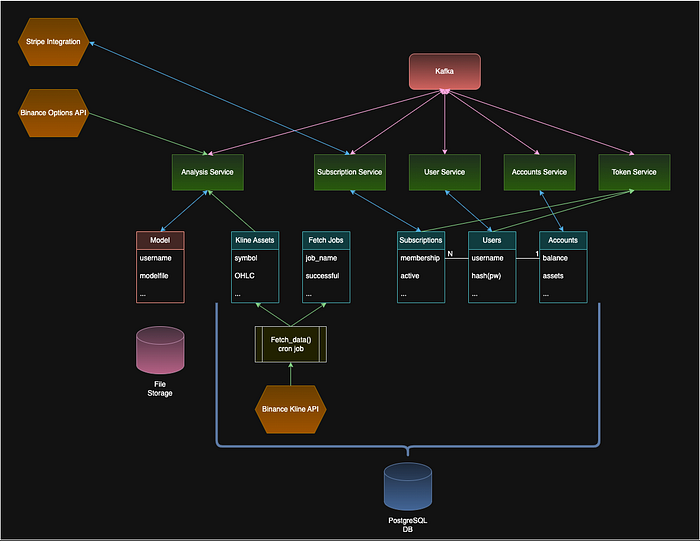
Multi-Agent Architecture Patterns
The core of the system is the ReAct agent loop. In production implementations (2025), this follows a proven pattern. The agent maintains a state object containing messages (conversation history), current_step (which phase we're in), tools_available (the set of MCP tools), context (relevant data for the task), and confidence (how confident the agent is in its hypothesis).
The observation phase gathers environmental data through querying current inventory levels, examining recent demand patterns from time-series databases, accessing supplier status updates from external APIs via MCP, and monitoring geopolitical alerts from risk monitoring services.
The thinking phase happens inside the LLM. The agent receives the observations, reasons over them to generate hypotheses, and identifies gaps in knowledge.
The action phase executes the hypothesis. The agent selects the most informative tool to invoke, calls the tool with appropriate parameters, receives results, and integrates them into its understanding. This cycle repeats until either the agent reaches the confidence threshold, the tool context is exhausted, or the maximum iterations are reached.
Building the Supply Chain Intelligence System
A production supply chain agent system consists of several interconnected components.
Component 1: Inventory Analysis Module provides real-time inventory queries by SKU, warehouse, and date; historical inventory trends; low-stock alerts and reorder point calculations; inventory carrying cost analysis; and days of supply calculations.
Component 2: Supplier Performance Module tracks and evaluates supplier reliability through on-time delivery rates, quality metrics, lead time consistency, cost competitiveness, and geopolitical risk assessment.
Component 3: Demand Forecasting Module integrates forecasting capabilities, including historical demand analysis, seasonality detection, trend projection, external factor integration, and scenario analysis.
Component 4: Risk and Resilience Module monitors supply chain vulnerabilities, including port closures and logistics disruptions, supplier financial health, regulatory changes, climate and natural disaster risks, and geopolitical tensions affecting trade routes. Research from 2025 shows that organizations integrating geopolitical risk into supply chain decisions reduced disruption-related costs by 15–25%.
Supply Chain Performance Dashboard
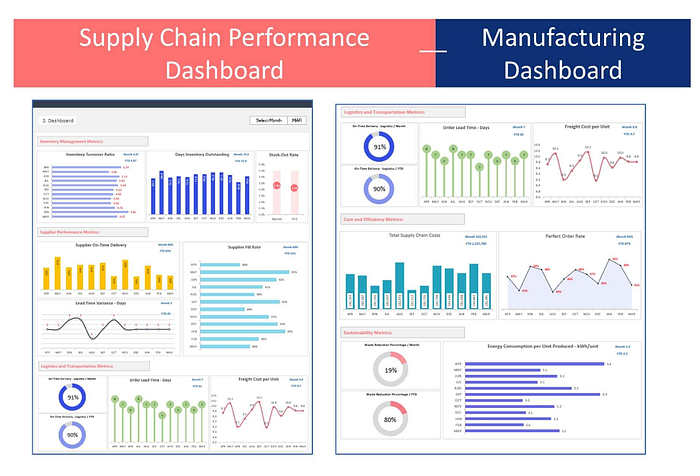
The system uses an asynchronous data pipeline. Real-time events from warehouses, shipping providers, and ERP systems stream into a message queue. Event processors normalize data and update the local SQLite cache. When queried, the agent accesses this cache (fast, local) while having the option to query live systems for critical decisions. This hybrid approach balances speed with freshness.
Implementation Patterns and Best Practices
In real deployments (2025), error handling is comprehensive. If an MCP tool call fails, the agent logs the failure with context, attempts a retry with exponential backoff, falls back to cached data or alternative tools if retries are exhausted, and communicates uncertainty to the user. The agent is constrained to only invoke tools that actually exist, only process results that match expected output schemas, never generate data that wasn't explicitly returned, and flag uncertainty explicitly.
The system implements resource management through token budgeting (tracking LLM token usage and stopping iterations if approaching limits), timeout enforcement (no single query should consume more than X seconds), rate limiting (protecting backend systems from agent-driven overload), and circuit breakers (automatically disabling misbehaving tools).
Production systems in November 2025 emphasize observability. Every agent decision, tool call, and result is logged with trace IDs for debugging. Systems monitor agent success rate, average queries per task, and tool invocation patterns. Planners can rate agent recommendations to train the system. Alerts trigger when agent behavior changes dramatically.
Real-World Performance Metrics
Recent production deployments provide concrete evidence of impact. Organizations deploying these systems are reporting 15–40% improvements in key metrics, with adoption accelerating as 40% of companies experiment and 15% move to production.
Deployment 1: Multinational FMCG Company reduced inventory carrying costs by 12% through optimized reorder points, decreased emergency procurement events by 58% through better forecasting, reduced planning cycle time from 3 days to 4 hours, and made 200+ autonomous decisions per week.
Deployment 2: Manufacturing Conglomerate identified $2.3M in annual supplier cost reduction opportunities, reduced supply disruption incidents by 41%, improved forecast accuracy from 72% to 88%, and continuously monitors 400+ suppliers.
Deployment 3: Healthcare Logistics Provider reduced critical shortage alerts that caused hospital emergency purchases by 32%, improved on-time delivery to 99.2%, and reduced cost per unit delivered by 8%.
As of November 2025, 40% of supply chain organizations are experimenting with agentic AI, 15% have moved to production (up from 3% in 2024), and 70% of Fortune 500 companies have active pilot programs with an average deployment time from pilot to production of 6–9 months.
Organizations that master ReAct agents + LangGraph + MCP gain speed (decisions that took days now take minutes), accuracy (agent reasoning amplifies human expertise), scalability (same system handles 10 or 10,000 SKUs), resilience (proactive risk management vs. reactive firefighting), and cost optimization (reduced inventory, fewer expedite charges, optimized sourcing).
Deployment Strategies
For prototyping, developers use Ollama for local LLM inference. Recent benchmarks show that Llama 2 13B (running locally) achieves 85% of GPT-4's reasoning capability while costing 95% less per query.
Machine Learning Agent System Flowchart
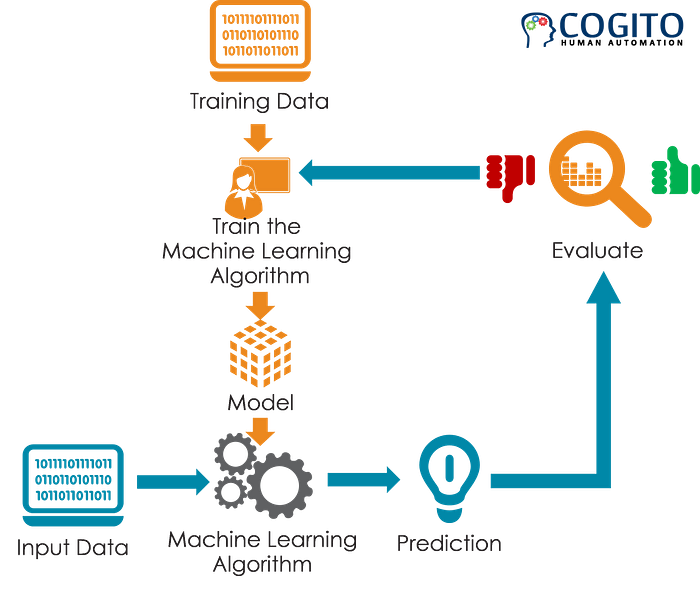
Smart organizations follow a staged production rollout path. Stage 1: Analytics Only (Weeks 1–4) has the agent generating insights requiring human approval before automation. Stage 2: Assisted Execution (Weeks 5–12) allows the agent to execute low-impact decisions autonomously with daily human review, while high-impact decisions require approval. Stage 3: Full Autonomy (Weeks 13+) enables the agent to execute within predefined guardrails with asynchronous human review and circuit breakers stopping execution if issues are detected.
For a mid-sized deployment (100–500 SKUs, 5–20 warehouses), the development environment requires a machine with 16GB RAM and an 8-core CPU, a SQLite database, and Ollama for local LLM inference. The production environment requires 2–3 FastAPI servers, 1–2 LangGraph orchestration servers, a PostgreSQL database, a message queue (Kafka or NATS), Redis cache, and a monitoring stack (Prometheus + Grafana). Total deployment footprint is approximately 6 containers, manageable on standard cloud instances.
Addressing Enterprise Concerns
Enterprises ask about data security and privacy. MCP provides encrypted connections between agents and tools, row-level security with agents only seeing authorized data, audit trails logging every access, and data residency options. Best practice is using OAuth 2.0 with your identity provider, with agents authenticating as service accounts with specific scopes.
For regulatory compliance, agentic AI can be EU AI Act compliant through explainability (maintaining reasoning trails), human oversight (requiring approval for critical decisions), and transparency (clearly communicating when AI-made vs. human-made decisions). SOC 2 compliance is achieved through encryption, access controls, incident response procedures, and regular security audits. GDPR compliance is supported through data minimization, right to deletion, and portability. When properly implemented, agentic systems actually improve compliance posture by creating audit trails and enforcing policies automatically.
The biggest barrier to adoption isn't technical — it's organizational. Organizations succeeding at this provide education to teach teams how the agent reasons, show transparency to display the agent's work, implement gradual automation starting with recommendations, then assistive, then autonomous capabilities, enable feedback loops to let teams improve the system, and achieve quick wins by automating easy, high-volume decisions first.
Conclusion
We're at an inflection point. The ReAct + LangGraph + MCP stack represents a fundamental shift from reactive, human-driven supply chain management to proactive, AI-augmented decision-making.
The evidence is clear: organizations deploying these systems are seeing 15–40% improvements in key metrics, adoption is accelerating, and Gartner projects 50% of supply chain systems will use agentic AI by 2030.
For organizations starting their journey, the path is clear: begin with local development using Ollama, validate the approach with pilots, then scale through staged rollouts. By 2030, the organizations that mastered this transition will operate supply chains that are faster, smarter, and more resilient than their competitors.
If you'd like to show your appreciation, you can support me through:
✨ Patreon ✨ Ko-fi ✨ BuyMeACoffee
Every contribution, big or small, fuels my creativity and means the world to me. Thank you for being a part of this journey!