
They are not.
They show up as system outages, missed deadlines, client escalations, people issues, or sudden business shocks. What separates strong teams from struggling ones is not the crisis itself, but how they respond in the first few days.
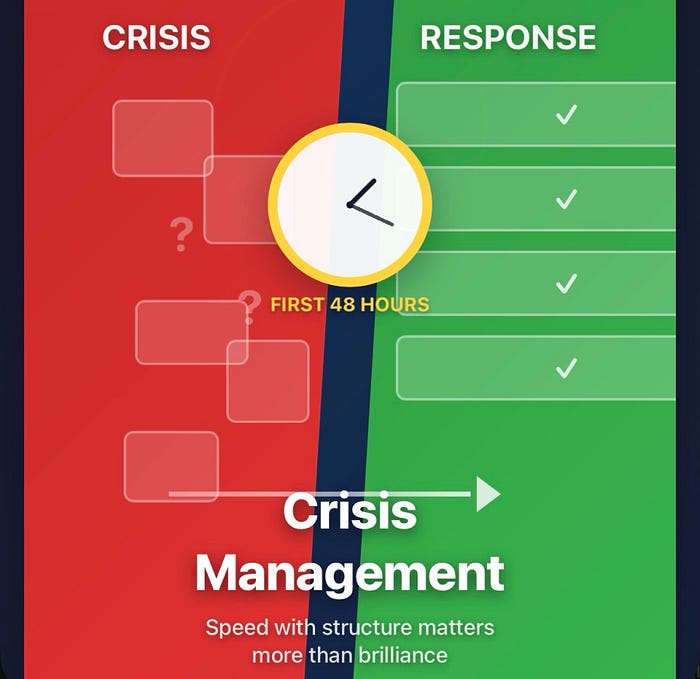
This article breaks down crisis management in plain terms – what fails, what works, and who usually steps up.
⸻
The First 48 Hours Decide Everything
In most crises, the biggest damage does not come from the original problem.
It comes from delay, confusion, and poor decisions that follow.
Across industries, patterns repeat:
• Early decisions shape most of the final impact
• Waiting for full clarity increases cost and stress
• Teams that act early recover faster, even if their first decision is not perfect
Speed with structure matters more than brilliance.
⸻
What Actually Breaks During a Crisis
When things go wrong, teams often assume the issue is technical or external.
But post-incident reviews tell a different story.
Most crises escalate because of:
• No clear decision owner
• Fear of escalation
• Too many people involved in decisions
• Silence or mixed messages
• Emotional reactions under pressure
Very rarely is the root cause lack of skill.
⸻
Decision-Making Under Pressure
In a crisis, information is incomplete. Waiting for certainty feels safe, but it usually makes things worse.
What works better:
• One clear decision owner
• Clear priorities, not long task lists
• Decisions made with partial information
• Willingness to adjust quickly
A fast decision that can be corrected is better than a perfect decision made too late.
⸻
Communication Is Not Optional
Silence during a crisis creates anxiety.
Over-polished communication creates delay.
What teams need is simple:
• Early updates, even if there is uncertainty
• Honest acknowledgment of what is known and unknown
• Clear internal alignment before external communication
People handle bad news better than no news.
⸻
How People Behave Under Pressure
Pressure changes behavior.
Some people take charge.
Some freeze.
Some become defensive or emotional.
Some wait for permission.
This is normal.
What matters most is leadership behavior. Teams often mirror the emotional state of their leaders. Calm leadership creates focus. Panic spreads quickly.
⸻
Who Usually Thrives in a Crisis
The people who perform well during crises are not always the most senior or visible.
They tend to:
• Focus on the top two or three priorities
• Ask clear, practical questions
• Separate emotion from action
• Act, review, and adjust quickly
These are learned behaviors, not personality traits.
⸻
After the Crisis Is Where Maturity Shows
Many teams move on as soon as the crisis ends. This is a mistake.
Strong teams:
• Run blameless retrospectives
• Identify process gaps
• Clarify ownership and escalation paths
• Make small but meaningful changes
This is how organizations reduce repeat crises.
⸻
The Real Lesson
Crisis does not build capability.
It reveals what was already there.
• Clear ownership
• Decision speed
• Communication habits
• Leadership behavior
The best time to prepare for a crisis is when everything feels stable.
Because when pressure hits, there is no time to build systems. You can only rely on the ones you already have.