
Your Prospect Thinks They Have an AI Strategy. They Actually Have 82% of Their Employees Using Tools Nobody Approved. Sell the Fix.
"We're in great shape with AI," he said. "We deployed an enterprise ChatGPT license last year. Everyone's using it. We've got guardrails in place."
I asked one question.
"How many of your employees are using their personal ChatGPT accounts, Gemini, Claude, or other AI tools that didn't go through IT procurement?"
Silence.
"I don't know," he said. Then: "We didn't ask."
That answer is worth $15K per month. Because I know the real number.
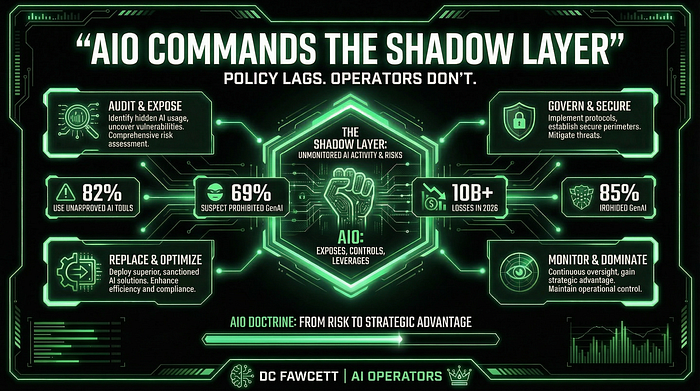
Atomicwork's 2026 AI in IT report revealed that 82% of end users are running AI tools their company never approved, and nearly 80% of them are doing it at least weekly.
That's not adoption. That's shadow AI. And it's the single largest unaddressed risk and opportunity in enterprise AI today.
The data on shadow AI in 2026 is staggering.
→ 82% of employees use AI tools their company never procured (Atomicwork)
→ 69% of organizations suspect or have evidence of employees using prohibited GenAI tools (Gartner)
→ 68% of employees use AI tools without IT approval
→ Only 47.1% of corporate AI agents are actively monitored or secured (Gravitee 2026)
→ $10 billion+ in losses predicted from ungoverned GenAI use in 2026 (Forrester)
And perhaps most alarming: employee trust in company-provided GenAI fell 31% between May and July 2025, while trust in agentic AI systems dropped 89% in the same period (Deloitte TrustID Index).
Employees don't trust the company's official tools, so they use their own.
Okta, one of the largest identity management companies on the planet, just launched security tools specifically designed to detect shadow AI agents. When Okta builds a product to solve a problem, the problem is real, widespread, and expensive.
Here's what this means for operators: your prospect's "AI strategy" is a fiction. The real AI strategy is whatever 82% of their employees are doing on their personal accounts, without oversight, without governance, and without anyone tracking what data is being uploaded to which external service.
This crisis is your entry point. Not for deploying new AI. For governing the AI that's already running without permission.
The Shadow AI Audit and Governance Engagement runs in 5 phases.
Phase 1 is Shadow AI Discovery. Survey the organization. Interview department heads. Scan network traffic for API calls to external LLM providers (OpenAI, Anthropic, Google). Map which employees are using which tools, how frequently, and what data they're feeding into them. The findings always shock the C-suite. Always. Because nobody has ever asked.
Phase 2 is Risk Quantification. Turn the discovery into dollars. How much sensitive data has been uploaded to external AI tools? What's the regulatory exposure if client data or financial records were shared with an unsanctioned platform? With EU AI Act enforcement approaching and Forrester projecting $10B+ in losses from ungoverned GenAI, the risk calculation isn't hypothetical. It's imminent.
Phase 3 is the Governance Framework. Design the rules: which AI tools are sanctioned, which are prohibited, what data can be input, what requires approval, and what audit trails are required. This isn't about restricting AI. It's about channeling it. Companies with proper AI governance push 12x more AI projects to production than those without. Governance accelerates. Chaos stalls.
Phase 4 is the Managed AI Environment. Replace shadow tools with sanctioned operator-managed alternatives that provide the same convenience employees want plus the governance leadership requires. When your managed AI system is faster and more capable than the personal ChatGPT account, employees switch voluntarily. The same strategy that solved shadow IT works for shadow AI: provide something better, not something restricted.
Phase 5 is Ongoing Shadow AI Monitoring. Shadow AI isn't a one-time fix. New tools appear monthly. New employees bring new habits. The operator builds continuous monitoring that catches unauthorized AI usage in real-time and channels it into the governed environment. This retainer is the gift that keeps giving, because the problem literally regenerates itself every time someone installs a new browser extension. 🛡️
Your prospect doesn't need more AI. They need control over the AI that's already running without their knowledge.
82% of employees. No governance. No audit trail. No idea what data is leaving the building.
That's not a technology problem. It's an operator opportunity.
The lesson that applies here is the same one that applied in 2003 when I was buying media for direct mail: you can't optimize what you can't see. And right now, nobody can see what their employees are doing with AI.
The operator who provides visibility, governance, and a managed alternative becomes the most trusted person in the building. Not because they built the coolest AI. Because they brought order to chaos.
Shadow AI is the crisis. Governance is the product. The operator is the one who delivers both.