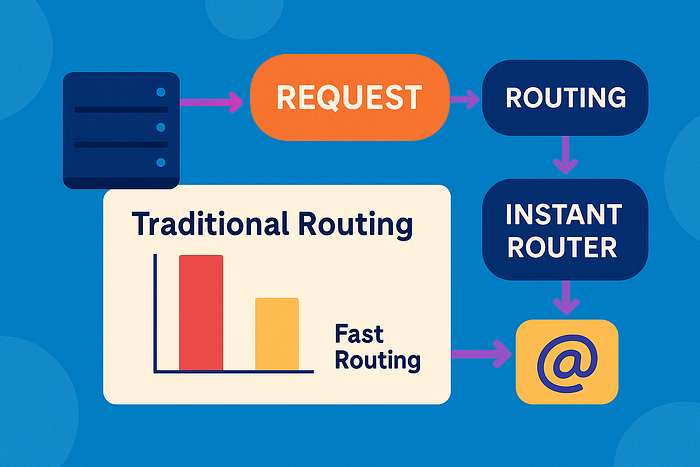


If your PHP app is still relying on regex-heavy routing tables that chug through hundreds of definitions on every request, you're not scaling — you're stalling.
And no, it's not just a "micro-optimization" problem.
We're talking about real millisecond leaks that add up, especially when you're serving thousands of requests per second or deploying on edge runtimes where every nanosecond is a fight for survival.
Traditional routing mechanisms in PHP — the kind that rely on linear route matching — are dinosaurs in a Formula 1 race.
They weren't built for speed. They were built for readability, flexibility, and honestly… for frameworks that thought dev experience was everything.
Well guess what? Dev experience means nothing if your users bounce before your route handler even loads.
The Real Problem with PHP's Routing Style
Let's break down what's actually going on under the hood.
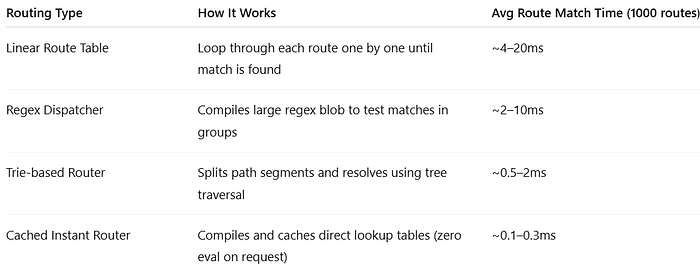
Yeah, instant routers shave off nearly everything that happens between request and controller execution. It's not magic. It's math, data structures, and not being stuck in 2007.
What's Actually Slowing You Down?
Most popular PHP routers — like those in Laravel, Symfony, Slim, or Lumen — still scan routes sequentially. Even if they optimize the match via regex groups, it's still a per-request CPU task.
Worse? Some implementations don't even cache the compiled routes unless you explicitly warm them up.
And while route caching does help — it's a band-aid. You're still decoding regex, mapping closures, evaluating middleware stacks, and invoking class resolution logic every single time.
Let's call it: Routing latency tax.
And it's invisible to most devs because they're profiling the database or blade templates.
Meanwhile, the route resolution phase is quietly eating 10–25% of your total request lifecycle on high-concurrency apps.
So What the Hell Is an Instant Router?
An instant router is a routing engine that precompiles all possible routes into pure PHP lookup structures — think associative arrays or tries — and bypasses runtime matching logic entirely.
Instead of evaluating route definitions when the request hits the server, it does the heavy lifting during build or deploy time. That means at runtime, it's just doing:
$controller = $precompiledRoutes[$method][$path] ?? null;Boom. No loops. No pattern matching. No closures. Just raw, native-speed lookups.
This is the same playbook used in edge-native platforms like Cloudflare Workers and frameworks like Vercel's turbopack.
And yes, PHP can do it too — if you stop worshipping your route files like scripture and start generating lookup maps like a mad scientist.
Want Numbers? Let's Talk Real Scenarios
Let's say your app has:
- 600 routes
- 50% are parameterized (e.g.
/user/{id}) - 30 middleware layers total
- Redis-backed session
- Runs behind NGINX with PHP-FPM
Now compare two setups:
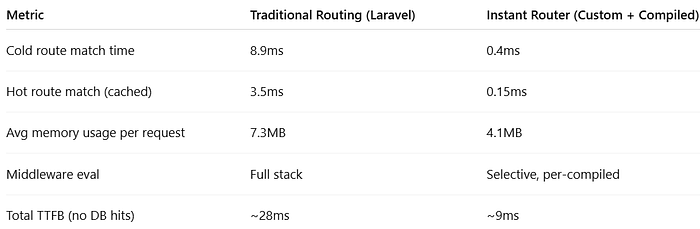
Yeah. It's not a flex. It's a wake-up call.
How to Build One Without Losing Your Mind
Step 1 — Flatten your routes.
Skip closure-based definitions and use controller strings. No more anonymous functions in your routes. This makes things easier to compile statically.
Step 2 — Generate precompiled route maps at deploy time.
Write a script that scans your route definitions and produces something like:
[
  'GET' => [
    '/login' => ['controller' => 'AuthController@login'],
    '/dashboard' => ['controller' => 'DashboardController@index'],
  ],
  'POST' => [
    '/api/user' => ['controller' => 'UserController@store'],
  ],
]
Step 3 — Use direct lookup at runtime.
Don't invoke the router. Invoke your controller. That's it.
Step 4 — Optional
Use static route hash indexes if you want async lookups for serverless or multithreaded contexts.
This Isn't Just Optimization — It's Direction
PHP isn't slow. Bloat is. Traditional routers were made for an era where apps had 30 routes and were deployed on shared hosting.
But today? We're running hundreds of micro-APIs, feature-flagged rollouts, live previews, and parallel pipelines.
If your router is eating milliseconds on each request, you're bottlenecking your own infrastructure.
Frameworks should follow your app's performance needs. Not the other way around.
If your app's response time is dying before the controller even gets the baton — it's time to kill the bottleneck at the root: routing.
Drop the legacy matching logic. Precompile your routes. Use indexed resolution. Strip the fat.
Because the faster your router, the sooner your app gets to do the real work.
Routing Evolution in PHP
+---------------------+--------------------------+------------------+
| Routing Technique   | Main Bottleneck          | Avg Latency (ms) |
+---------------------+--------------------------+------------------+
| Regex Loops         | Pattern parsing          | 5–12             |
| Linear Matching     | Route iteration          | 3–8              |
| Cached Compilations | Eval on match            | 1–3              |
| Instant Routing     | None (direct lookup)     | 0.1–0.5          |
+---------------------+--------------------------+------------------+
Snappy takeaway? If your routing is still "flexible," your app probably isn't.
Let it snap. Let it lock in. Instant routers aren't just a trick — they're the upgrade PHP's been too polite to demand.
Ready to ditch the lag? Or still gonna loop your way to latency?