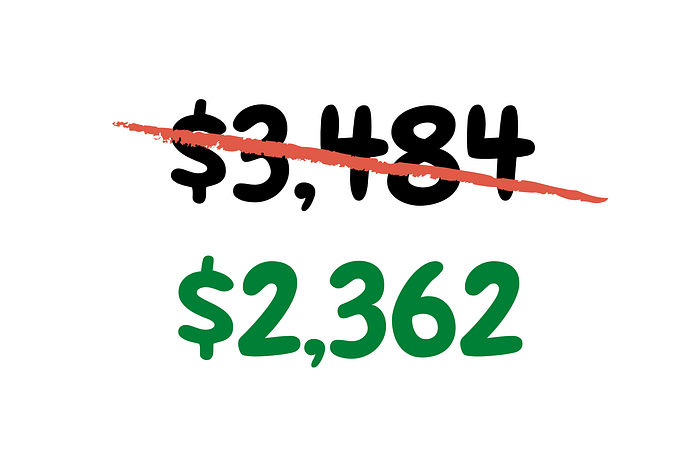


From January 2018 through June 2019, I was spending $3,484 per month, on average.
At the time, I worked 70 to 80-hour weeks in corporate and investment banking. Since my job left me little free time, my finances got shoved to the backburner.
But here's the thing, it's not like I was budgeting for $3,484 of expenses every month. My actual budget was $2,935.
In any given month, I was going over my budget by $549.
That really inspires confidence, right? Let's trust this guy with our personal finance needs.
Just hear me out.
Working in banking was physically and emotionally taxing — but the pay was great (and predictable). Although it was an inefficient use of my earning power, I could get away with dropping $3,484 a month. It wasn't smart, and I wish I saved more. But, you know, hindsight is 20/20.
For a slew of reasons, I ditched my corporate job to pursue freelance writing full time in July 2019.
My income took a big hit.
This wasn't a surprise by any means. I knew what I was getting myself into. But I couldn't expect to live the same lifestyle as before. Healthy, recurring paychecks wouldn't be flowing into my bank account on a biweekly basis. So, to offset the sharp decline, I had to rejigger my budget.
At that point, I'd been (inconsistently) budgeting for a couple of years, so the wheel didn't need to be recreated. I reviewed each expense category, considered my wants/needs, and took hedge clippers to my budget…
…trimming it to $2,275 per month.
Or $1,209 less than my average living costs over the previous 18 months.
Lowering my monthly expenses was not an easy exercise. It took a reality check. I had to decide what was important. For me, that was maximizing my chances of succeeding as a freelance writer. To do that, I had to make sacrifices (which I'll detail a little later).
If you want to take control of your finances and maximize your freelance income, here's a straightforward, actionable list of steps to lower your monthly expenses.
Step number one…
Create a budget
First things first, if you're going to spend less each month, you'll need a budget.
It's not a super exciting activity, but it's a necessary step. Don't worry — you don't need to spend a ton of time on your budget. And you don't need an incredible amount of detail.
Although I've already written about the world's sexiest budget, I'm going to outline what your budget should include. I've always been a DIY-budget guy, but you can also use digital budgeting platforms (like Mint).
So long as you use credit and debit cards for your purchases, it'll be easy to consolidate your expenses. To get a clear picture of your spending habits, focus on your last three months of expenses.
This is a pretty simple example with only a few purchases, but here's a general view of what your downloaded activity will look like.
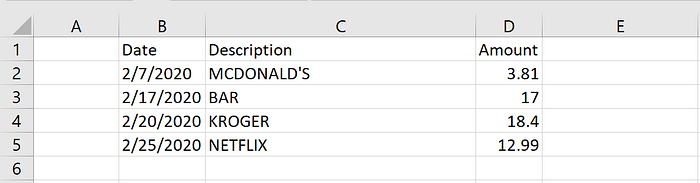
Once you pull your transaction activity into an Excel spreadsheet (use CSV formatting), categorize each expense. Here are five standard labels, but you can be as specific as you want to (e.g. "Food & Entertainment" could be two categories).
- Housing: rent, utilities, maintenance, property taxes, etc.
- Transportation & Travel: gas, Ubers, parking, metro, flights, etc.
- Food & Entertainment: groceries, dining out, alcohol, events/tickets, etc.
- Goods & Services: clothing, home goods, subscriptions, haircuts, insurance, etc.
- Miscellaneous: anything that doesn't reasonably fall into the above categories.
Important note: keep your business expenses separate from your personal expenses. You should still budget for business expenses, but you'll want to keep track of these in a separate tab or spreadsheet. You can follow the same process outlined here to track your business expenses.
When the time comes to pay your tax estimates, it'll be much easier to calculate what you owe if your personal and business finances are not combined.
Anyway, back to the budget. Next, you'll categorize each expense.
Add up each category, calculate the three-month average, then divide each category's average by your monthly income. This will give you an idea of where your income is going. For example, let's assume you earn $4,000 a month and spend $1,250 on rent/utilities. To figure out how much your housing is relative to your income, divide $1,250 by $4,000 — which equals 31.3%.
Using arbitrary numbers, here's what a three-month budget looks like. Since you want to be able to calculate how much you're saving, include your business expenses here.
You'll have a nice overview of your inflows and outflows. In this example, rent is the largest expense by far. But Food & Entertainment is pretty high too. If this were my budget, I'd look through Food & Entertainment purchases first.
Identify areas of excess spending
Here's a little personal anecdote to give you an example.
Back in my banking days, I was very inconsistent when it came to budgeting every month. I was so drained every week that I had zero desire to do more finance in my precious free time.
In reality, I'd budget once every two or three months. Well, after one particular stretch of budgetless months, I finally decided it was time to update my budget. It's like recklessly racking up a bar tab, only to see the self-inflicted damage the next day.
Well, for this set of months, it wasn't alcohol driving up my spendings.
Not groceries either.
Gas? Ubers? Nahh.
It was smoothies. $145 of smoothies — in one month. $302 of smoothies over four months. I know what you're thinking. "Smoothies? What's wrong with you?"
First off, smoothies are my guilty pleasure. Second, I didn't realize I was doing it. Well, that's not totally true. I wasn't zombie-walking my way to smoothie heaven — it was a conscious effort. I just didn't realize how routine it was.
Seven, eight dollars a pop adds up fast.
It became a problem once it became an unchecked routine. A casual afternoon smoothie to break up the time between lunch and dinner became a daily activity.
Without budgeting, the damage could have been far worse. Guess how much I've spent on smoothies in the last 14 months?
$132
That's roughly one smoothie every month or so, which I'm happy with. You don't need to nix enjoyable purchases altogether. The name of the game is calculated moderation.
Change your lifestyle
With a budget, it won't take long to pinpoint where most of your money goes. Scan each category. What're your biggest expenses?
Unless you're living with your parents or somehow have an extraordinary living situation, your housing expenses will be the largest piece of your budget. That's normal and expected.
Not everyone has the flexibility to move. But, if you do, you should strongly consider moving to a cheaper apartment/house or living with roommates. It can really bring down your monthly expenses and maximize your business's chances of success. Right before I quit my job, I moved to a cheaper apartment. My rent shrunk from $1,275 (not including utilities) to $850.
Here's a list of the biggest budget changes I made:
- Moving saved me $425 per month.
- Spending less at restaurants saved me $160 per month.
- Switching car insurance saved me $120 per month.
- Drinking less alcohol saved me $80 per month.
- Buying less clothing saved me $74 per month.
- Dropping subscriptions saved me $70 per month.
- Buying cheaper groceries (e.g. fewer steak dinners) saved me $65 per month.
- Avoiding Starbucks saved me $40 per month.
There are other areas too, but these moved the needle. I relocated from a high-rise condo in the heart of Atlanta to an apartment in a less expensive area. The view doesn't compare, but it's cozier and way cheaper.
I cut back my food costs by (a) going to less expensive restaurants and (b) buying less expensive food at the grocery store. Back in my high roller days, I still cooked most of my meals — but I'd buy more expensive ingredients. And when I went out to eat, I'd use my salary to justify lavish meals.
I still drink coffee (I can't imagine giving that up), but I rely on my apartment leasing office's free coffee. It's the little things that really make a difference over time.
Everyone's spending habits are different, so yours may vary, but here are a few areas to focus on.
- Dining out. I'd guesstimate that 90% of people spend more than they'd like to on food.
- Groceries. In most cases, making your own food is less expensive than dining out. But it's still very possible to overspend at the grocery store.
- Alcohol. Total personal decision, but drinking is expensive.
- Shopping. Fortunately and unfortunately, shopping is as convenient as ever. You're just a few taps on your phone away from making a purchase.
- Subscriptions. Yep, this one stings a little. Subscriptions add up. Cable (if you still have it). Amazon Prime. Netflix. Hulu. Spotify. HBO.
Again, moderation is key. I'm not saying you can't go to a restaurant ever again. That's unreasonable. But can you make a few more meals each week? Can you dine at less expensive establishments?
I'm also not suggesting to cancel all of your subscriptions. But, if you have Netflix, Hulu, and HBO, do you really need all three?
Keep in mind, you don't have to say "goodbye forever" to anything. Once you start bringing home more bacon (see what I did there?), you can reintroduce previous pleasures.
Hold yourself accountable
Budgeting isn't challenging or complicated. For the most part, it's straightforward. It's the commitment to consistent budgeting that becomes a tall task.
There are a few steps you can take to hold yourself accountable, including…
Set a date every month to budget
Schedule an appointment for one hour with yourself. It won't even take that long to update and review your budget, but this builds in some cushion.
There's never a perfect time to budget, you have to make time. Do it during lunch on Wednesday, save it for your last task on a Monday. It doesn't matter when, just pick a time and stick to it.
Budget with someone else
Build an extra layer of support and accountability by budgeting with a friend. This creates an external pressure to budget on top of the internal one.
Limit or avoid credit cards
I'm a believer in credit cards as a financial tool. When managed with a prudent mindset, they can be used to generate free money in the form of rewards.
But if you can't control your spending, using a credit card will be counterproductive. Because credit cards make it so easy to make purchases.
I know we're living through the gradual transition to a cashless world. But, if you struggle with overspending, stick to cash when you can. It's easier to control your spending when you have to physically hand over your hard-earned money.
Follow the 30-day rule
Before you make any sort of "want" inspired purchase (like buying shoes), wait 30 days to see if you really need this want. I know that sounds strange, but bear with me.
This process all but eliminates impulse purchases. It forces you to be patient and consider what you're buying. If 30 days go by and you still want it (and it's within your budget), go for it.
If you learn one thing from this post…
If there's one lesson to burn into your subconscious, it's this: you won't be perfect.
It's not feasible. There will be surprise expenses, there will be times when FOMO overrules your financial principles. It's okay. You can go over your budget every now and then.
Don't beat yourself if this happens.
I'm by no means perfect. My average over the last eight months is $2,362, which is obviously still above my budget of $2,275. But I'm way below what I used to be spending, and I'm happy about that.
Establishing a stable financial future takes time, patience, and commitment. If you want to spend less so you can save more, start by creating a budget.
Do you want to learn more about personal finance? But without the complicated jargon and dry explanations? Sign up here for Bits — our personal finance newsletter.