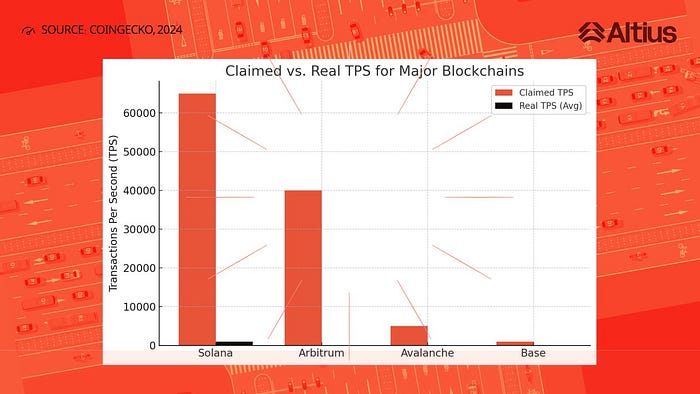

At Altius, we decided to move past the marketing decks and into the real-world data. What we found reveals a stark contrast between ambition and execution.
📊 The Data Speaks
Let's compare claimed TPS vs. observed production throughput:
- Solana
- Claimed: 65,000 TPS
- Actual: ~1,500 TPS average
- Avalanche
- Claimed: 4,500 TPS
- Actual: 2–6 TPS range
- Arbitrum
- Claimed: 40,000 TPS
- Actual: ~8 TPS
- Base
- Peak: 959 TPS
- Sustained: ~150 TPS — even during memecoin surges
This is not a minor discrepancy — it's an industry-wide misalignment between theoretical limits and practical capacity.
🚧 Why It Matters
Most chains benchmark in perfect lab conditions — not in congested, volatile networks. The consequences?
- Developers build for ideal numbers, and hit performance walls.
- Users suffer hidden costs: delays, failed transactions, unpredictable UX.
- Ecosystem builders can't scale reliably on fragile infrastructure.
🔧 The Altius Approach
We're building parallel execution infrastructure designed for modular, production-grade chains. What that means:
- True scalability, not "lab math"
- No TPS time bombs — performance holds under pressure
- One integration unlocks real-world throughput
If a chain can't sustain even 1,000 TPS in live environments, it's not ready for prime time — no matter how flashy the whitepaper.
🔍 Follow the Data, Not the Drama
The future of Web3 depends on real infrastructure — not inflated metrics. Follow @AltiusLabs for ongoing insights on modular scalability and honest performance data.