
Artificial Intelligence (AI) has rapidly evolved into a monumental catalyst for change, fundamentally reshaping the way we live, work, and conduct business. In recent years, AI has transcended its role as a mere technological tool to become a transformative force.
Some estimates project that by 2030 the global GDP will be doubled just because of the effects of AI. Consensus estimates put the global GDP at $130 trillion by 2030, but it is expected that the growth could be increased by another $140 trillion just because of the impacts of AI on the economy ¹.
Generative AI specifically is poised to play a pivotal role in shaping the future of organizations across various industries. Generative AI has the potential to revolutionize the way organizations operate, innovate, and compete, offering solutions to challenges and opening new avenues for growth.
This article delves into how organizations, specifically mid-sized ones, should approach leveraging Generative AI. It covers the framework organizations should use to maximize the benefits and reduce the risks of using this technology, along with an overview of the multiple dimensions and business outcomes of Generative AI.
Multiple dimensions of Generative AI:
Generative AI is a type of artificial intelligence that focuses on generating new content. The use of Large Language Models (LLMs) like ChatGPT, is the most common use of Generative AI, but the opportunities are much more than that. Generative AI could also be used for creating and editing new images, new music, new videos, voice simulation, and more.
For example, solutions like DALL-E and others can help create new images based on text prompts. Solutions like Adobe's Generative Fill can help designers make changes to graphics and other visual assets by typing in their desired effects. Furthermore, many technology companies are focusing on creating products for niche uses of Generative AI. For example, Autodesk's Generative AI tools help with design exploration for architecture, engineering, and manufacturing. MusicLM from Google can develop new music from text descriptions.
Therefore, organizations must keep abreast of all the innovations happening in this space as there might be a new product that would be particularly helpful for their business.
Business outcomes:
Business outcomes of using Generative AI fall into three categories:
a) Improving productivity: It is predicted that AI should increase the productivity of knowledge workers more than four-fold by 2030 ¹. For most organizations, this would be the primary business outcome of most Generative AI use cases, delivered using LLMs like ChatGPT and others. Applications could include data analysis, summarization of content, language translation, marketing content creation, and many other use cases. In addition, image and video-related Generative AI tools might also be used as a productivity enhancer by some organizations.
b) Improving customer experience: Generative AI could be used in creative ways to transform the customer experience. One example is GE Appliances' SmartHQ consumer app, which uses Google Cloud's generative AI platform, to enable users to generate custom recipes based on the food in their kitchen. Another example is a solution that Wendy's is piloting to create an automated and efficient drive-through experience.
c) Creating new revenue streams: As an organization matures in its use of Generative AI, use cases for generating new revenue streams could also be identified. For example, online retailers might offer Generative AI capabilities for their merchants to help with the creation of product images and marketing content that they can post on the retailer's website.
Generative AI framework:
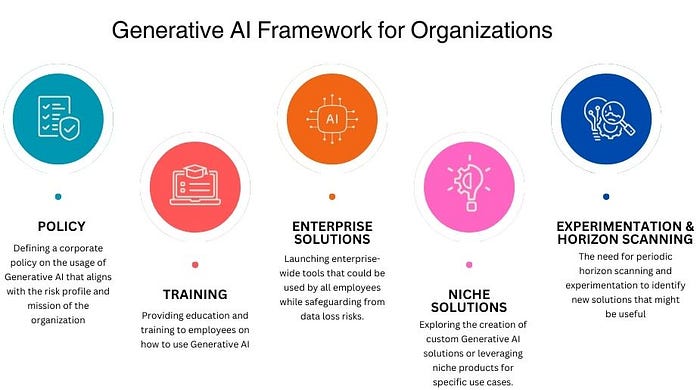
Organizations should consider five dimensions as part of a framework to maximize the opportunities of Generative AI. The dimensions include:
1. Policy: Defining a corporate policy on the usage of Generative AI that aligns with the risk profile and mission of the organization
2. Education and training: Providing education and training to employees on how to use Generative AI
3. Enterprise-wide solutions: Launching enterprise-wide tools that could be used by all employees while safeguarding from data loss risks.
4. Solutions for niche use cases: Exploring the creation of custom Generative AI solutions or leveraging niche products for specific use cases.
5. Experimentation and horizon scanning: Scanning the horizon periodically and experimenting to identify new solutions that might be useful.
1. Policy:
The creation of a corporate policy for the use of Generative AI is a key first step for any organization. The policy should cover multiple aspects, including the ethical and responsible use of the technology within the organization, compliance with regulatory requirements, data privacy and security, and risk management. Having a policy in place also facilitates employee training and awareness programs to inform staff members about the ethical considerations, guidelines, and best practices associated with Generative AI, reducing the likelihood of unintended misuse.
The contents of the policy largely depend on the risk tolerance of the organization, regulatory implications, and the culture of the organization. An organization with low-risk tolerance might take a conservative stance on the use of Generative AI compared to an organization that has a higher risk tolerance or growth-minded culture. A policy could also be focused on allowing more experimentation in one business area vs. another while keeping risk mitigation and potential benefits in mind.
Overall, the policy will help manage risks, ensure compliance, and contribute to the responsible and transparent integration of Generative AI technologies into the organization's operations.
2. Education and training:
The rapid integration of Generative AI into organizational workflows underscores the pressing need for comprehensive education on its utilization. As this transformative technology becomes an integral part of various industries, employees at all levels must acquire a nuanced understanding of its capabilities, ethical considerations, and potential implications. Education on Generative AI is essential not only to unlock the full potential of the technology but also to ensure responsible and ethical deployment.
Education in this area can be broken into three buckets:
a) General education: This type of training should be made available for all employees. It will cover aspects of what Generative AI is, detailed information on capabilities, examples of uses that might apply to most employees, the downsides (hallucinations, risk of losing confidential data, etc.), details on the organization's policy, and how employees can access tools that are approved by the organization.
b) Role-specific training and prompt engineering: Some roles within the organization might be able to leverage Generative AI more than others. It is important to identify all the key roles within the organization based on impact and create role-specific training. For example, an organization might identify a sales representative as a key role. They will then focus on doing a detailed analysis of how a sales representative could best use Generative AI. The result would be detailed training that includes prompts that a sales representative could use for specific situations and how they could maximize outcomes using these tools. This type of training is extremely important as the power of Generative AI tools could be maximized with the creative usage of prompts. Defining all the common prompts that could be used for different scenarios of a role could make it easier for the adoption of these tools within that role.
c) Ethical and Responsible AI use: This training is especially important for niche and custom usage of Generative AI solutions. Technology employees who would be involved in creating these new solutions and decision makers using the solutions should be made aware of the risks, ethical considerations, and the organization's policy on responsible use of AI so that new solutions are built using that lens. This part applies not just to the use of Generative AI but to any AI solution that will be used or built within an organization.
As Generative AI is an ever-evolving technology, organizations will need to continually train and educate their employees about its usage. By investing in training programs and fostering a culture of continuous learning, organizations can empower their workforce to make informed decisions, contribute to innovation, and uphold ethical standards in the dynamic landscape of Generative AI.
3. Enterprise-wide solutions (Personal AI assistant):
Organizations should identify and approve certain Generative AI solutions for use by all employees within the organization, which will improve the productivity of day-to-day tasks. For example, the creation of new text content is the broadest use of Generative AI for most companies. Many large tech organizations have launched LLMs, such as ChatGPT, Microsoft Copilot, and LLMs from Google, that could be used enterprise-wide. Organizations should select one of these tools for use across the enterprise and provide access to all employees. This tool could be used as an AI assistant by all employees for their day-to-day work.
A cross-functional team should assess which tool aligns best with the organization's needs. This assessment could depend on various factors such as pricing, existing technology ecosystem, protection of company data and IP, and if there is a need for a niche industry solution.
Once this tool is selected, it should be launched across the organization, along with training on how to use it. For most organizations, there will be just one key tool that is used by all users.
Considerations for launching this tool should include all aspects of change management that are required for launching any new technology solution within the organization. For example, organizations that use social media for employees could create a new channel where users can share how they are using the tool to help improve adoption and maximize the benefits.
4. Solutions for niche use cases
An enterprise-wide solution will address the broad use of Generative AI within the organization, but it might not address the use of niche Generative AI products or the creation of custom solutions for specific needs. Custom solutions would capitalize on existing LLMs for niche organization use cases, rather than creating new LLMs that are extremely costly.
An organization's leaders should consider niche opportunities in two dimensions:
a) Enhancing internal productivity: Organizations can use niche products or custom solutions to improve productivity. For example, they could employ a custom solution that can be used by employees to find the right answer to their questions using all the enterprise content. Building a solution like this would involve integrating with an existing LLM and using it to go through an organization's content. It could also involve procuring access to a niche product or building a custom solution that solves a specific workflow or activity (e.g., video creation for training materials).
d) Improving customer experience or creating new revenue models: Organizations have a huge opportunity to rethink how they can interact with their customers. Custom solutions could help improve the customer experience or could open a new revenue stream for the organization. One example is Priceline's personalized hotel booking experience, powered by Generative AI, which helps customers find preferred hotels by proximity to local attractions, restaurants, and activities.
5. Experimentation and horizon scanning:
The Generative AI space is evolving so quickly that organizations must give constant attention to how they can leverage these technologies through experimentation and horizon scanning. In addition, organizations will need a level of creativity to rethink new opportunities that are beyond the obvious.
Ongoing horizon scanning checks if there are new solutions or uses of these technologies that can be leveraged by the organization. It can be done by staying abreast of technological advancements in the Generative AI space and also by looking at how other industries are leveraging these technologies. Organizations should also constantly experiment with either existing Generative AI products or the creation of new custom solutions. The experimentation approach could follow the organization's current structure for driving rapid innovation. The need for rapid solutions and user testing is critical to identify solutions that could be beneficial for the organization.
Organizations should assign roles that are focused on horizon scanning and driving experimentation if such roles do not already exist.
Conclusion
As this technology continues to advance, organizations that embrace and integrate Generative AI into their workflows are likely to stay ahead of the curve and drive success in the digital era. Generative AI has strong potential to improve productivity, improve customer experience, and create new revenue streams. By following a five-part framework of policy, training, enterprise-wide solutions, niche solutions, and horizon scanning and experimentation, organizations can maximize their opportunities by using Generative AI while minimizing their risk.
Sources:
1 — Big Ideas 2023 by ARK Invest (https://www.ark-invest.com/big-ideas-2023/