

The year was 2021.
The situation: we were gearing up to launch a newly formulated Men's body wash that promises to give the freshest shower experience yet.
The problem: it was our first time launching a Men's body wash.
Our team had absolutely no experience marketing for any male shower products.
Naturally, we did what most amateurs would have done in this situation: take the closest competitors' products and match the marketing they've done for them.
That includes copywriting (finding the best shower-related terms), campaigns (more in-store activations than you can dream of), and pricing.
The result?
The new product flopped — big time. It was easily one of our biggest marketing failures in our company's history.
It was only many months later, where we did our annual consumer focus group that we discovered the main reason behind this catastrophe.
It wasn't that the product wasn't great — in fact, users said they loved it.
It wasn't that the marketing wasn't sound — everyone could understand our USP (Unique Selling Point) easily.
It was the price.
All of them expressed the same grievance: the price point was too high for them.
"Wait — didn't our competitors price their products similarly too? What went wrong?"
And more importantly, how on earth does one know what's the perfect price point for their products?
The Most Complete Pricing Model To Date
If the earlier situation feels familiar to you, don't worry — you're not alone. Thousands of marketers go through the same headache every day.
And it's even worse when it's a category you've never ventured into before. After all, there's only so much reliable data you can work with.
So the golden question has to be asked: how does one match the price of their new products to exactly how much consumers are willing to pay for it?
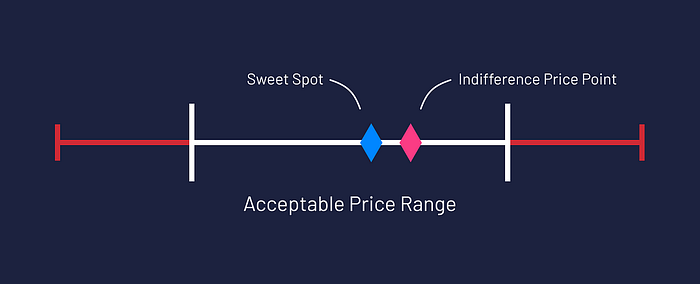
Enter the Van Westendorp price sensitivity meter.
Hailed as one of the best pricing models for businesses ever created, this meter is meant to help you find that sweet price spot for your product through four simple questions you need to ask your consumers.
And in case you have doubts, don't fret — I personally tried and tested this pricing meter in my marketing launches over the past three years to great success.
Through this pricing model, that aforementioned body wash series had a successful relaunch, and now sits as one of our best-selling shower products to date.
Alright, enough digression — let's get down to this questionnaire:
To make this more effective, carry this out with a research company on a focus group/consumer pool of at least 30 pax or more. This will enhance the reliability of the results.
Question #1: Too Expensive
"At what price would you consider the product to be so expensive that you would not consider buying it?
The first question's objective is simple but critical: to find out what's the uppermost limit of the consumer's spending.
In other words, if your product is priced beyond this point, it's a no-go — no one's going to even think twice about rejecting it.
Take the earlier body wash for example. For an 18-ounce bottle, we were initially selling it for $9.
Compared to Method Men (an established Men's shower brand), in which a bottle of similar size was only going for ~$8.
Worse still, we were barely established in this space, making our consumers less willing to spend more on us.
Through this survey, we found out that our consumers would not spend a dime over $7 for our product.
Imagine that: a mere difference of $2 was the sole undoing of our marketing campaign. Pricing truly does matter.
But we've only just gotten started:
Question #2: Too Cheap
After you've found the uppermost limit to your product's price, the natural next step would be to find the lowermost limit.
But wait — lowermost limit? Is there even such a thing?
After all, people can price it as low as possible to maintain the highest competitive advantage, right?
Not at all. You'll understand when you see the second question:
"At what price would you consider the product to be priced so low that you would feel the quality couldn't be very good?"
Yes, too low of a price is actually a bad thing.
Think of a $100 Louis Vuitton bag. Or a $50 pair of AirPods. You'd be suspicious of these products, right?
Because it hints that the product quality may be questionable(even though it may not be necessarily true) and that in turn will harm the brand image.
This question is essential in that it helps you to discover the lower limit to your products' price — one that indicates to your customers that your products are reliable.
Let's move on to the third question.
Question #3: Expensive
Good — now we know the uppermost and lowermost limit of our product's price.
It's a great starting point, but we need to know more. After all, the range between the top and bottom could still be huge.
Which is why we need this third question:
"At what price would you consider the product starting to get expensive, so that it is not out of the question, but you would have to give some thought to buying it?"
The objective for this question is simple: we want to find the price point where people will start debating on whether your product is worth it or not.
It also happens to be the price point where you can potentially draw the most profit out of your product, simply because this point represents the maximum limit in which you can price your product.
Case in point for the body wash: through this question, we found out that at $6.50 a bottle, people expressed that they may still purchase our product, but they may also start looking for other options in the market.
You may have also realized that the difference between the answers to the first and third question is a mere $0.50 — yes, that's how price-sensitive some products can be.
Which leads us to our final question:
Question #4: Cheap (Bargain)
We all love a good bargain.
In fact, many of the everyday products we purchase are usually bargains (think toilet paper, frozen meat, etc.). We want to know we're getting a good deal.
Which is why the last question is:
"At what price would you consider the product to be a bargain — a great buy for the money?"
It's as simple as that. This question exists just to help you see if you can price your product just a little lower (at the expense of profit, of course) to sweeten the deal for your consumers.
Now that we've answered these four questions, how do we use them to get the perfect price point?
Bringing It All Together
Once you plot out the results of your survey, you will get something like this.
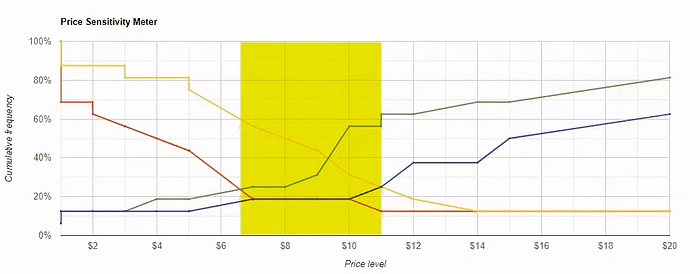
So how do you read this graph?
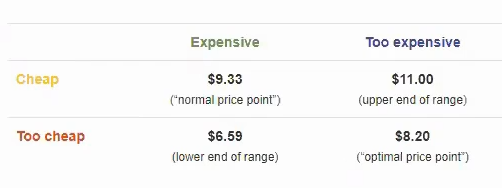
Well firstly, you can check your price range by checking what falls between the intersections of the (Expensive, Too Cheap) and (Cheap, Too Expensive). (Essentially the range between the leftmost intersection and the rightmost intersection)
In this case, it's between $6.60 and $11.
Now to the most important question: what is the perfect price point?
Simply check the intersection between Too Cheap and Too Expensive. In this case, it's $8.20
And the reason for this is because, at this point, you're going to get the least amount of people saying that your product is too expensive and/or too cheap.
Survey completed!
Conclusion
There you have it — four simple questions later, you've got the perfect price point for your product.
The great thing about this methodology is that you can do it with little to no resources.
Simply reach out to existing customers, ask them these four questions, and plot the graph out — you'll get the answer you want.
How do you price your products?
Want more marketing tips and tricks? Subscribe to the Better Marketing newsletter The Marketing Memo here.