Imagine watching Cristiano Ronaldo on the field, where every movement he makes is tracked in real-time using computer vision technology. Instead of simply watching the game, this advanced system analyzes his speed, distance covered, and positioning relative to opponents throughout the match. Elite soccer clubs use this data to optimize team strategies, make informed substitutions, and improve player performance. As a fan, you benefit too — detailed stats about Ronaldo's performance appear on your smartphone, enhancing your understanding of the game and bringing you closer to the action. Computer vision is transforming how we experience sports, making every second count.
In the age of data-driven sports, the use of Computer Vision (CV) has transformed the way coaches, analysts, and even fans interact with the game. With precise object detection, real-time tracking, and predictive analytics, CV has become a cornerstone of modern sports technology. In this blog, we will explore the technical underpinnings of computer vision in sports and examine real-world applications that illustrate its profound impact on the sports industry.
Tiktok : Layman.ai
What is Computer Vision?
At its core, computer vision is a field of artificial intelligence that enables machines to interpret and process visual data from the world — images and videos — similar to how humans do. In sports, CV systems can be used to track player movements, analyze game footage, and extract critical metrics in real-time.
To make this happen, CV systems use algorithms like object detection, segmentation, motion tracking, and pose estimation. These allow computers to detect not only the objects in an image or video but also their locations and movements over time.
Applications of Computer Vision in Sports
1. Player and Ball Tracking
Tracking player movements and the ball's trajectory is foundational to understanding the dynamics of any sport. Computer vision algorithms, particularly object tracking and pose estimation, are used extensively for this purpose.
- Object detection models like YOLO (You Only Look Once) or SSD (Single Shot Detector) are employed to detect players and the ball in real-time.
- For player tracking, multi-object tracking algorithms such as DeepSORT or ByteTrack are used to maintain the identity of each player even when they overlap.
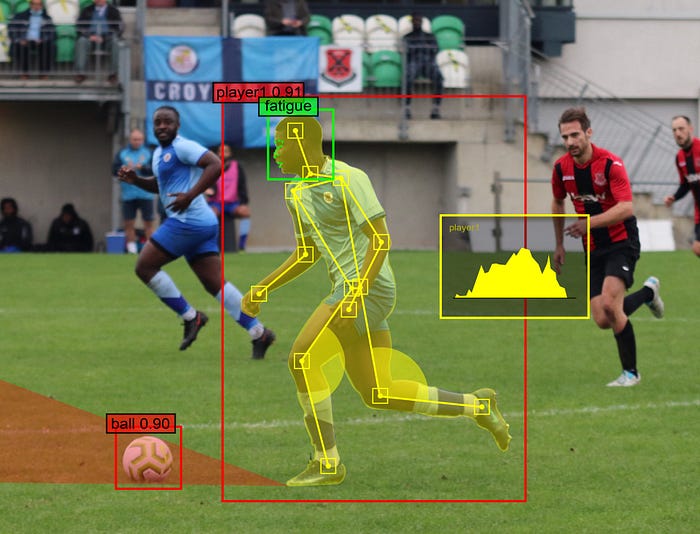
- Pose estimation algorithms such as OpenPose track the player's skeletal movements, identifying joint positions to assess performance metrics like speed, agility, or positioning.
Example:
In football (soccer), multiple cameras positioned around the stadium feed live video to a DeepSORT tracking algorithm that keeps tabs on every player's position on the field. A combination of object detection algorithms like YOLOv8 or Mask R-CNN are first used to detect the players and ball in each frame. Then, algorithms such as DeepSORT handle the temporal association, ensuring that each detected player is tracked accurately from frame to frame, even in situations with severe occlusion or high-speed movements.

2. Referee Assistance and VAR (Video Assistant Referee)
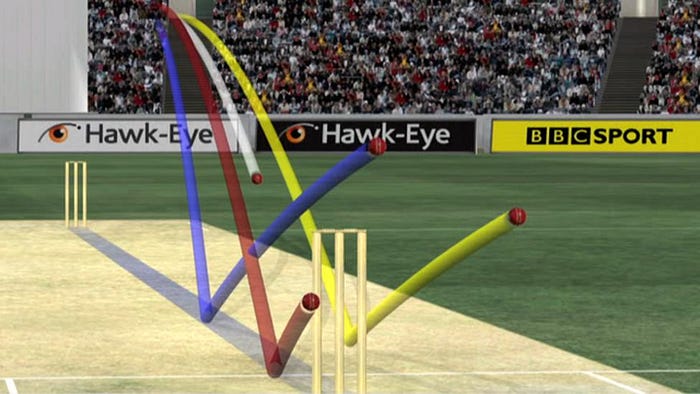
One of the most impactful applications of computer vision is in referee assistance systems like VAR (Video Assistant Referee) in football or Hawk-Eye in tennis and cricket. These systems use high-speed cameras and CV algorithms to assist referees in making accurate decisions.
- Frame-by-frame analysis is used to capture fast-moving balls or contentious moments in sports where human perception may fall short.
- In sports like tennis, 3D ball tracking and trajectory prediction algorithms help determine if a ball landed in or out.
- In football, goal-line technology uses multiple cameras combined with real-time object tracking to accurately detect when the ball crosses the goal line.
Example:
In cricket, the Hawk-Eye system analyzes ball trajectories and provides a real-time visualization to assist umpires in decisions such as leg-before-wicket (LBW). It captures multiple camera angles, processes the data, and predicts the exact ball movement even after it bounces.
3. Performance Analysis and Injury Prevention
In elite sports, athletes and coaches rely on detailed performance data. Computer vision aids in analyzing player performance by tracking motion, calculating speeds, and identifying inefficiencies in technique, allowing for real-time feedback.
Technical Breakdown:
- Optical flow and motion tracking algorithms help analyze the fluidity and efficiency of player movements.
- Pose estimation allows coaches to analyze biomechanics during activities like running, jumping, or swimming.
- Kinematic analysis using keypoint detection can pinpoint incorrect movements that lead to injuries. The CV system can alert coaches when a player exhibits risky movement patterns.
Example:
In basketball, coaches use pose estimation algorithms like AlphaPose or OpenPose to monitor how players land after jumps. By analyzing the angles of knees and ankles during high-impact movements, CV systems can detect risky landing mechanics that might lead to injuries like ACL (Anterior cruciate ligament injury) tears. If the system detects a potentially dangerous movement, it can provide real-time feedback to the player, helping them adjust their posture or technique during practice.

4. Automated Highlight Generation and Fan Engagement
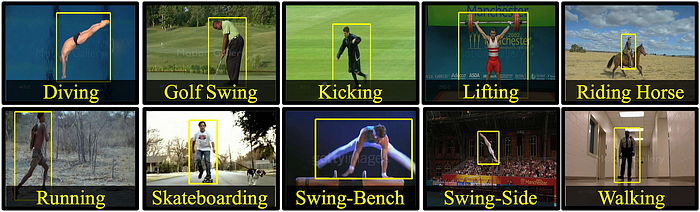
In today's digital age, sports broadcasters and content creators rely on CV systems to generate automated highlights, ensuring that fans never miss key moments. These systems can automatically detect critical moments such as goals, fouls, or close calls.
Technical Breakdown:
- Event detection algorithms identify significant actions (like a goal in football or a slam dunk in basketball) using features such as sudden changes in player speed or crowd noise.
- Deep learning models can classify different actions in a game, such as passes, shots, or tackles, and create highlight reels accordingly.
- Facial recognition and sentiment analysis further help broadcasters focus on fan reactions, adding emotional depth to the highlights.
Example:
In professional basketball leagues, CV systems use action recognition models to detect specific events like dunks, 3-point shots, or blocks. By analyzing the player's movements, ball trajectory, and crowd reactions, these systems can automatically package highlight reels during live broadcasts.
5. Virtual and Augmented Reality (VR/AR) in Sports Training
Computer vision powers VR and AR applications to simulate real-life game scenarios, providing athletes with immersive training environments.
Technical Breakdown:
- 3D reconstruction using CV allows real-time generation of virtual environments where players can practice without physical constraints.
- Markerless motion capture uses CV to monitor the player's movements in a virtual environment, offering instant feedback on technique.
- Augmented reality overlays allow coaches to place virtual objects or instructions in the athlete's view, creating a more interactive training session.
Example:
A basketball player can use AR goggles with CV systems to simulate free throw scenarios, adjusting their technique in real-time based on feedback generated from the system.
Challenges in Applying Computer Vision to Sports
Despite its advantages, deploying computer vision in sports is not without challenges:
- Real-time processing: requires high computational power, especially for multi-object tracking in fast-paced games.
- Data variability: Weather, lighting conditions, and camera angles can significantly affect the accuracy of CV models.
- Generalization: Training models that work across multiple sports and environments requires large, annotated datasets, which can be time-consuming and expensive to create.
However, with advancements in hardware (e.g., GPUs) and algorithmic efficiency, many of these challenges are being addressed.
Importance of Computer Vision on Sports
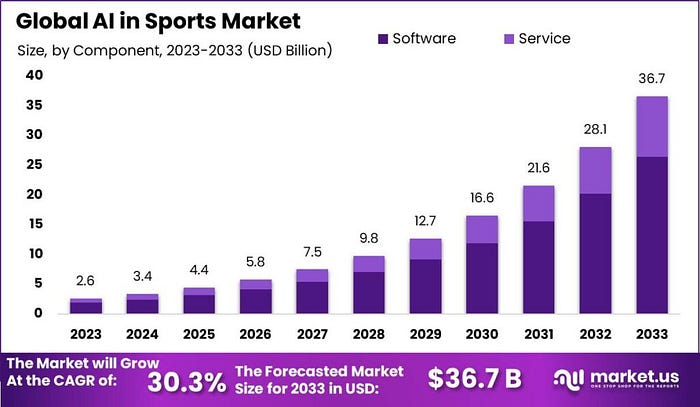
source : link
- Market Growth: The computer vision market in sports is projected to grow significantly, with estimates suggesting it could reach $2.8 billion by 2026, expanding at a compound annual growth rate (CAGR) of 25.3% from 2021 to 2026.
- Injury Statistics: In the United States, over 200,000 individuals suffer from Anterior Cruciate Ligament (ACL) ruptures each year, making it one of the most common severe sports injuries. Computer vision technologies are being developed to analyze movements and help prevent such injuries.
- Player Tracking: Advanced computer vision systems can track the movements of up to 22 players on a football field simultaneously, providing detailed analytics on player positioning and movement patterns during a game.
- Referee Assistance: Systems like Hawk-Eye, used in sports such as tennis and football, have been implemented in over 20 sports worldwide, enhancing the accuracy of officiating and decision-making processes.
- Performance Analysis: The Detroit Pistons utilize computer vision to monitor player movements, contributing to performance improvements and injury prevention strategies. This kind of analysis is becoming standard practice among more than 30 NBA teams, reflecting a growing trend in professional sports.
- Fan Engagement: Automated highlight generation using computer vision is increasingly popular, with broadcasters reporting that over 70% of sports fans prefer watching highlights generated by AI systems due to their speed and efficiency.
Market and Financial Impact
- Global Sports Market: The global sports market is projected to grow from $486.61 billion in 2022 to $512.14 billion in 2023.
- Sports Technology Market: Valued at $13.14 billion in 2022, the sports technology market is expected to grow at a CAGR of 20.8% from 2023 to 2030. The sports technology market is projected to reach $40.2 billion globally by 2024. This growth is driven by the increasing adoption of advanced technologies like computer vision and AI in sports.
- AI in Sports Market: The AI in sports market is expected to grow at a CAGR of 30.3%, reaching $19.2 billion by 2030. This includes applications in performance analysis, injury prevention, and fan engagement.
- Investment in Technology: Over 50% of sports organizations plan to allocate more than a quarter of their budget to technology. This significant investment highlights the importance of tech innovations in enhancing sports performance and operations.
Financial Impact and Revenue Generation
- Enhanced Fan Engagement: Computer vision technologies are being used to create immersive fan experiences through augmented reality (AR) and real-time statistics. This not only enhances fan engagement but also drives higher revenues from ticket sales, merchandise, and digital content.
- Operational Efficiency: Implementing computer vision for tasks like security, crowd management, and facility maintenance can lead to cost savings and improved operational efficiency.
- Sponsorship and Advertising: Advanced analytics and personalized content delivery can attract more sponsors and advertisers, leading to increased revenue streams for sports organizations.
Real-World Examples: Computer Vision Products in Sports
Hawk-Eye Innovations: In the United Kingdom, Hawk-Eye technology is utilized in sports like tennis and cricket. This system is employed across over 20 sports globally, offering precise ball tracking and assisting referees in making accurate decisions. Hawk-Eye tracks the ball's trajectory at speeds of up to 360 frames per second, ensuring pinpoint accuracy in calls regarding whether the ball is in or out.
Sentio: Based in the United States, Sentio is a real-time player tracking system used in soccer. By analyzing player movements and performance during matches, Sentio can track up to 22 players simultaneously, offering valuable insights into player positioning and team strategy. This enables teams to make data-driven decisions to optimize performance.
Zebra Technologies: In the United States, Zebra's RFID technology is widely used in American football, specifically in the NFL. Players wear RFID tags that send real-time data to receivers on the field, allowing for accurate tracking of player speed, distance covered, and other game statistics. This technology is now a standard across all 32 NFL teams.
GAMEFACE: Originating from the Netherlands, GAMEFACE uses computer vision to analyze match footage, primarily in soccer, but also across other sports. The platform processes large volumes of video data to generate detailed reports on player performance and opposition strategies. This allows coaches to formulate effective game plans based on in-depth video analytics.
Pioneer Sports: In Australia, Pioneer Sports applies computer vision in cricket for ball tracking and player analysis. Their technology examines player techniques and performance metrics, which contribute to enhanced training methods and more effective game strategies for teams.
Conclusion: A New Era of Sports Analytics
Computer vision is revolutionizing sports by making games safer, faster, and more enjoyable. From real-time tracking of players and balls to enhancing fan engagement and refining athlete performance, CV's applications are broad and impactful. As the field continues to evolve, we can expect even more sophisticated CV systems in sports, helping athletes push boundaries and giving fans unparalleled experiences.
Get in touch
As I believe "If you want to go fast, go alone. If you want to go far, go with others." I am available to work together to pave the path for the AI revolution. let's connect and grow together. Don't hesitate to ask your question, if you have one.
LinkedIn: https://www.linkedin.com/in/suraj-agrahari-1622aa18a/
Instagram: https://www.instagram.com/surraj_._agrahari/
Facebook: https://www.facebook.com/suraj.agrahari.01/
Gmail: surajagrahari330@gmail.com
Happy learning !!