

Rust continues to push the boundaries of systems programming, redefining safety, performance, and modern development. With the release of Rust 1.84.0 and 1.84.1, and the upcoming Rust 1.85 on February 20, 2025, the language is evolving faster than ever.
But how does Rust compare to Go? What's changing in WebAssembly? And why are companies like AWS, Microsoft, and Google investing in Rust?
Let's break down Rust's trajectory in 2025 and beyond.

🔥 Rust's Unstoppable Growth: Why Developers Are Making the Switch
1️⃣ Rust is Driving Cloud and Energy-Efficient Computing
💡 Fact: Amazon Web Services (AWS) has found that Rust-based applications consume significantly less electricity than Java applications. 🔹 This translates to lower costs, faster execution, and a smaller carbon footprint, making Rust ideal for cloud-native, edge computing, and serverless applications.
2️⃣ Memory Safety Without Garbage Collection
Rust eliminates entire classes of memory-related bugs (buffer overflows, use-after-free, null pointers) without relying on a garbage collector (GC). 🚀 Industries benefiting the most: ✔️ Finance & Trading: Safe and lightning-fast transaction processing. ✔️ Security & Cryptography: Reduces vulnerabilities and exploits. ✔️ Embedded & IoT: Performance-critical applications with strict memory constraints.
3️⃣ Rust vs. Go: Which One is Better in 2025?
Both Rust and Go are popular choices for modern systems programming, but they serve different purposes:
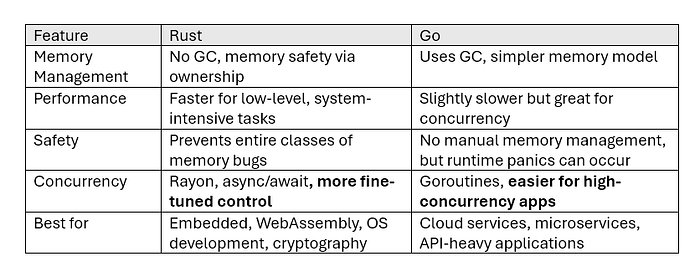
Bottom Line: ✅ Go excels in developer productivity and concurrency, making it a top choice for cloud-native apps and microservices. ✅ Rust prioritizes memory safety and performance, making it ideal for low-level programming, security, and high-performance computing.
🚀 What's New in Rust 1.84.0 & 1.84.1? Game-Changing Features
Rust's latest updates introduce powerful enhancements that improve security, dependency management, and compilation performance.
🌟 Rust 1.84.0: Key Highlights
✅ MSRV-Aware Resolver: A new Minimum Supported Rust Version (MSRV)-aware resolver helps Cargo automatically prefer dependency versions that match your project's Rust version.
Enable it in .cargo/config.toml:
[resolver]
incompatible-rust-versions = "fallback"
or set package.resolver = "3" in Cargo.toml (requires MSRV 1.84).
✅ New Trait Solver for Better Compilation Rust 1.84 improves coherence checking for trait implementations, fixing long-standing overlapping trait conflicts and making the compiler smarter.
✅ Strict Provenance APIs for More Secure Pointer Handling Rust now provides safer provenance APIs, reducing reliance on integer-pointer casts. This makes: ✔️ Code easier to analyze ✔️ Compiler optimizations more effective ✔️ Debugging and security audits simpler
✅ Breaking Change: WebAssembly System Interface (WASI) Target Name Change Rust 1.84 renames the WebAssembly System Interface (WASI) target, which could affect developers working with Wasm-based Rust applications. If you're using Rust with WebAssembly, check for compatibility updates in your toolchains and dependencies.
🐞 Rust 1.84.1: Bug Fixes & Performance Improvements
This point release resolves several key issues:
🔹 Fixes ICE 132920 related to duplicate-crate diagnostics. 🔹 Improves incremental builds by resolving trait solver issues. 🔹 Fixes LLVM debugging issues, helping developers analyze Rust binaries more effectively. 🔹 Speeds up compilation for large Rust projects.
➡️ Net result: Rust 1.84.x is faster, more stable, and easier to debug.
🛠️ Rust 1.85 (Releasing February 20, 2025) — What's Coming?
Rust 1.85 is set to introduce stable support for async closures, making asynchronous programming more ergonomic.
🔹 Why this matters: ✅ Async closures will enable more expressive, readable async code. ✅ Expect better compatibility with async frameworks like Tokio and async-std.
For full details, check out the official Rust 1.85 preview: 📢 Rust Update: Fixing "Forever Compilation"
🎮 Is Rust Replacing C++ in Game Development?
Rust is gaining traction in game development, but C++ remains the dominant language for AAA games. 🎮 Where Rust is making an impact: ✅ Game engines like Bevy and Fyrox are bringing Rust into game dev. ✅ Indie and mid-tier game developers are experimenting with Rust for performance benefits. ✅ Security-focused games benefit from Rust's safety features.
However, most AAA studios still rely on C++ due to legacy engines, ecosystem maturity, and performance optimizations built over decades. Rust isn't replacing C++ yet, but it's carving out a niche in the game dev world.
🌍 Looking Ahead: Rust's Future in 2025 & Beyond
Rust's influence is only expanding, with major industry trends on the horizon:
🚀 More OS-level adoption: Expect Rust-powered kernels, device drivers, and embedded systems.
🌍 Cloud-native Rust: AWS, Microsoft, and Google are investing in Rust for scalable cloud computing.
📡 Better async programming: Async closures (Rust 1.85) will simplify concurrent programming.
🦀R
Rust isn't just a language — it's a revolution.
🚀 Join the Rust Revolution!
🔗 Read more: Rust's official blog
💬R