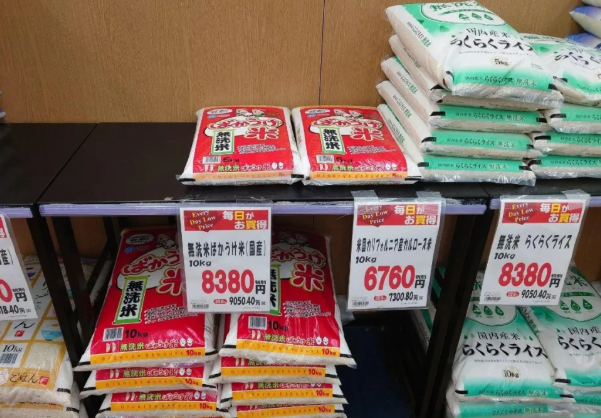


The price of rice in Japan has risen again! Data released by the Ministry of Internal Affairs and Communications of Japan on April 25 showed that the price of rice in the Tokyo metropolitan area rose by 93.8% year-on-year in April, setting a record high since comparable data was available in 1971.
Foods related to rice have also risen, with rice balls rising by 15.8% year-on-year and sushi for eating out rising by 8.3%. The overall price of food other than fresh food rose by 6.4% in April.
In order to ease the rice supply and demand dilemma, Japan has imported rice from South Korea in March, the first time Japan has imported rice from South Korea in 25 years. Next, the Korean Agricultural Cooperatives plan to export rice to Japan again in May.
After being levied a tariff equivalent to RMB 8.75 per 500 grams, the price of these Korean rice is still lower than the price of Japanese rice, and they are quickly snapped up by Japanese housewives. Many Japanese also transport rice from South Korea to solve their urgent needs.
The soaring price of Japanese rice started in August and September last year. At that time, Japan's rice supply was seriously insufficient, and the shortage rate of rice in supermarkets once reached 40%. This situation was called the "Reiwa rice riot" and was not alleviated until the new rice was listed in late September.
However, since September last year, although the rice supply has temporarily eased, the price of rice has never come down again.
As of April 21 this year, according to data from the Ministry of Agriculture, Forestry and Fisheries of Japan, the average retail price of rice in supermarkets across Japan has risen for 15 consecutive weeks, reaching 4,217 yen per 5 kilograms (about 21.7 yuan per 500 grams), breaking the historical record again. The price of rice has risen by 92.1% year-on-year.
This is still an average value. In fact, there are many Japanese supermarkets that sell rice for more than 25 yuan per 500 grams, and cheap goods are completely out of stock.
After the price of rice rose, it brought a chain reaction.
Matsuya, one of the three major beef rice chain brands in Japan, announced that it would increase the prices of many dishes, with the largest increase of more than 9%.
In order to maintain the price of boxed lunches, Lawson convenience stores have launched a new product that replaces some rice with pasta.
The price of white rice in the cafeteria of Tokyo University has increased from 150 yen to 220 yen. For students with a monthly living expense of only 80,000 yen, the price difference of 70 yen is enough for them to choose instant noodles to fill their stomachs.
Katano City, Osaka Prefecture, recently announced that all local elementary and secondary schools will reduce the number of rice supplies from the previous three times a week to two times from the next semester, and replace rice with bread. Katano Mayor Kei Yamamoto said that this is a "painful decision", but there is no other way to deal with the high rice prices. According to him, if the price of rice continues to rise, the local area will have to reduce the supply of rice for lunch for elementary and secondary school students to once a week.
Speaking of this, friends who often watch the news may be surprised. Hasn't the Japanese government released reserve grain to the market twice this year? Why is the price of rice still rising?
Yes, the reserve grain has really been released.
Since March 18, the Japanese government has released two batches of reserve rice, totaling 210,000 tons, which is said to be equivalent to 2.9 billion bowls of rice.
However, it is puzzling that not many Japanese people have seen the so-called "reserve rice" on supermarket shelves, and the price of rice has not been cheap at all.
Small supermarket operators complained that it must be the big supermarkets that got the reserve rice first. But in Japan's big supermarkets, there is still a high probability that there is no reserve rice, or even no rice.
So where did Japan's reserve rice go? When the Japanese government announced the answer, people realized that the government actually sold the rice to the Japanese Agricultural Cooperatives.
The threshold for the Japanese government to release reserve rice is high and there are many restrictions. These restrictions are simply tailor-made for the Agricultural Cooperatives, and it is difficult for other merchants to meet the standards.
The Japanese government requires that in order to sell reserve rice, the annual purchase volume must reach more than 5,000 tons, and it must be able to allow the government to repurchase the same amount of rice within one year. In other words, the rice must be "returned".
So, apart from the Agricultural Cooperatives, which supermarket owner has the ability to grow rice and return it to the government?
So, in the first bid of 140,000 tons of reserve rice, 7 companies won the bid, and the Agricultural Cooperatives won 132,999 tons, accounting for 93.8% of the total.
The second bid of about 70,000 tons of reserve rice, a total of 4 companies won the bid. The Agricultural Cooperatives again took the majority, winning 66,271 tons, about 94.2% of the total.
And the Agricultural Cooperatives made a lot of money in this process. According to statistics, the price of the reserve rice purchased by the Agricultural Cooperatives from the government was about 177 yen (about 9 yuan) per 500 grams, and it reached 284 yen (14 yuan) per 500 grams in the hands of retailers. In this regard, the Agricultural Cooperatives said it was "packaging fees", and the Japanese government did not say anything. No one can figure out whether there is any interest transfer in this.
Japan's Agricultural Cooperatives are comprehensive agricultural cooperatives established according to rural administrative regions. They have more than 10 million members across the country, covering almost all registered farmers, and firmly controlling all aspects of Japan's agricultural production. Its business scope is extremely wide, covering product purchase and sale, agricultural management guidance, agricultural supply, credit insurance and other fields. It also controls the output of rice and artificially creates a shortage of supply to raise the price of rice.
Japan's agricultural cooperatives not only monopolize grain planting, but also monopolize the release of reserve grain. Since the agricultural cooperatives support many members of parliament and are one of the important vote banks of the ruling Liberal Democratic Party of Japan, no one in Japan dares to touch the agricultural cooperatives.
Besides, Japan's agricultural cooperatives lost 1.5 trillion yen in speculation on US bonds last year. Shouldn't they find a way to make up for this loss?
At the same time, the agricultural cooperatives also have to export high-quality Japanese rice to the United States to please their American masters, so the domestic supply is naturally even more insufficient.
This week, Japan's Minister of Agriculture, Forestry and Fisheries Taku Eto once again expressed his position: Japan will continue to release reserve grain, and will release it to the market every month before July.
But what if it is released? Anyway, it will not reach the consumers' bowls. Japanese experts pointed out more directly that this year, the price of rice in Japan will never return to below 4,000 yen per five kilograms.
The price of Japanese rice is still rising, and releasing grain reserves is a scam. Japanese politicians are doing this for the benefit of agricultural capital, but the world has seen through it clearly in this rice crisis.