

- Payment requests 💳
- Order creation 🛒
- Wallet top-ups 💰
- OTP / Subscription triggers 🔐
If the client retries due to: ✔ Network timeout ✔ Load balancer retry ✔ Kafka redelivery ✔ User double-click ✔ API gateway automatic retry
…you may charge twice or create duplicate orders 😱
So we must guarantee:
🔐 Same request ID = Same result Even if executed multiple times
Let's implement this the correct microservices way 👇
🔑 What Makes a POST Idempotent?
Client sends a unique Idempotency-Key HTTP header:
Idempotency-Key: cff23e65-bf11-4dfe-a601-a618735b45c2API checks: ❌ Key exists → return stored result ✔ Key not found → process & store result
🗂️ Step-by-Step Implementation
1️⃣ Create an Idempotency Store (Redis recommended)
public interface IdempotencyRepository {
    Optional<String> getResponse(String key);
    void saveResponse(String key, String response);
}
Redis Implementation
@Repository
public class RedisIdempotencyRepository implements IdempotencyRepository {
@Autowired
    private StringRedisTemplate redisTemplate;
    @Override
    public Optional<String> getResponse(String key) {
        return Optional.ofNullable(redisTemplate.opsForValue().get(key));
    }
    @Override
    public void saveResponse(String key, String response) {
        redisTemplate.opsForValue().set(key, response, Duration.ofHours(1));
    }
}
✔ TTL prevents storage explosion ✔ Redis = atomic and super fast
2️⃣ Service Layer Wrapper for Idempotency
@Service
public class IdempotencyService {
@Autowired
    private IdempotencyRepository repo;
    public ResponseEntity<?> execute(String key, Supplier<ResponseEntity<?>> action) {
        return repo.getResponse(key)
            .map(cached -> ResponseEntity.ok().body(cached))
            .orElseGet(() -> {
                ResponseEntity<?> result = action.get();
                repo.saveResponse(key, result.getBody().toString());
                return result;
            });
    }
}
3️⃣ Controller Example: "Create Payment"
@PostMapping("/payments")
public ResponseEntity<?> createPayment(
        @RequestHeader("Idempotency-Key") String idempotencyKey,
        @RequestBody PaymentRequest req) {
return idempotencyService.execute(idempotencyKey, () -> {
        Payment payment = paymentService.process(req);
        return ResponseEntity.ok(payment);
    });
}
🧪 Testing the Behavior
Send POST twice with same key:
curl -X POST http://localhost:8080/payments \
  -H "Content-Type: application/json" \
  -H "Idempotency-Key: 999-111-ABC" \
  -d '{"amount":100,"userId":"U1"}'
📌 Result: First call = real processing 📌 Second call = cached response returned instantly ✔ Payment executed only once ✨
🔒 Hardcore Production Concerns
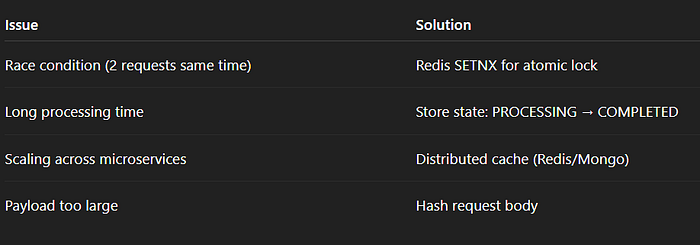
Example Redis atomic lock:
boolean locked = redisTemplate.opsForValue()
    .setIfAbsent("lock:"+key, "1", Duration.ofSeconds(10));
if (!locked) {
    throw new RetryableException("Request in progress!");
}
Best Practice Summary Checklist ✔
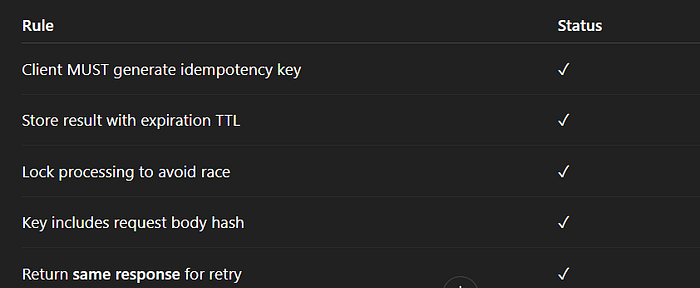
Idempotency is not optional in event-driven microservices.
It protects users and money It keeps systems correct under retries It prevents duplicate side effects
🧠 Idempotency = Trust in distributed systems